

Single-card observation and revision
Content version · · Sources & references

Use the Four of Swords to distinguish a first impression from a source description and a practical question. The aim is a traceable learning note, not a prediction that must fit the day.
The short version7 min read
The Four of Swords may first resemble a resting person, while Waite describes a knight’s effigy on a tomb. Keeping both the first impression and source-based correction makes the learning visible. A later association can then become one concrete question.
- Record what you initially thought and what the source subsequently identified. Correcting an object need not erase the path to understanding it.
- Waite’s depicted effigy and assigned meanings such as retreat and vigilance are different materials; not every source word is a visible object.
- Choose a fresh observation task for the next image. Movement, interaction and stillness should not all inherit the same advice to rest or balance.
Read first
The apparent resting person is an effigy in the text
A first glance at the reclining form may suggest a person resting. Waite's Four of Swords description identifies a knight's effigy, extended on a tomb in an attitude of prayer. Once you have consulted the entry, record that identification as information from the source. Do not quietly rewrite the first note to make it appear that you recognised the effigy immediately.
Rest can remain an association you choose to explore. It should no longer be presented as the author's literal description of a living person asleep. Likewise, the presence of a tomb in the image does not diagnose the reader's health or predict a death. A represented object and a claim about a real person are different kinds of statement.
The entry also lists interpretive ideas such as retreat and vigilance. Those belong to the author's assigned meanings, not automatically to the list of things that can be seen. Distinguishing the image description from that list is part of reading the source carefully, rather than treating every word in it as a visual observation.
First look
- Reclining, like rest
- Identity not checked
After reading
- Knight’s effigy
- Prayer pose, on tomb
The correction identifies a depicted object, not a real reader’s condition
Choose a learning task before choosing a card
A single card need not be asked to forecast an entire day. It can support a much smaller exercise: identify an object, compare a description with a source, or notice where an interpretation adds something that the image does not establish. State which task you are practising so that there is a way to tell what you learned.
For this exercise, select the Four of Swords deliberately. Random selection is not required when the purpose is to study a particular image. If you do draw, preserve the edition, orientation and any replacement in your handling record. Do not describe a deliberately chosen study card as a random result.
The task today is to keep an initial impression and a later correction visible on the same page. A polished note that hides every correction can be less informative than an imperfect note that shows how understanding changed.
Choose one learning target
Identify the reclining form without requiring a forecast of the day.
Record how the card was chosen
Distinguish deliberate study from random drawing.
Preserve the starting point
Write a short note before consulting the source so the correction remains visible.
Make room for different kinds of evidence
The U.S. National Archives artwork-analysis resource separates noticing people, objects and activities from questions about the maker, historical context and evidence for an interpretation. It also asks what additional material could help. That is a useful educational principle for studying an image. The resource does not endorse tarot divination, and a tarot image is not a documentary record of today's events.
The notebook below is an original exercise using that distinction. It is not a reproduction of the Archives worksheet or a prescribed historical tarot method. Keep three fields, each with a different job.
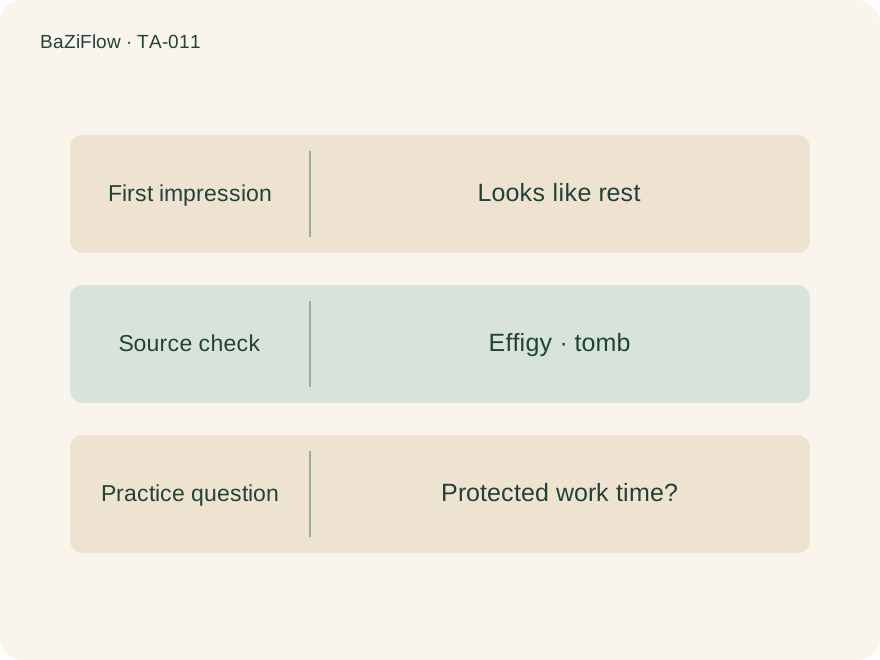
Original BaZiFlow note-taking diagram. It compares written observations without reproducing the card or making a claim about health or death.
| Field | Example note | What the wording preserves |
|---|---|---|
| First impression | I read the reclining form as a person resting | This was my initial perception |
| Source check | Waite describes an effigy on a tomb | The identification came from a consulted text |
| Practice question | Does my schedule allow uninterrupted work? | This is a question I constructed, not a depicted fact |
A later discovery belongs in the source field or a dated addition. It should not travel backwards into the first impression. If you compare another edition or artwork, identify it separately; a description of one version should not silently stand in for all versions.
Take the practical question outside the card
For a concrete study task, suppose you want forty-five uninterrupted minutes to transcribe an oral-history recording and, for this exercise, the diary shows only one twenty-minute opening. The still arrangement prompts a question about that work period. In a real case, check the actual diary, the recording length and whether the shared room will be available. Those details determine whether a change is useful. The card does not establish that the reader is overworked, needs treatment or must withdraw from other people.
If the schedule already contains enough space, record that the prompt produced no new issue. Do not rescue the exercise by broadening “rest” until it includes every pause in the day. Waiting for a lift, taking a planned break and receiving a delayed reply are different situations. Counting all of them as confirmation tells you little about the original question.
A learning log can avoid hit rates altogether. Ask whether the description became more precise, whether a source was identified correctly, and whether the proposed application was constrained by real information. These are observable improvements in the practice even when no prediction was made and no striking coincidence occurred.
You can also ask another reader to mark the statements that describe the image, those that depend on a source, and those that propose something about the world. A disagreement then becomes specific enough to investigate. It need not end with the claim that everyone has a different intuition; sometimes one sentence simply makes a stronger claim than its evidence supports.
20 min available · 20
0 ↔ 60
- Free slot · 0–20
- Task needs · 0–45
Assumed minutes: 45−20=25. The gap comes from the diary, not the card
Can another reader reconstruct what you actually learned?
Give a fellow learner two notes with the card names covered. If both say only “slow down and find balance”, there is no way to tell which image prompted which account. The useful question is not whether both sound kind. Ask what new object, source correction or practical question distinguishes one note from the other.
The next card should not inherit the Four of Swords question by default. A scene of movement, a group interaction or an image without a prominent person may invite a different study task. The repeatable part is the care taken with the record, not a conclusion about slowing down, staying balanced or believing in yourself.
After several distinct cards, review where your attention tends to go. Perhaps you notice faces and omit backgrounds, or interpret every static posture as passivity. These are observations about your reading habits, not diagnoses of your personality. They can suggest a concrete next exercise, such as describing the setting before the central figure.
Leave uncertainty in the notebook when needed. “I cannot yet identify this object” is a useful research question; a generic paragraph written to avoid the gap is not. Once individual notes retain their differences, a three-card spread can place those observations into separately defined positions. The value of the single-card practice is that it supplies specific material for that later comparison.
Next scene
Moving figure
- Start by observing
- Direction and object left behind
- Do not inherit
- Always rest
Group interaction
- Start by observing
- Who acts toward whom
- Do not inherit
- Always balance
No main figure
- Start by observing
- Objects and spatial relations
- Do not inherit
- Invented emotions
Questions readers ask next
Must a card for single-card study be randomly drawn?
No. A specific image can be selected for study and recorded as a deliberate choice. If it is randomly drawn, retain the deck edition, orientation and any replacement rather than presenting a chosen object as a chance result.
Does identifying the effigy rule out an association with rest?
No, but rest cannot be presented as Waite’s literal description of a living person asleep. The still arrangement can prompt a scheduling question, which is then tested against actual available time and task requirements.
What would count as progress in this practice?
Look for a more specific description, a corrected identification, a clear source and meaningful differences between notes on different cards. A similar event found later that day is not required to establish that these learning changes occurred.
Was this article helpful?