

Leap months, hours and day rules
Content version · · Sources & references
Compare two Zi Wei charts by separating the recorded lunar date, the month used for palace placement, the selected hour and the late-Rat day rule.
The short version6 min read
A different Life position need not mean a different birth record. Isolate the month used for placement, the selected double-hour and the day-assignment rule. Three small calculations show what changes before any personality interpretation is considered.
- The recorded leap month and the month number used for placement are separate fields; a convention changes the latter.
- Month four at Rat gives Si for Life and Body; month five gives Wu. Month four at Ox gives Life at Chen and Body at Wu.
- A late-Rat day rule can alter day-dependent placements. Recheck Life and Body inputs if the assigned date also crosses a month.
Read first
What birth information does a Zi Wei chart need, and where does each item go? ↗
A small puzzle before you compare two readings
Suppose one chart places both the Life and Body positions at Si, while another places both at Wu. Has the birth record changed? Not necessarily. The two calculations may be using different month numbers for the same recorded leap-month birthday.
Now consider a third result: Life at Chen and Body at Wu. That can arise in this exercise by keeping the placement month fixed and moving from Rat hour to Ox hour. A chart difference has a calculable location before it has any interpretation. Finding that location is more useful than immediately choosing whichever personality description feels familiar.
The exercise below uses a method recorded in the An Shen Ming Li passage in Zi Wei Dou Shu Quan Shu, volume 2. It is deliberately incomplete: no year, full date or personal outcome is supplied. The purpose is to isolate two inputs, not to manufacture a plausible-looking birth chart.
| Month used for placement | Selected hour | Life position | Body position |
|---|---|---|---|
| Four | Rat | Si | Si |
| Five | Rat | Wu | Wu |
| Four | Ox | Chen | Wu |
Birth record
- Lunar date
- Leap-month flag
Chosen rules
- Placement month
- Hour and day
How to reproduce those three rows
Start the first month at Yin and move forward through the branch positions until the chosen month. This puts month four at Si and month five at Wu. From that month position, count the hours backward for Life and forward for Body, with Rat hour at the starting position.
At Rat hour no further step is taken. At Ox hour there is one step in each direction. Starting from Si therefore gives Chen for Life and Wu for Body. The first two rows change only the month; the first and third change only the hour. Changing both at once would obscure which choice produced which difference.
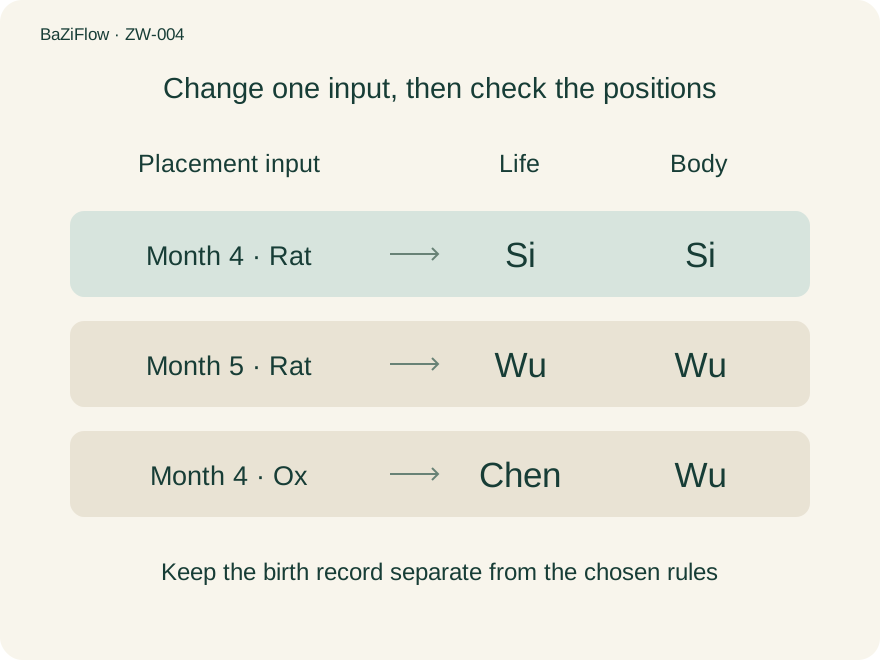
Keep Rat fixed to compare months; keep month four fixed to compare hours. Only Life and Body are calculated.
The Life and Body palace guide explains the roles of these positions. Here, their value is that they give us a result we can check without deciding whether a reading describes anyone accurately.
Month four at Ox
A leap-month label does not choose the placement rule
A calendar conversion establishes the lunar year, month, day and whether that month is an intercalary month. The Hong Kong Observatory publishes Gregorian–lunar conversion tables for checking dates. A Zi Wei convention then decides how to use that established date in its calculation. These are separate tasks.
The classical passage used above treats a leap first month as the second month for this placement procedure and extends that example to other leap months. Modern iztro documentation describes a split treatment: the first half of the leap month uses the preceding month number and the later half uses the following one. Their disagreement is a reason to record the convention, not a reason to alter the birth record.
For an illustrative birthday on day ten of leap month four, the whole-month-forward treatment uses month five; the split treatment uses month four. On day twenty, both treatments use month five in this comparison. In all cases, the recorded month remains leap month four. We have not named a year or converted an actual Gregorian birthday.
A birthday close to the split point needs the exact rule used by the particular version. The informal phrase “first half” should not be expanded into an invented boundary. Nor should one library's documented settings be presented as a universal Zi Wei standard or as a claim about every current BaZiFlow calculation.
Classical passage
- Day 10 → month 5
Split treatment
- Day 10 → month 4
Late Rat hour introduces a day-assignment question
After the time basis has been established, suppose the selected time is 23:30 and it falls in Rat hour. The day used for chart calculation still needs a convention: retain the current day or assign the late-Rat period to the next day. The iztro configuration documentation explicitly offers both choices.
That choice is distinct from selecting the hour. If the month and hour stay fixed, the Life and Body procedure demonstrated above continues to use the same two inputs. Placements that depend on the lunar day may nevertheless need recalculation. At a month boundary, assigning the next day may also change the month, so the effect cannot always be isolated to a day number.
There is another earlier decision: what time is being classified? A recorded civil time and a time obtained through another stated conversion cannot be compared as though they were identical. Preserve the original time, then document any conversion before determining the hour. The birth-data guide provides the starting checklist for those records.
Same month and hour
- Same Life/Body inputs
- Check day-based stars
Next date crosses month
- Confirm month again
- Recalculate affected steps
Save a comparison someone else could repeat
Keep two columns: evidence about the birth and choices made by the calculation. In the first, preserve the original date, time and source. In the second, record the converted lunar date, leap-month flag, placement convention, selected hour, late-Rat day rule and tool version. A screenshot of the finished wheel alone may hide the decisive setting.
Compare the calendar inputs first, then change one convention at a time. Record the first field that differs and follow the relevant placement steps from there. Do not move every star by the same amount merely because Life has moved: different stars use different placement inputs. A complete chart needs a coherent recalculation under the selected method.
When the birth time is only approximate, retain the candidate hours and explain the uncertainty. Selecting a more appealing interpretation does not turn an uncertain time into a documented fact. Reproducing a chart difference establishes what the settings did; it does not establish that either interpretation predicts a person's life.
Questions readers ask next
Must leap month four be treated as month five?
Not from the calendar label alone. The classical placement passage uses a whole-month-forward treatment; iztro documents a split treatment. Keep leap month four in the birth record and identify the rule used for the placement month.
Why check the day if 23:30 is already Rat hour?
The double-hour identifies a time interval, while day assignment selects the date used in calculation. Day-dependent placements may change. At month-end, check whether the assigned next day also changes the month.
How can a placement difference be traced to one setting?
Fix the calendar record and change one input at a time. Compare month four with month five at Rat to isolate the month, then Rat with Ox in month four to isolate the hour. Save the convention and tool version with the results.
Was this article helpful?
Sources & references
Continue reading
The twelve Zi Wei palaces: a map of questions ↗
Zi-hour day boundaries: decide the hour branch, day pillar and hour stem separately ↗