

The Travel palace: across from Life
Content version · · Sources & references
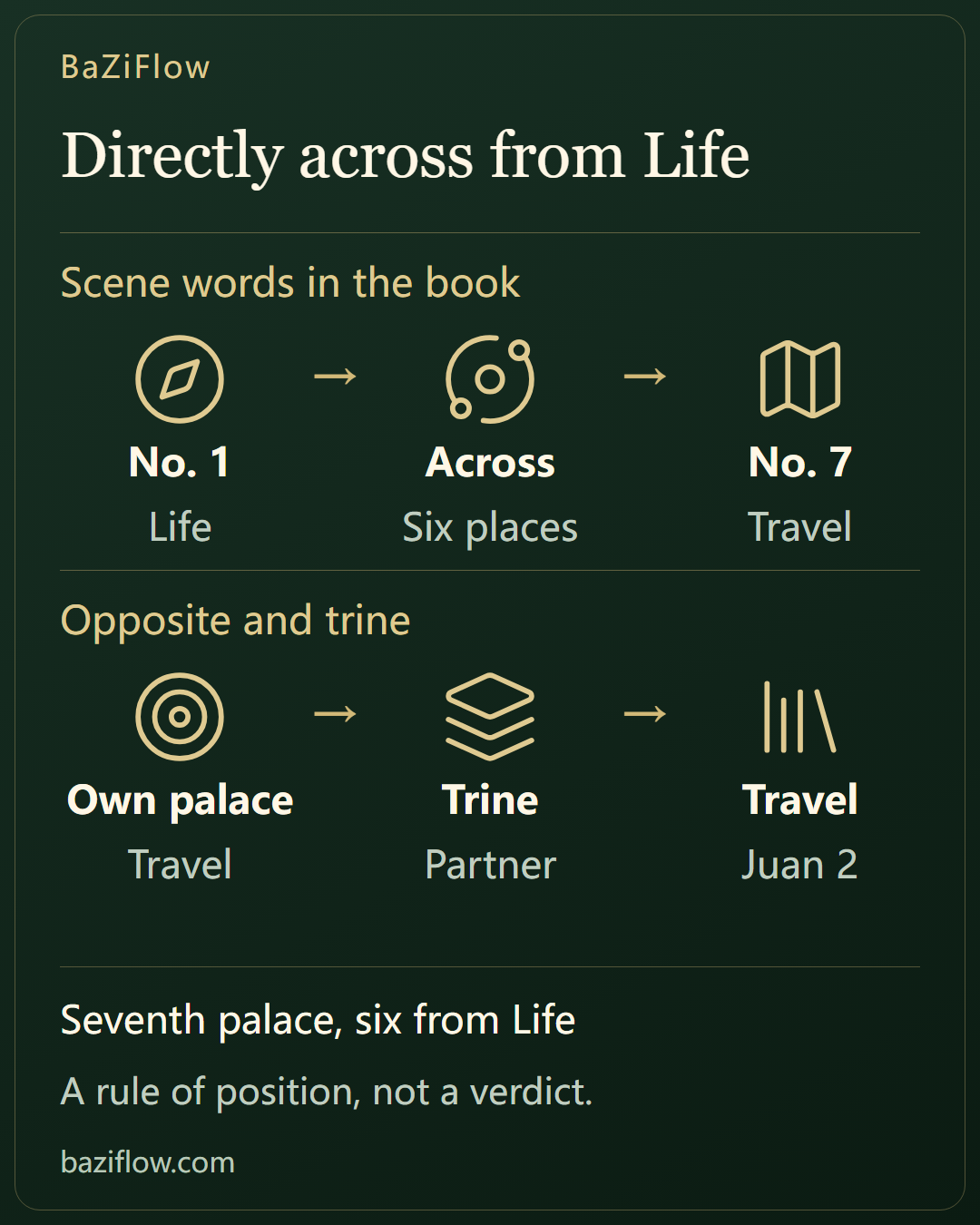
The Travel palace is the seventh of twelve, six places from Life. Work out its opposite and trine palaces, then read juan 2's word choices, the Tian Shi and Tian Shang flanking rule, and the strong and weak palace table.
The short version8 min read
The Travel palace (迁移宫) is the seventh of the twelve palaces, six places from the Life palace and so directly across from it; juan 2 of the Zi Wei Dou Shu Quan Shu writes it with the words "go out," "be away" and "stay put," as a palace about what lies beyond the door.
- Travel is no. 7 in the palace order. Its opposite is Life, and its trine palaces are Partner (no. 3) and Wellbeing (no. 11); all three positions come from simple counting, not memory.
- The "Travel" section of juan 2 has 24 paragraphs. "Go out" appears 18 times and "be away" 21 times, while "stay put" appears 4 times and "at home" twice: the emphasis is on life away from the familiar setting.
- One line of the Dou Shu Gu Sui Fu in juan 1 names Wellbeing, Travel, the substance and use of opposite palaces and the trine together; the juan 2 strong-and-weak table is split by male and female charts and lists Travel as strong only for men.
Read first
Counting to the seventh place
Count six places on from the Life palace and you land directly across from it, on the seventh box: the Travel palace.
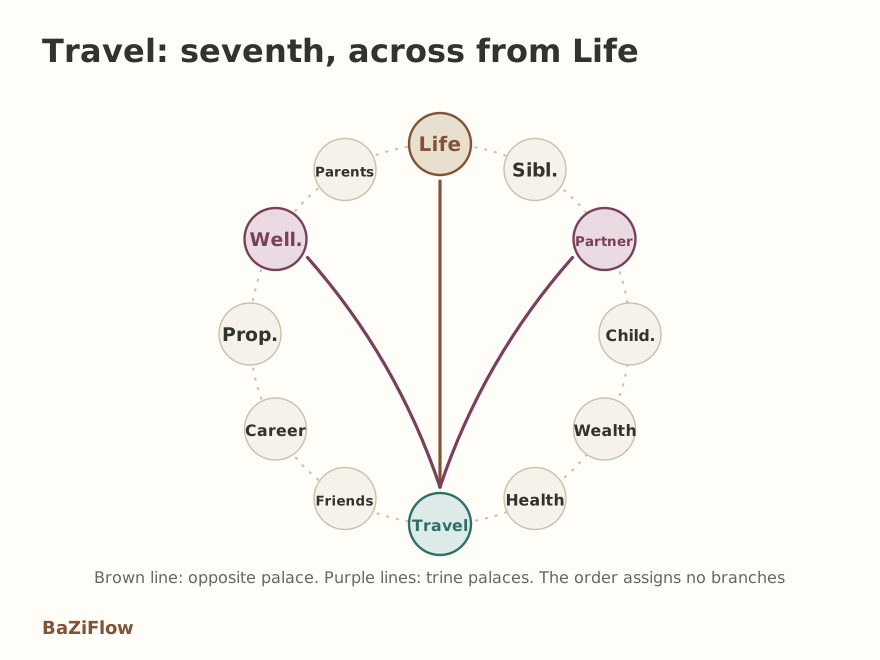
Palace ring: the Travel palace in green, the opposite Life palace in brown, and the trine Partner and Wellbeing palaces in purple. Relations are computed from the order, which does not assign branches.
The twelve circles in the picture are the palace order: Life is no. 1, Siblings no. 2, and so on up to Parents at no. 12. Travel is no. 7, six places from no. 1, and that is its "opposite palace." Count four places each way from Travel and you reach the Partner palace (no. 3) and the Wellbeing palace (no. 11). Those two are its trine palaces. The home palace, the opposite one and the two trine ones add up to four palaces, which are read together as "three sides and four directions." The rule for that reading range is in what the three sides and four directions are.
What the book writes: a section full of "going out"
Juan 2 takes the twelve palaces one at a time, listing stars with a short entry for each. The "Travel" section has 24 paragraphs, and a few of its words are worth counting:
Enlarge diagram · scroll sideways to read
"Go out" and "be away" together appear nearly forty times, while "at home" and "stay put" total fewer than ten. That ratio is the character of the section: in this book the Travel palace is a place for talking about what lies beyond the door. A few typical entries each name a star and then describe it outside and at home:
Enlarge diagram · scroll sideways to read
The entries share one structure: a star, then its state "going out" or "at home," and often a closing condition such as "with Qing Yang, Tuo Luo, Huo Xing, Ling Xing, Di Kong or Di Jie it goes this way." Seventeen paragraphs mention the joining of such malefic stars, which shows that the book wants "who else is in the palace" read, not one star decided alone. Star effects combine through their relations, not as stacked keywords.
The opposite palace: "substance and use"
The opposite palace of Travel is Life, so the two palaces look at each other. The "Dou Shu Gu Sui Fu" (斗数骨髓赋) in juan 1 of the Quan Shu has a line on reading order that puts Travel and the opposite palace side by side:
First look at Wellbeing, then examine Travel closely: tell apart the substance and the use of the opposite palace, and fix the source and stream of the trine.
The line lists its steps in order: look at the Wellbeing palace first, then Travel in detail, tell apart substance and use across opposite palaces, then trace the trine for origins. "Substance and use of the opposite palace" is a general reading instruction and names no particular pair; applied to Travel, the opposite palace is Life. The book does not spell out what "substance" and "use" mean in practice. What the reader gets is the order of work.
Enlarge diagram · scroll sideways to read
Wellbeing and Travel also happen to belong to one trine group in the palace order. When the Travel palace holds no major star, the stars of the opposite Life palace are consulted, which is called borrowing stars; the method is in empty palaces and borrowed stars.
Between Health and Friends
The neighbors of Travel are the Health palace (no. 6) and the Friends palace (no. 8). The juan 2 rule for placing Tian Shang and Tian Shi puts one minor star in each: Tian Shi in the Health palace and Tian Shang in the Friends palace, which the old text calls the servants' palace. Checked chart by chart against the site engine (iztro), both stars land in those two palaces every time.
Enlarge diagram · scroll sideways to read
That gives the book a line like this:
The body, or a year or decade limit, is held between Shang and Shi.
It is a position rule: when the body palace, or a decade or annual limit, happens to fall on the Travel palace, it is "held" between Tian Shi and Tian Shang. The book follows with a verdict on that arrangement; that verdict belongs to the book, and here only the location rule is recorded. For the difference between flanking, opposite and converging, see opposite, flanking and converging palaces.
A strong palace still needs company
Juan 2 sorts the palaces into two groups, and the grouping for male and female charts differs:
Enlarge diagram · scroll sideways to read
That table is one old book's classification, and it would be wrong to lay it unchanged on any person today. More useful is another line the book gives on the same palace:
Travel, though a strong palace, still needs support; with auspicious stars shining on Life, one rises through other people.
Even a palace listed as strong is said to need "support," meaning other stars next to it; it cannot be read alone. It is the same principle as "a single palace cannot be read apart from the whole chart."
Find Life, then count to Travel
Counting from Life, the seventh place is Travel; its opposite is Life and its trine palaces are nos. 3 and 11.
Say which kind of "outside" you mean
Travel, surroundings and a house move each have their own entry; for a move, the dwelling itself belongs to the Property palace.
Cite with the source
"Go out" and "stay put" are the wording of one juan 2 section; another book or school may word it differently.
Two exercises
Life is on Rabbit. On which branch is Travel, and where are its two trine palaces?
Travel is on Rooster. The order runs against the branches, so Partner is on Ox and Wellbeing on Snake. Juan 3 gives the example "Life on Rabbit, Travel on Rooster" too.
Travel has no major star: should the opposite palace's stars simply be moved over?
No. Consult the stars of the opposite Life palace first, then read Travel's own auxiliary and malefic stars; the conditions for borrowing are in the article on empty palaces.
For how the whole set of palaces divides the work, go back to what the twelve palaces cover; the two palaces next door are Health and Friends.
Questions readers ask next
Is the Travel palace only about moving house or going abroad?
The name contains a character for moving, and the juan 2 section mostly uses going-out words, but that is traditional imagery. This site reads it as the outer setting, travel and encounters beyond the familiar. A house move has to be split up, and the dwelling itself is a Property palace question.
My Travel palace has no major star. What now?
A palace with none of the fourteen major stars is called empty. Its opposite palace is Life, so the stars of the Life palace are usually consulted first; that is the borrowed-star step. How it works is in the article on empty palaces, and the opposite palace's stars are not simply copied over.
Is Travel always on the branch opposite Life?
Yes. The palaces are six places apart, and their branches are also six apart. The book's own example puts Life on Rabbit and Travel on Rooster. Move the Life palace and Travel moves with it, so there is no fixed "Travel branch."
Was this article helpful?
Sources & references
Continue reading
The Friends Palace in Zi Wei Dou Shu: Three Names and the Kin Palaces on Its Axes ↗