

Jian (蹇): going meets obstruction, coming differs
Content version · · Sources & references
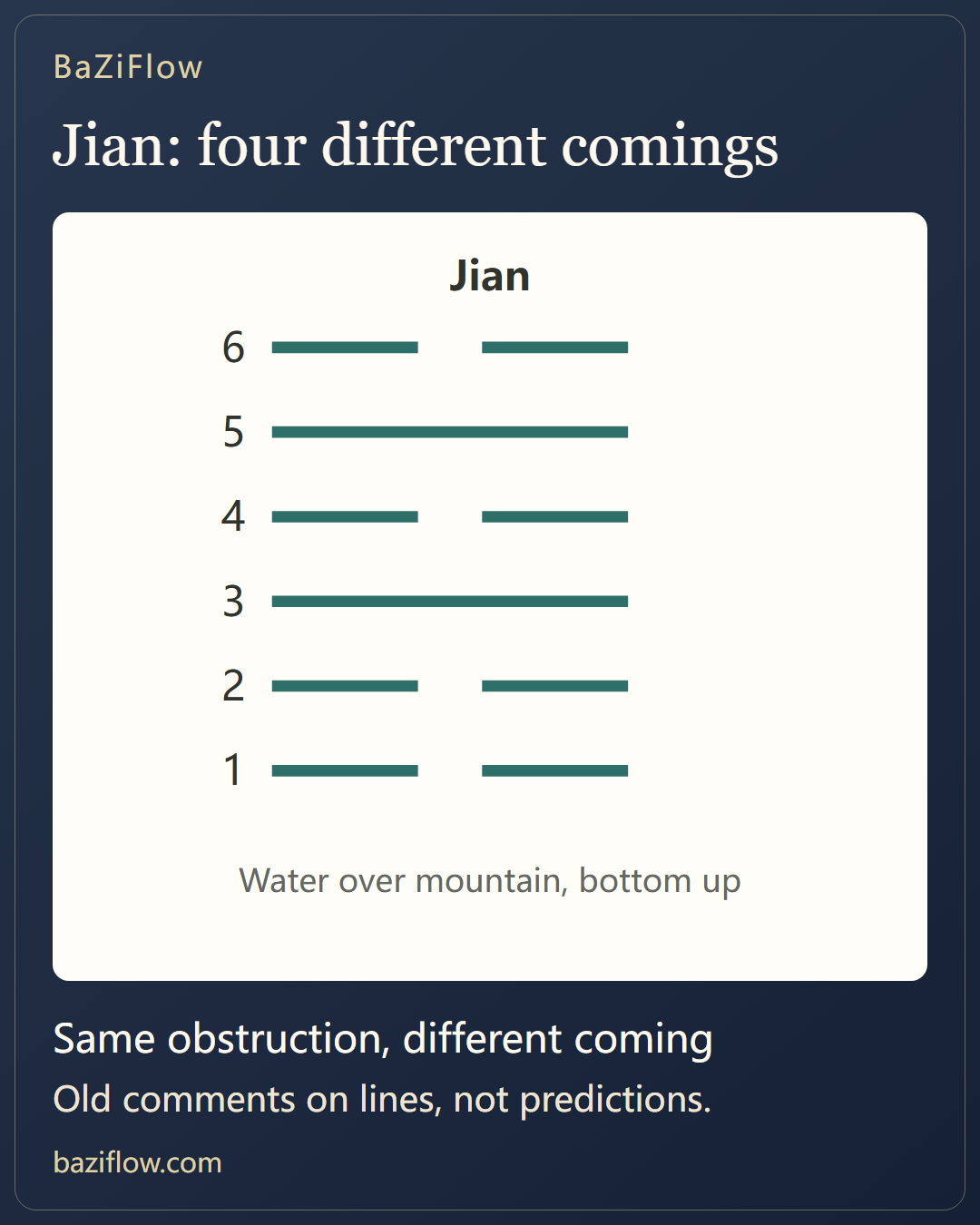
Jian (蹇) is the 39th hexagram: Kan (water) above Gen (mountain). Read “seeing danger and stopping”, the Great Image on turning back to the self, and four lines where “going” is blocked but each “coming” differs.
The short version7 min read
In Jian the words “going meets obstruction” occur four times, and what follows changes each time: coming brings praise, turning back, a link, greatness. The text uses this pair, going and coming, to show one kind of hardship finding different ways out.
- Jian stacks Kan (water) on Gen (mountain). In the Shuo Gua Gen is “stopping” and Kan is “sinking in”, and the Commentary on the Judgments reads the figure as danger ahead, and being able to stop on seeing it.
- The judgment says “fitting to the southwest, not fitting to the northeast”; the Commentary explains one as “going reaches the middle” and the other as “that way is at an end”. The Great Image’s “turn back to the self” shares the word “back” with line 3.
- Four of the six lines say “going meets obstruction”: coming brings praise, a return, a link, greatness. Line 2’s doubled “obstructed” and line 5’s “great obstruction” are two intensified lines with no “going”.
Read first
The Sixty-Four Hexagrams: How Upper and Lower Trigrams Form One Figure ↗
Judgment and Line Statements: Whole Hexagram or Single Line? ↗
Water over a mountain: the foot stops, the danger lies ahead
Jian (蹇) has Gen (mountain) below and Kan (water) above. The Shuo Gua gives Gen the word “stopping” and Kan the word “sinking in”. Reading upward, lines 1 and 2 are yin, line 3 is yang, line 4 is yin, line 5 is yang and line 6 is yin, so the only yang lines are the third and the fifth.
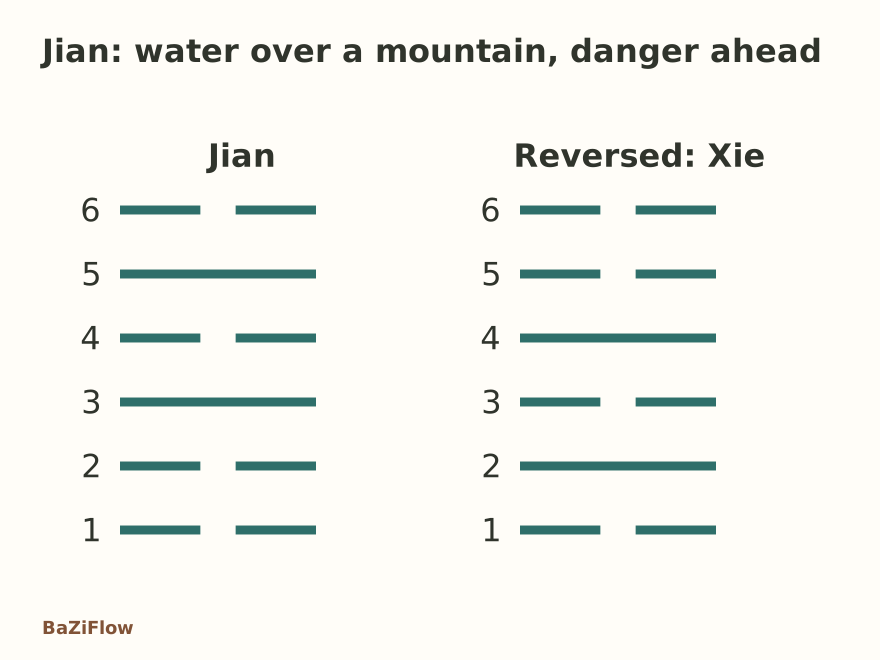
Jian and its reversed hexagram Xie: turned upside down, the Kan above Jian lands below Xie, and Gen below Jian becomes Zhen above Xie.
Enlarge diagram · scroll sideways to read
Three terms: Jian, going and coming, southwest and northeast
- Jian
- The Xu Gua says: Jian means hardship. Literally it is going with difficulty. The name is close to the 53rd hexagram’s in pinyin (jiǎn / jiàn, different tones), so tell them apart by the original character.
- Going, coming
- A pair of verbs that keeps returning in the lines. Tradition usually reads “going” as heading forward and outward, and “coming” as turning back and inward.
- Southwest, northeast
- The two directions in the judgment. The Shuo Gua says outright that Gen is the trigram of the northeast, and Gen is the lower trigram of Jian.
The judgment and the Commentary: danger ahead, and stopping on seeing it
The judgment of Jian runs: southwest is fitting, northeast is not; it is fitting to see a great person, and steadfastness is fortunate. The Commentary on the Judgments defines the name first and only then goes through those clauses one at a time.
Jian means hardship: danger lies ahead. To see danger and be able to stop: that is wisdom!
Enlarge diagram · scroll sideways to read
“Danger lies ahead” faces the upper trigram Kan, and “see danger and be able to stop” faces the lower trigram Gen: stopping underfoot, sinking in beyond. The Commentary calls this “knowing”, which tradition reads as wisdom: to see danger, and to be able to halt.
The two directions are a pair. “Fitting to the southwest” is explained as “going reaches the middle”, and “not fitting to the northeast” as “that way is at an end”. The last line explaining the judgment is “in the proper place, steadfastness is fortunate, and so one sets a state right”, after which the Commentary closes with “the time and use of Jian are great indeed”. This can be checked on the figure: of the six lines only line 1, a yin line in a yang place, is out of place, and the other five sit properly, in keeping with the “proper place” in the Commentary and in the Small Image of line 4.
The Great Image: “turn back”, a word shared with line 3
The Great Image (大象) of Jian reads:
On the mountain there is water: Jian. The noble person turns back to the self and cultivates virtue.
“On the mountain there is water” reads the figure. What the noble person takes from it is two movements: turn back toward oneself, then cultivate virtue.
Enlarge diagram · scroll sideways to read
The same word turns up in the lines. Line 3 says “going meets obstruction; coming, he turns back”, and its Small Image reads “those within are glad of it”. The Small Image of the top line also says “the aim is within”. The Image’s “turn back”, line 3’s “coming back” and the Small Images’ “within” all point inward.
Six lines: going meets obstruction; each coming has its own name
Four of the six statements of Jian begin with “going meets obstruction”. After each, the word “coming” is followed by a different word.
Enlarge diagram · scroll sideways to read
Line 1 says “going meets obstruction; coming brings praise”: going forward is blocked, coming back earns praise, and the Small Image says it is fitting to wait. Line 3, “going meets obstruction; coming, he turns back”, has the Small Image “those within are glad of it”. Line 4, “going meets obstruction; coming, linked”, takes the Small Image “in its proper place, and solid”; tradition usually reads the link as being joined to others, though some read it as hardship that goes on, so readings differ. Line 6, “going meets obstruction; coming is great”, is fortunate, with “fitting to see a great person”, and the Small Image says “the aim is within” and also “it follows the noble”.
Lines 2 and 5 have no “going”. Line 2 reads “the king’s servant is obstructed, and obstructed again”, with the word doubled for emphasis, and gives the reason: “it is not for his own sake”. Line 5, “great obstruction; friends come”, makes the hardship great and brings friends. The Small Image says “central, so in measure”. These two sit exactly in the second and fifth places: one is the king’s servant, the other holds the fifth place, and each stands in this hardship in his own way.
Kui, Xie and Weiji: neighbors of Jian
Turn Jian upside down and you get Xie (解), so Xie is the reversed hexagram (综卦) of Jian (see the figure above): the Kan above Jian drops to the lower trigram of Xie, and Gen below Jian becomes Zhen above Xie. The Commentary’s wording changes with it: Jian is “danger ahead”, Xie is “danger, and moving”.
Flip every line of Jian to its opposite and Kui (睽) appears: that is the inverse hexagram (错卦). The nuclear hexagram (互卦) comes from the middle four lines regrouped. Lines 2 to 4 (yin, yang, yin) form Kan and lines 3 to 5 (yang, yin, yang) form Li, and Kan below Li is Weiji (未济).
Enlarge diagram · scroll sideways to read
Kui stands before Jian, and the Xu Gua’s reason is that estrangement must bring hardship. Xie stands after it, because hardship cannot last without end.
Questions readers ask next
Is Jian (蹇) the same as the hexagram Jian (漸)?
They are alike in pinyin apart from the tone (jiǎn / jiàn), but are different characters and different hexagrams. This one is the 39th and its word means going with difficulty; the other is the 53rd and means gradual progress. Their upper trigrams differ (Kan and Xun) while both have Gen below, and their texts speak separately, so tell them apart by the original character.
Does “fitting to the southwest, not fitting to the northeast” point to real directions?
On the surface it names directions, but the Commentary reads them as two situations: the southwest, where going reaches the middle, and the northeast, where the way is at an end. The Shuo Gua also says Gen is the trigram of the northeast, and Gen is the lower trigram of Jian. The judgment of Xie begins with “fitting to the southwest” as well.
What does the “link” in “coming, a link” mean?
Tradition usually reads it as being joined with others, though some readers take it as hardship that goes on, so readings differ. The Small Image comment is “in its proper place, and solid”, which is worth keeping in view when you read that line.
Was this article helpful?
Sources & references
Continue reading
Kui: fire over a lake, and five of its six lines are about seeing or meeting ↗
The Sixty-Four Hexagrams: How Upper and Lower Trigrams Form One Figure ↗
Judgment and Line Statements: Whole Hexagram or Single Line? ↗