

Meng: one word, five ways of treating it
Content version · · Sources & references
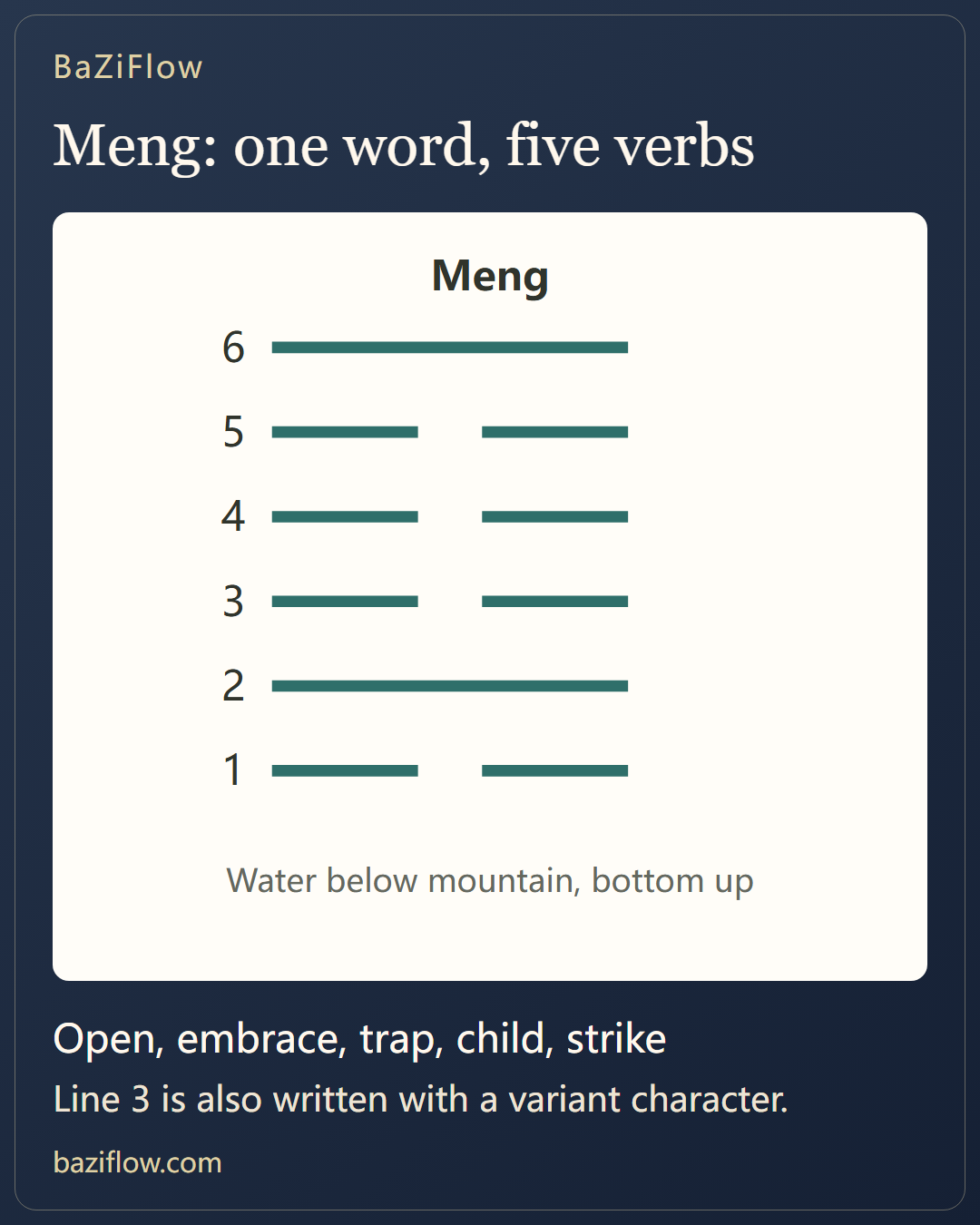
Meng is the fourth of the 64 hexagrams, water below and mountain above. The judgment sets a rule for asking, the Great Image speaks of resolute action, and five lines treat the word meng in five ways.
The short version7 min read
The judgment of Meng sets a rule for asking: the one who asks speaks first, the first question is answered, and asking again and again is not. Then six lines put five different words in front of one word, meng.
- Meng puts water below mountain, and its only yang lines are the second and the top. The Shuo Gua says "water is a pit" and "mountain is stopping"; the Commentary on the Judgments joins them: "below the mountain there is danger; with danger, it stops".
- The judgment is about asking and answering: "it is not I who seek the young and ignorant, the young and ignorant seek me; at the first divination I tell; asking again and again is pestering". The Commentary on the Judgments ends on nurturing what is upright.
- Five of the six lines say how to treat meng: open it, embrace it, be trapped by it, be childlike in it, strike it. Only line 3 has no such word; it says "do not take this woman".
Read first
The Sixty-Four Hexagrams: How Upper and Lower Trigrams Form One Figure ↗
Judgment and Line Statements: Whole Hexagram or Single Line? ↗
Mountain over water: danger below, and a stop
Meng (蒙) is the fourth hexagram: water below, mountain above. From the bottom its lines are yin, yang, yin, yin, yin, yang, so the yang lines are the second and the top. The Shuo Gua has one word for each trigram, "water is a pit" and "mountain is stopping", and the Commentary on the Judgments (彖传) links them in a single phrase: "below the mountain there is danger; with danger, it stops: Meng." There is danger, and one halts in front of it: that is Meng.
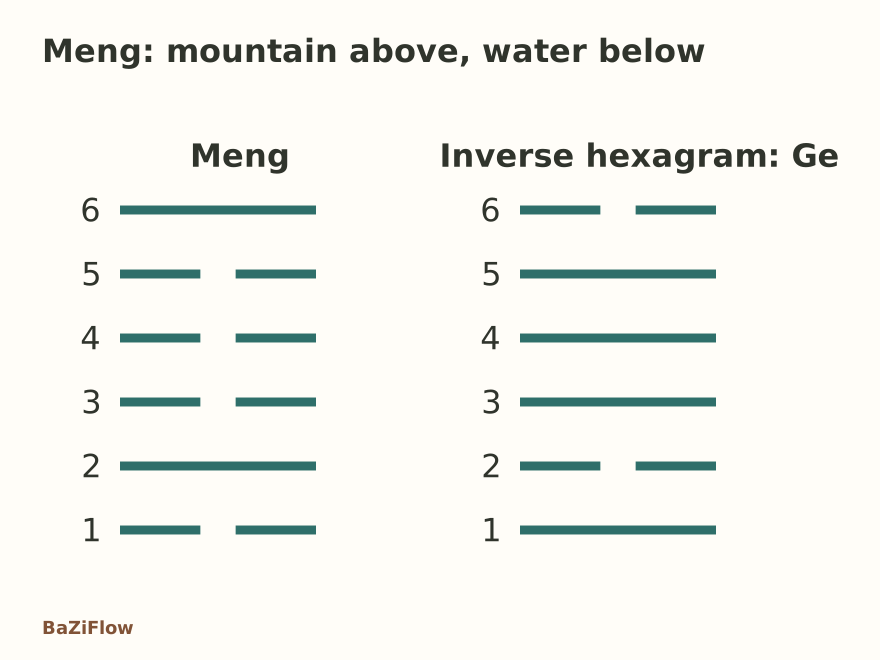
Meng and its inverse hexagram Ge: the inverse changes every line to the opposite polarity.
Enlarge diagram · scroll sideways to read
The hexagram before this one, Zhun (屯), has thunder (movement) below water (danger), "moving within danger". Meng swaps the movement for a stop: mountain above, water below, halted in front of the danger. Both hexagrams contain water, one moving inside the danger and the other stopping before it, so the two read well side by side.
The Xu Gua explains Meng this way: "meng is meng, the immaturity of things". The word has long meant covering, and it also means young and dim; both senses fit the text as a whole.
The judgment: not I who seek the young, but the young who seek me
Meng's judgment sets out a rule for asking and answering.
Free-flowing. It is not I who seek the young and ignorant; the young and ignorant seek me. At the first divination I tell. Ask twice, ask thrice, that is pestering, and when pestered I do not tell. Fitting and steadfast.
So it is not the one who knows who goes out looking for the one who does not; the one who does not comes to ask. "Divination" here is the yarrow-stalk consultation. At the first consultation, the answer is told; asking again and again is pestering; and pestering is not answered.
Enlarge diagram · scroll sideways to read
The Commentary on the Judgments has a reply to each phrase. "Their wills answer each other": the one who asks and the one who is asked are of one mind. "Because of the firm center": a firm center is a firm line in a central place, and of the two yang lines in Meng, the one in the middle of the lower trigram is the second. "Pestering the ignorance itself": what is pestered is meng itself. The Commentary on the Judgments ends on "Meng nurtures what is upright: this is the work of a sage."
Because "divination" is consultation, tradition reads these sentences in two ways: as a rule for teaching and learning, or as a rule for consulting the oracle. The text supports both, and everything explained above comes from the wording and the Commentary on the Judgments.
A spring below the mountain: the Great Image
The Great Image for Meng reads: "a spring comes out below the mountain: Meng. The noble person is resolute in action and nurtures virtue." The mountain is above and water wells up at its foot, matching the upper trigram of mountain and the lower of water. From this the noble person learns resolute action and the nurturing of virtue: resolute means decisive, and nurturing means cultivating.
Enlarge diagram · scroll sideways to read
Side by side, Zhun's "sorts the threads" puts a tangle in order, while Meng's "resolute in action, nurtures virtue" is half action and half nurturing. The idea of nurturing recurs in three places: in the Commentary on the Judgments ("Meng nurtures what is upright"), in the Great Image ("nurtures virtue"), and in the Xu Gua, which says what is immature "must be nurtured".
One word, five treatments: opening, embracing, trapped, childlike, striking
In five of the six line statements the word meng sits in the sentence with a different word in front of it: open, embrace, trapped, childlike, strike. Only line 3 lacks it.
Enlarge diagram · scroll sideways to read
Line 1: "Opening the ignorant: it is fitting to use punishing a person, to use taking off the fetters. To go on brings regret." Opening is uncovering. "Punishing a person" and "fetters" are words of penal law, and "taking off" is the verb for removing the fetters. The Small Image says "it sets the law right".
Line 2: "Embracing the ignorant: good fortune. Taking in a wife: good fortune. The son can manage the household." To embrace is to hold something within one's arms; taking in a wife is bringing her into the house; managing the household is being able to hold a family up. The Small Image says "the firm and the soft meet".
Line 3: "Do not take this woman as wife: she sees a man of gold and does not keep herself; nothing is favorable." "Man of gold" is usually read as a wealthy man, and "does not keep herself" as unable to hold herself together. The Small Image says only "conduct would not be in accord".
Line 4: "Trapped by ignorance: regret." The Small Image says "alone, far from the solid". Solid and hollow are opposites: a yang line is solid, a yin line is broken (for how the places are counted, see line positions). Meng's yang lines sit in the second place and at the top, and of the four yin lines only line 4 has yin lines on both sides; every other yin line touches a yang line.
Line 5: "Childlike ignorance: good fortune." The Small Image says "compliant and gentle". Line 6: "Striking the ignorant: not fitting to act as a bandit, fitting to guard against bandits." The Small Image says "above and below are in accord".
Zhun, Meng and Xu: three hexagrams in a row
The Xu Gua says "whatever is born must be ignorant", and that is why Meng follows Zhun. After Meng comes: "what is immature must be nurtured, so it is followed by Xu (需); Xu is the way of food and drink." The immature cannot go unfed, so the next hexagram is Xu, which deals with eating and drinking. (What each of the Ten Wings is for is in how the Ten Wings are read.)
Enlarge diagram · scroll sideways to read
Meng is Zhun seen from the other end. Meng's top line is Zhun's first line turned over, and Meng's second line is Zhun's fifth turned over. So the only two yang lines of Meng mirror the two yang lines of Zhun: one in the middle of the lower trigram, one at the very top. Line 2 is "embracing the ignorant", line 6 is "striking the ignorant": one embraces, the other strikes.
Meng's inverse hexagram is Ge (革), where every line takes the opposite polarity; its nuclear hexagram is Fu (復), built from the middle four lines.
Enlarge diagram · scroll sideways to read
Questions readers ask next
Does "at the first divination I tell; asking again and again is pestering" mean you cannot ask a second time?
Literally it says the first divination is answered, repeated asking is pestering, and pestering is not answered. The Commentary on the Judgments glosses the pestering as "pestering the ignorance itself" and says nothing about how to ask again. It is a statement in the text about how to ask, and the text goes no further than that.
Does "the young and ignorant" mean a small child?
The two characters mean young and ignorant, so together a person who does not yet know. The Xu Gua says "the immaturity of things", which stretches it to everything newly born. The judgment and line 5, "childlike ignorance: good fortune", use the same two-character phrase.
What does line 3, "sees a man of gold and does not keep herself", mean?
"Man of gold" is usually read as a wealthy man, and "does not keep herself" as losing hold of herself. The Small Image gives only "her conduct would not be in accord" and goes no further, so this is the traditional reading, not a definition stated in the text.
Was this article helpful?
Sources & references
Continue reading
Zhun: one sentence, "riding a horse, circling", with three different endings ↗
Xu: from "waiting in the outskirts" to "entering the cave", six places of waiting ↗
The Sixty-Four Hexagrams: How Upper and Lower Trigrams Form One Figure ↗
Judgment and Line Statements: Whole Hexagram or Single Line? ↗