

Kun (坤): three yin lines, two sets of earth images
Content version · · Sources & references
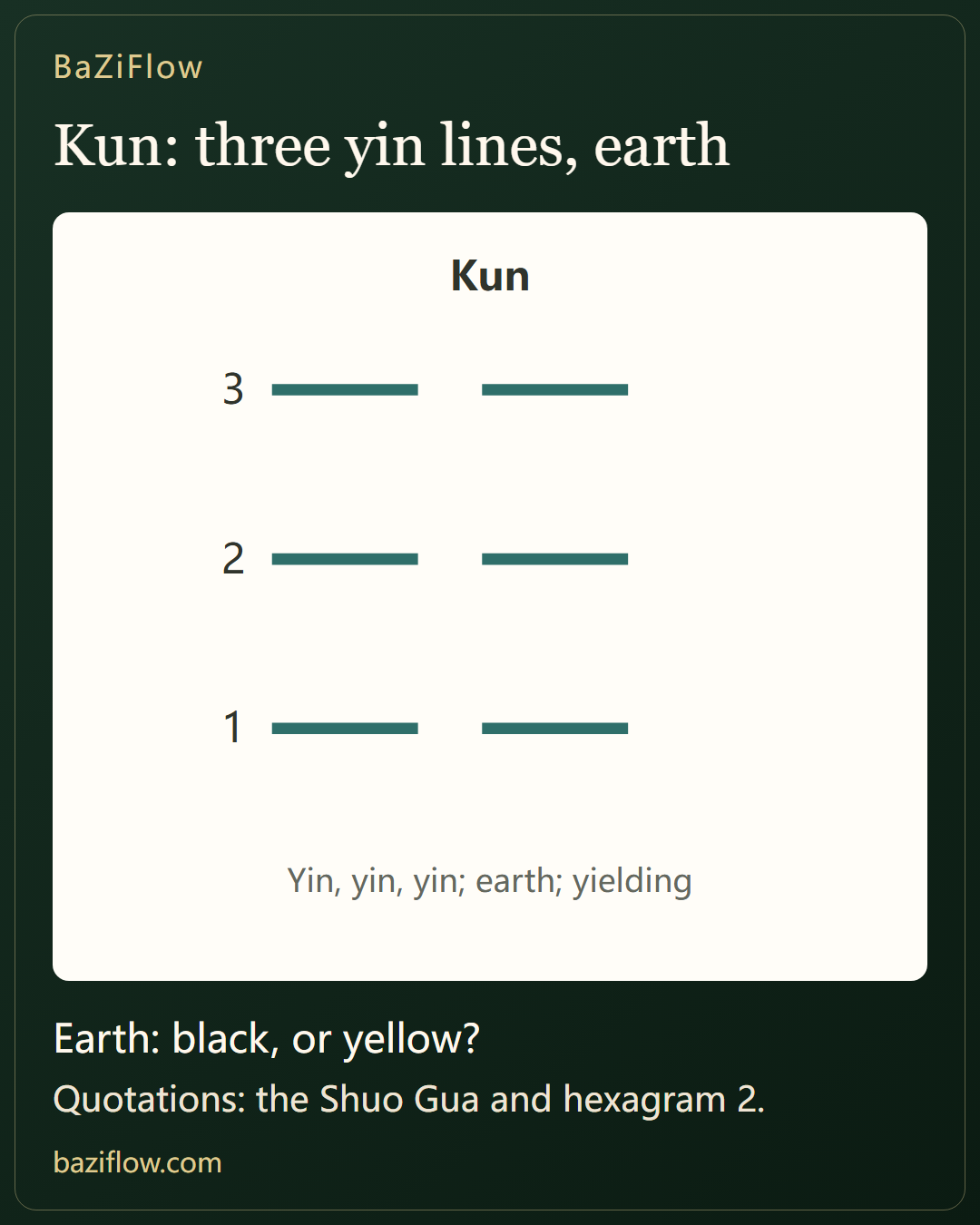
Kun is the trigram of three yin lines, the inverse of Qian. Read the seven Shuo Gua chapters where it stands with Qian, the southwest in the Judgment, the list of chapter 11, and two sets of images, black and yellow.
The short version7 min read
The word Kun occurs nine times in the Shuo Gua, in seven chapters, and Qian is present in every one. Kun's figure is three yin lines, each the opposite of Qian's; in the text of hexagram 2 the earth is still the subject, but its color turns from black to yellow.
- The word Kun occurs nine times in the Shuo Gua, in seven chapters, and Qian is present in every one; Qian comes first everywhere except chapter 5, where Kun is the fourth stop and Qian the sixth.
- Chapter 5 gives Kun only “earth” and “nourishment”; the southwest comes from the Judgment and Commentary of hexagram 2, “gain friends in the southwest, lose friends in the northeast”, matching where the later diagram puts Kun and Gen.
- The Shuo Gua says the earth is black and Kun is a cow, while the line texts and Wenyan of hexagram 2 say yellow skirt, mare and “heaven is dark, earth is yellow”: two texts, two sets of images.
Read first
Eight Trigrams: Three-Line Structure and Basic Images, Read Through the Shuo Gua ↗
In second place: the seven chapters where Qian and Kun appear together
The figure of Kun (坤) is three broken lines, all yin, none joined from bottom to top; the memory verse calls it “Kun, six breaks”. Turn every line into its opposite and you have Qian (乾), so the two are a pair of inverse trigrams among the eight.
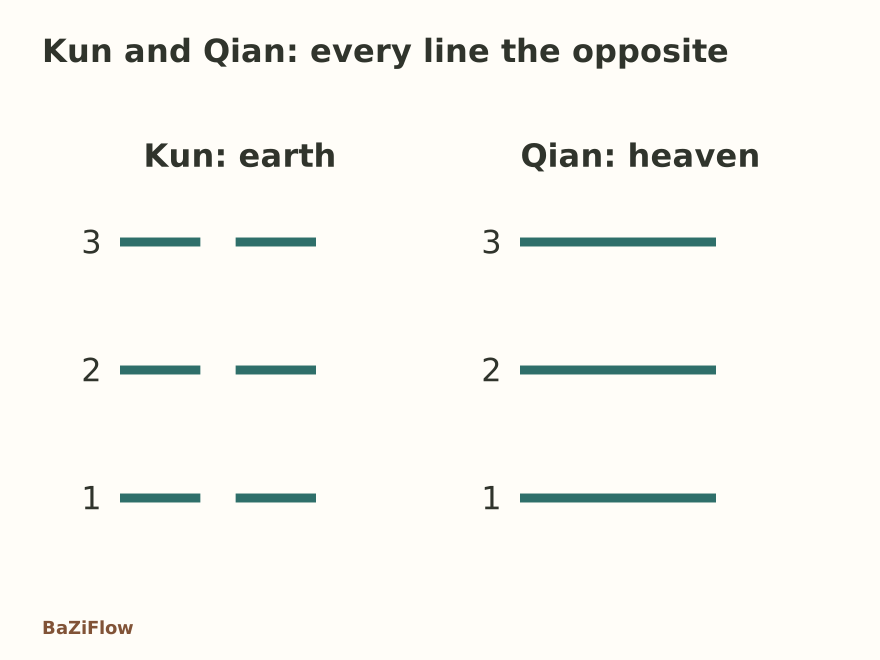
Kun beside Qian: Kun is three broken lines and Qian three unbroken ones, each line the opposite of its counterpart.
The word Kun occurs nine times in the Shuo Gua (说卦), in seven chapters, and Qian is present in every one of them. The table lists the line each gives to each trigram, chapter by chapter:
Enlarge diagram · scroll sideways to read
Two patterns show in the table. In chapter 4 and in chapters 7 to 11 Qian comes first and Kun after; only chapter 5 reverses this, with Kun the fourth stop of the journey and Qian the sixth. Chapter 6 gives six things one verb each, and neither Qian nor Kun appears. The “heaven and earth fix their places” of chapter 3 is traditionally read as the Qian and Kun pair, but it uses the two words heaven and earth and writes no trigram name.
The southwest: not in chapter 5, but in the Judgment
The entry on Kun in chapter 5 is short: it says only that Kun is the earth and that all things receive nourishment there, which is why the stop is called “has them serve in Kun”, and it names no direction.
The word southwest is in the text of hexagram 2 itself, once in the Judgment (卦辞) and once in the Commentary on the Judgments (彖传):
It is favorable to gain friends in the southwest and to lose friends in the northeast.
In the southwest it gains friends, going with its own kind; in the northeast it loses friends, and in the end there is cause to rejoice.
Enlarge diagram · scroll sideways to read
The Later Heaven diagram puts Kun in the southwest and Gen in the northeast, matching the two directions of the Judgment; chapter 5 calls Gen “the trigram of the northeast”. So Kun’s direction has two sources: its place on the diagram comes from the order of chapter 5, while the word “southwest” is in the Zhou Yi. On the Prior Heaven diagram Kun stands in the north, following the pairs of chapter 3, and neither diagram is in the Shuo Gua itself.
Eleven items: cloth, cauldron, carriage, and “stinginess” in between
Chapter 11 gives Kun this entry:
Kun is earth, mother, cloth, cauldron, stinginess, evenness, the cow with her calf, the great carriage, pattern, the multitude, a handle. Of the earth, it is black.
Eleven items when counted, and a separate closing sentence just for the earth. The four rows below group them by content; the division is ours, not the text’s:
Enlarge diagram · scroll sideways to read
The cow becomes “the cow with her calf” in this list, while chapter 8 writes only “Kun is the cow”. The list of Dui has a line of its own, “of the ground, it is hard and salty”, hard saline soil: speaking of the earth, Kun writes black and Dui writes salt, each taking one side.
One earth, two sets of images: black and yellow, cow and mare
The Shuo Gua assigns Kun black and the cow. In the text of hexagram 2 itself, the earth turns yellow and Kun’s animal becomes the mare:
A yellow lower garment: supreme good fortune.
Heaven is dark, and earth is yellow.
Enlarge diagram · scroll sideways to read
The top line says “its blood is dark and yellow”, and the Wenyan (文言) explains those words: “dark and yellow are the mixture of heaven and earth; heaven is dark and earth is yellow.” In the Shuo Gua, dark yellow is one item in the list of Zhen, “is dark yellow”. The same two characters serve in one place for the dragon’s blood, in another as an image of Zhen, and in a third are explained as heaven and earth mixed.
The Shuo Gua puts “pattern” in Kun’s list, and the Small Image (小象) of the fifth line, which gives one line of explanation per line, says “the pattern is within”. Both use that one word, a rare place where the two texts can be joined. The Shuo Gua writes black and the Zhou Yi writes yellow because each text takes its own images and need not be forced into one; when quoting, say which place you rely on.
Yielding and carrying: from “Kun is yielding” to “carry things with thick virtue”
Chapter 7 gives Kun a single quality word:
Kun is yielding.
The same word “yielding” appears three times in the Commentary on the Judgments of hexagram 2 and twice in the Wenyan. A second thread is “carrying”:
Enlarge diagram · scroll sideways to read
In chapter 7 yielding is a quality word; the Commentary puts it into three sentences, “it follows and receives heaven”, “gentle, yielding, favorable, steadfast” and “after, yielding, it gains constancy”, and the Wenyan has “the way of Kun, is it not yielding” and “this speaks of yielding”. The “great carriage” in the list of chapter 11 is a large cart that carries loads; the Commentary says “Kun, thick, carries things, its virtue matches the boundless”, and under this hexagram the Great Image (大象) gives what the noble person does:
The terrain is Kun; the noble person, with thick virtue, carries things.
Reading on, yielding is a quality and carrying is what it does; setting the great carriage beside “carries things” is a reading, not a conclusion of the text.
The six-line Kun is the second hexagram, see Kun, hexagram 2; the trigram with every line opposite is Qian, and the last stop of the journey is Gen.
Questions readers ask next
Kun is “yielding”: does that mean one should simply comply?
Chapter 7 gives Kun a single quality word, “yielding”. The Commentary on the Judgments puts it into “it follows and receives heaven” and “gentle, yielding, favorable, steadfast”, which speak of how Kun takes up Qian’s lead; the sentence about what a noble person does is the Great Image’s “with thick virtue he carries things”. How far to yield, and under what conditions, has to be read in each sentence.
Where is Kun’s southwest written?
Not in chapter 5 of the Shuo Gua, which says only earth and nourishment about Kun. The southwest is in the Judgment of hexagram 2, “favorable to gain friends in the southwest”, and in the Commentary, “in the southwest it gains friends, going with its own kind”; the later diagram puts Kun in the southwest, which fits those two lines.
Is the three-line Kun the same as hexagram 2?
Keep them apart. The Shuo Gua discusses the three-line Kun; hexagram 2 is Kun over Kun, six lines. Sentences such as the mare in the Judgment, the yellow skirt and "heaven is dark, earth is yellow" belong to the six-line Kun and are not in the Shuo Gua, which is why every quotation here names its source.
Was this article helpful?
Sources & references
Continue reading
Gen (艮): yang pressed on top, and the last stop that is also the first ↗
Trigram imagery: why a round clay bowl has two possible routes ↗