

Fan Yin: position clash and name clash
Content version · · Sources & references
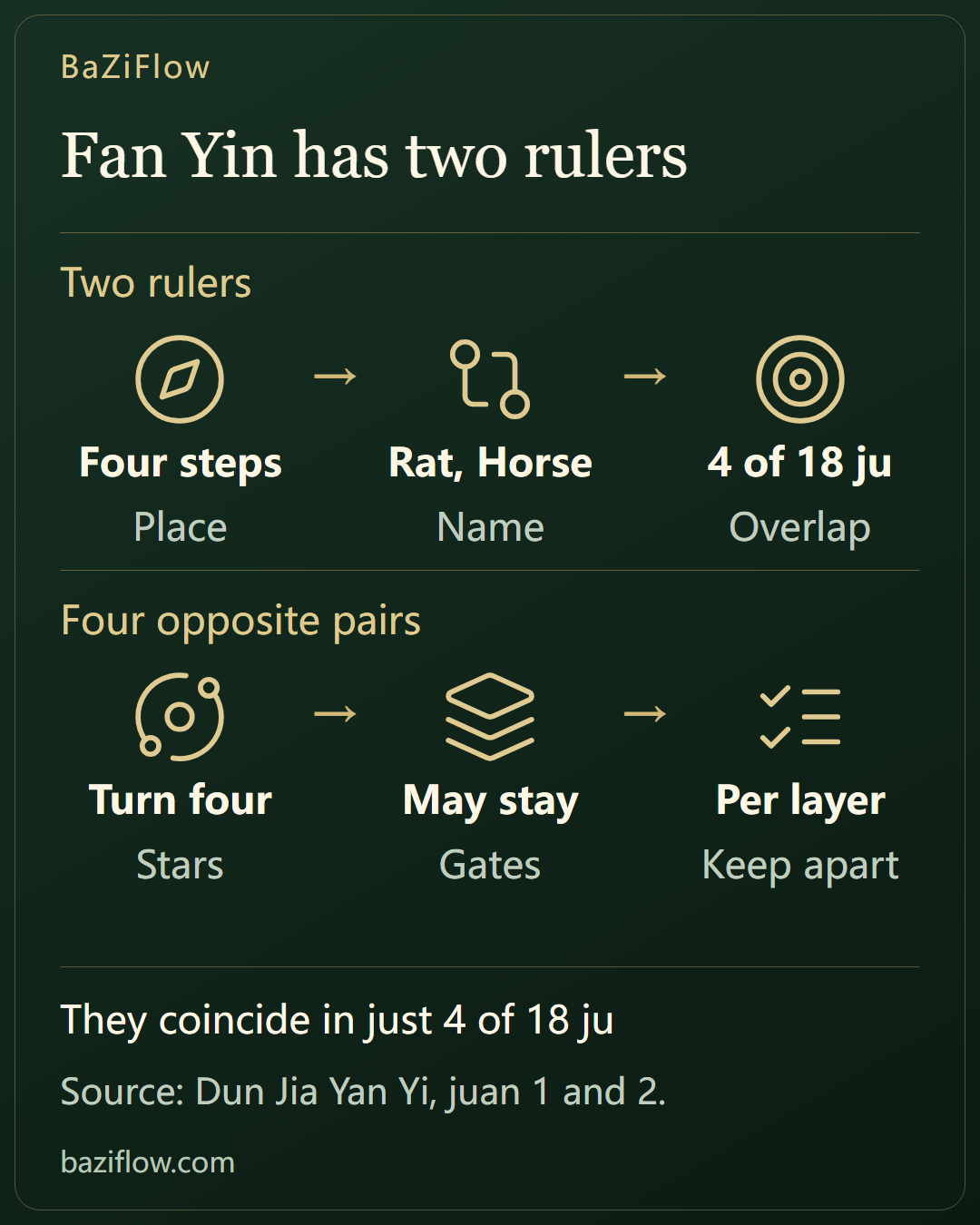
Fan Yin has two rulers for "opposite": four palaces apart in position, a Rat-and-Horse or Dog-and-Dragon clash in name. A worked Yin-mode ju 3 board, its share of 1080 charts, and the book's two lines on wonders.
The short version8 min read
Fan Yin turns on the word "opposite", yet the book measures it with two rulers: in position the whole ring turns four steps and a star lands in the opposite palace; in name the heaven-plate Jia Zi presses on the earth-plate Jia Wu. In most ju the two do not coincide.
- The place ruler counts steps round the outer ring: opposite palaces are four apart, and a ring turned four steps sets every star on the far side of its home palace.
- Name ruler: heaven Jia Zi on earth Jia Wu, Jia Xu on Jia Chen; read as position, only 4 of the 18 ju send the Chief to the opposite palace.
- Star-layer Fan Yin is 120 of 1080 charts, one ninth, and none at a decade-opening hour; the book says a wonder can cover it and in the same entry that a wonder does not help.
Read first
Two rulers for "opposite": four steps apart, or a clash of names
Fan Yin (反吟) turns on the word "opposite", and Dun Jia Yan Yi (遁甲演义) measures it with two rulers in its Fan Yin entry in juan 2.
One measures position. The verse says:
If Tian Peng should reach Tian Ying, know that this is the Fan Yin palace.
The home of Tian Peng is Kan One and the home of Tian Ying is Li Nine, due north and due south, with four steps between. The other ruler measures names, and the note reads:
This is the Chief's Fan Yin: the upper-plate Jia Zi added onto the lower-plate Jia Wu, the upper-plate Jia Xu onto the lower-plate Jia Chen.
Jia Zi and Jia Wu are a Rat-and-Horse clash, Jia Xu and Jia Chen a Dog-and-Dragon clash: this is "opposite" among the branches. The picture lays the two rulers side by side.
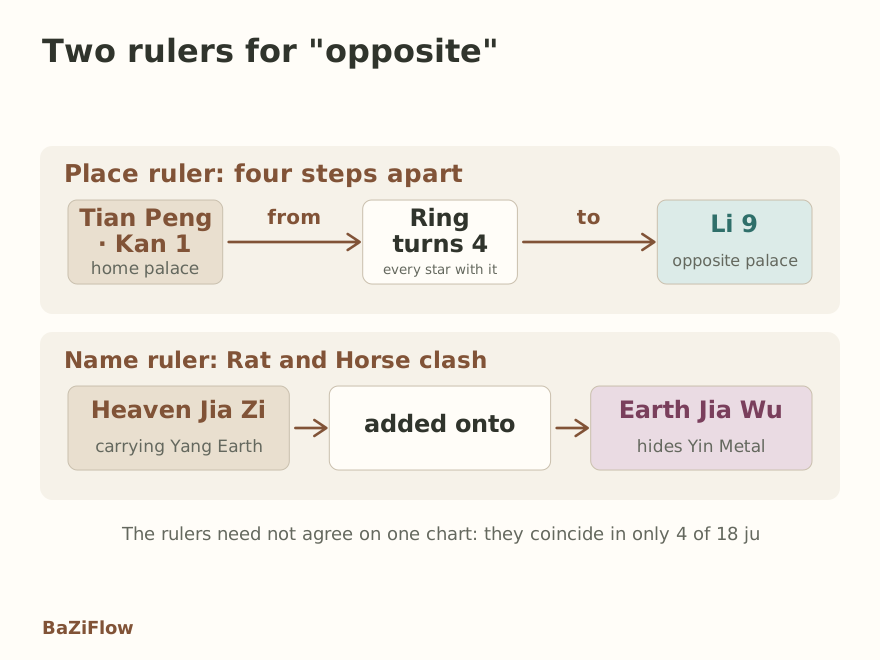
Two ways the book measures "opposite": the place ruler comes from the verse line "if Tian Peng reaches Tian Ying", the name ruler from the note in the Fan Yin entry, juan 2 of Dun Jia Yan Yi, "the upper-plate Jia Zi added onto the lower-plate Jia Wu".
Both rows speak of the same word and measure different things: the upper row follows one star from one palace to another, the lower row looks at the names of two instruments.
The place ruler: four opposite pairs, four steps round
The eight outer palaces form a ring, and the opposite palace is the one four steps away: Kan One against Li Nine, Gen Eight against Kun Two, Zhen Three against Dui Seven, Xun Four against Qian Six.
Enlarge diagram · scroll sideways to read
The plate turns as one ring, so when the ring turns four steps every star lands opposite its home: Tian Peng and Tian Ying swap places, Tian Ren and Tian Rui swap, Tian Chong and Tian Zhu swap, and Tian Fu and Tian Xin swap. A summing-up line in the same note speaks of just this:
Whenever the stars and the Chief stand opposite, it is all Fan Yin.
The center has no opposite. In the rotating-plate model Tian Qin rides with Tian Rui, and its opposite is counted as Kun Two's, Gen Eight; this lodging rule is pending on this site.
The name ruler: three pairs of instruments, each meeting the place ruler in four ju
The opposition in names is between instruments: Yang Earth against Yin Metal (Rat and Horse), Yin Earth against Yang Water (Dog and Dragon), Yang Metal against Yin Water (Monkey and Tiger). The book writes only the first two pairs and the third follows the same way. Each pair matches one definite hour in a decade: in the Jia Zi decade the Xin Wei hour has the Chief carrying Yang Earth and the hour stem Yin Metal, which is "upper-plate Jia Zi added onto lower-plate Jia Wu".
The catch is whether that hour is really four steps round on the chart, which depends on whether Yang Earth and Yin Metal sit in opposite palaces on the earth plate, and that depends on the ju.
Enlarge diagram · scroll sideways to read
So "Jia Zi onto Jia Wu" does not mean the stars have reached the opposite palace: for the same Xin Wei hour, only 4 of 18 ju send the Chief to the far side, and in the other 14 the clash is in the names alone. In the other direction, most boards where the ring really turned four steps are not one of these three hours.
One worked board: Yin-mode ju 3, the Gui You hour
Take Yin-mode ju 3 at the Gui You hour, the tenth hour of the Jia Zi decade (a Yang Wood or Yin Earth day). On the earth plate Yang Earth stands in Zhen Three and Yin Water in Dui Seven. The Chief, Tian Chong, carries Yang Earth and goes to the palace of the hour stem Yin Water, Dui Seven: from Zhen Three to Dui Seven is exactly four steps, and the ring turns four with it, so every star goes opposite:
| Opposite pair | One star: home to now | The other star: home to now |
|---|---|---|
| Kan 1 and Li 9 | Tian Peng: Kan 1 to Li 9 | Tian Ying: Li 9 to Kan 1 |
| Gen 8 and Kun 2 | Tian Ren: Gen 8 to Kun 2 | Tian Rui: Kun 2 to Gen 8 |
| Zhen 3 and Dui 7 | Tian Chong: Zhen 3 to Dui 7 | Tian Zhu: Dui 7 to Zhen 3 |
| Xun 4 and Qian 6 | Tian Fu: Xun 4 to Qian 6 | Tian Xin: Qian 6 to Xun 4 |
The gate layer has not moved at all. Gui You closes its decade, so the duty door has made its full round of nine and stands again where it began, with all eight gates at home: Fu Yin at the gate layer. One chart, Fan Yin among the stars and Fu Yin among the gates:
Enlarge diagram · scroll sideways to read
How common: one ninth of 1080 charts at the star layer
Build every chart there is in this model (eighteen ju, sixty hours in each) and count how many steps each ring turned:
Enlarge diagram · scroll sideways to read
Charts with zero steps (Fu Yin) are double any other count, and the 120 charts with four steps (Fan Yin) are one ninth. At a decade-opening hour the ring does not move, so there is no Fan Yin at those hours at all. The gate layer also has 120 Fan Yin charts, but both layers are Fan Yin together in only 19.
Can a wonder cover Fan Yin: the book has two lines
On the outcome of Fan Yin the note says:
If you meet a wonder and a gate that cover it, no harm comes; if not, disaster arrives at once.
So wonder and gate together can cover it. Once the entry has worked its example (set at the winter solstice, Yang-mode ju 1, the Yi Chou hour) the text says something else:
If gates of Fan Yin and Fu Yin are met, even with a wonder they cannot be used.
The first line says a wonder covers it, the second says it cannot be used even with one. Both sit in one entry and the standard is not the same. The note also adds a recommendation by the commentator Tang Wei (汤谓): a Rat coming onto a Horse is Fan Yin, not a time for troops but for distributing relief and tending storehouses.
Steps apart, or names clashing?
The Chief Tian Peng goes from Kan One to Li Nine. How many steps, and what is it?
Kan One and Li Nine are four steps apart, the ring turned four steps, and it is star-layer Fan Yin.
Is the Xin Wei hour of the Jia Zi decade always Fan Yin?
No. In names it is "Jia Zi onto Jia Wu", but in position only Yang 5, Yang 8, Yin 2 and Yin 8 are really four steps round.
Can the Jia Zi hour of the Jia Zi decade be Fan Yin?
Never. At a decade-opening hour the Chief does not move, the ring turns zero steps, and it is Fu Yin.
The end where the ring does not move is in what makes Fu Yin hold; the habit of recording stars and gates separately is covered in reading Fu Yin, Fan Yin and the void branches; one more tag can sit on the same chart, which is the next article, what makes a void branch hold.
Questions readers ask next
Does Fan Yin just mean a star has left its home?
No. There are seven ways to leave home, the ring turning 1 to 7 steps, and Fan Yin is only the one of four steps, to the opposite palace. Of 1080 hour charts, 120 turn four steps and each of the other six turns has 120 too, none of them called Fan Yin.
Does "Jia Zi added onto Jia Wu" mean the stars reached the opposite palace?
Not by itself. It says two instrument names clash, and whether the ring is four steps round depends on the ju: for the same hour only 4 of 18 ju send the Chief to the opposite palace, and in the other fourteen the clash is in the names alone.
Does the center palace have an opposite?
Only the eight outer palaces do. In the rotating-plate model Tian Qin rides with Tian Rui, so its opposite is counted as Kun Two's, which is Gen Eight; how the center lodges is still pending on this site.
Was this article helpful?
Sources & references
Continue reading
Fu Yin (伏吟): Star Layer, Gate and Chief, and the "Hour Pattern" Are Three Different Things ↗
Void Branches of a Decade (旬空): Find the Decade, Split Day from Hour, Then Map to a Palace ↗