

Block Gate: the Wood gate at home in Xun Four
Content version · · Sources & references
The Block Gate has its home in Xun Four and the element Wood. A worked example dated Wanli 25, the year-family "ten years a move" note and three lines on joining Yin Fire, Yin Water and Yin Earth show how it leaves home.
The short version8 min read
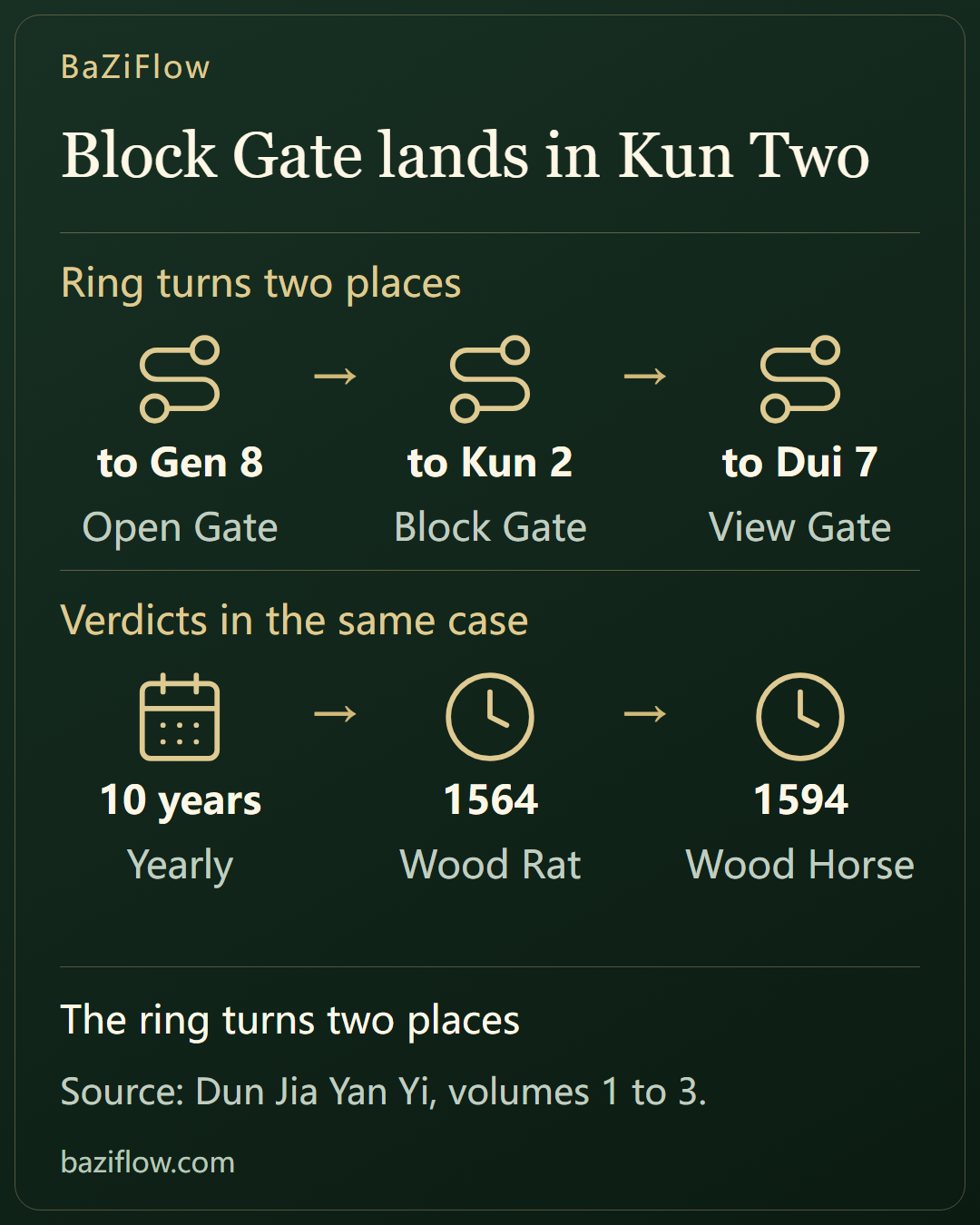
Volume 3 of Dun Jia Yan Yi lays out an example chart for the Yang Fire Horse hour of the twelfth day of the fourth month, Wanli 25: the Open Gate reaches Gen Eight, the Block Gate turns with it from Xun Four to Kun Two, and the book notes on the spot that the Block Gate on Kun is gate pressure, not lucky.
- In the example (Wanli 25, Yang-mode ju 2, Yang Fire Horse hour) the Open Gate lands in Gen Eight and all eight gates turn two places: Block from Xun Four to Kun Two, View from Li Nine to Dui Seven, as the book states.
- The verdicts come in pairs, a wonder and a gate in each box. Kun Two carries "tomb entry" and "Block Gate pressure": two labels with different conditions on the Block Gate's landing.
- The year-family note reads "from the Yang Wood Rat year 43 of Jiajing the Block Gate, ten years a move, to Rest in the Yang Wood Horse year of Wanli": 1564 to 1594 is three decades, the cycle head changes three times, and the book omits the two middle stops.
Read first
A chart from Wanli 25: the Block Gate goes from Xun Four to Kun Two
This one starts from an old chart. The Block Gate (杜门) lives in Xun Four and counts as Wood. Volume 3 lays out an example chart on a date in Wanli 25 (the text opens with "suppose"), in which it is pushed to Kun Two, with a verdict written next to it. The picture first shows the Block Gate dropped into every palace (the gate element follows its home palace, as set out in the Rest Gate). Wood beats Earth, so Kun Two and Gen Eight are both gate-over-palace boxes, and they are the two palaces the pressure passage lists for the Block Gate.
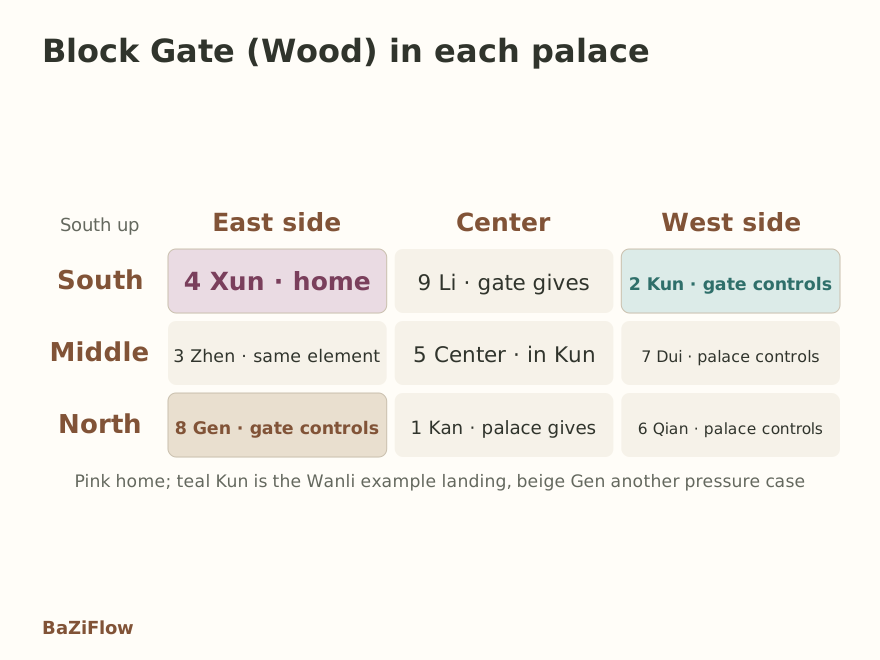
How Wood, the element of the Block Gate, relates to each palace, with south at the top and east on the left. The gate element is taken from its home palace and palace elements follow the usual assignments; pink is home, teal the landing in the Wanli example and beige another gate-pressure case in the book.
Teal Kun Two is where the Block Gate lands in the chart below. Beige Gen Eight appears only in the book's pressure example, and pink Xun Four is home.
The book's example takes the Yang Fire Horse (丙午) hour of the Yang Water Monkey (壬申) day, the twelfth of the fourth lunar month of Wanli 25. That day belongs to the middle ju of Grain Buds, Yang-mode ju 2, with Yang Wood Rat started from the Kun palace. Yang Fire Horse falls in the Yang Wood Dragon (甲辰) cycle, which hides under Yang Water. Yang Water lies in Qian Six on the Yang-mode ju 2 earth plate, and Qian Six's home items, Tian Xin and the Open Gate, become the pair that rules this hour. The hour stem, Yang Fire, sits in Li Nine on the earth plate, and Tian Xin carries the heaven plate there. The Open Gate is counted on from Qian Six: Yang Wood Dragon at Qian, Yin Wood Snake at Dui, Yang Fire Horse at Gen. It lands in Gen Eight.
The whole ring turns two places: how the Block Gate reaches Kun Two
The Open Gate goes from Qian Six to Gen Eight, two places forward on the outer ring (Qian Six, Kan One, Gen Eight). The eight gates keep their order and turn together by the same number of places, so the Block Gate goes from Xun Four through Li Nine to Kun Two, and the View Gate from Li Nine through Kun Two to Dui Seven. The book's "the Open Gate joins Gen", "the View Gate joins Dui" and "the Block Gate joins Kun" all match what the turn produces.
Enlarge diagram · scroll sideways to read
Enlarge diagram · scroll sideways to read
Six verdicts in one chart
The book writes a verdict on each of this hour's landings, and they read as three pairs. The one that lands on the Block Gate is:
The Yin Wood wonder reaches Kun: tomb entry; the Block Gate joins Kun, gate pressure, not lucky.
Gen Eight and Dui Seven each get a line about a wonder and a line about a gate as well, so every one of the three landings holds one of each:
Enlarge diagram · scroll sideways to read
Reading the gate column against the element relations above: the Open Gate (Metal) in Gen Eight (Earth) is Earth generating Metal, the palace giving to the gate, which the book calls "generating"; the View Gate (Fire) in Dui Seven (Metal) is Fire controlling Metal; the Block Gate (Wood) in Kun Two (Earth) is Wood controlling Earth. Both of the last two are gate-controls-palace, and the book marks both as pressure: "the View Gate joins the Dui palace, pressure, not lucky" and "the Block Gate joins Kun, gate pressure, not lucky".
Ten years a move: the Block Gate in the year-family example
The "year Qimen" entry of the same volume runs on a longer beat:
From the Yang Wood Rat year 43 of Jiajing the Block Gate is set out, moving once every ten years; in the Yang Wood Horse year of Wanli it moves to Rest.
Jiajing 43 is 1564, indeed a Yang Wood Rat year, and the Yang Wood Horse year of Wanli is 1594. Thirty years, three decades, three changes of cycle head: Yang Wood Rat, Yang Wood Dog, Yang Wood Monkey, Yang Wood Horse. The book names only the opening Block Gate and the closing Rest Gate and leaves out the two stops between.
Enlarge diagram · scroll sideways to read
In the gate order Rest, Life, Harm, Block, counting three places back from Block lands exactly on Rest (Block, Harm, Life, Rest), which fits three decades. That is a coincidence of counting only, and the book does not say how the step is taken.
The Block Gate joined to Yin Fire, Yin Water and Yin Earth: three landings, three lines
In the opening volume's rhapsody on the gates, the Yan Bo Diao Sou fu (烟波钓叟赋), the Block Gate gets this line:
The Block Gate is good for intercepting and for hiding.
In the ruses-and-feints passage the Block Gate turns up three times, each time joined to Yin Fire, Yin Water and Yin Earth, and what differs is where it comes down:
Enlarge diagram · scroll sideways to read
Turn it yourself
Two more turns on the example
The Open Gate went two places to Gen Eight. Where does the Block Gate, from Xun Four, go in the same two?
The outer ring runs Xun Four, Li Nine, Kun Two, so two places lands it in Kun Two.
With the Block Gate in Kun Two, how do gate and palace relate, and how does the book label it?
Kun Two is Earth and Wood controls Earth: the gate controls the palace. The book writes "the Block Gate joins Kun, gate pressure, not lucky".
Go on to the Xun Four palace to see how the Block Gate's home sits in the nine palaces; the gate before is the Harm Gate and the one after is the View Gate.
Questions readers ask next
With the Block Gate in Kun Two, are "tomb entry" and "gate pressure" the same thing?
No. Tomb entry compares the Yin Wood wonder with a tomb position, while gate pressure compares a gate with the element of its palace. The book writes two labels in the Kun Two box with different conditions, so ask first whether the label is about a wonder or about a gate.
Does "Block" mean this gate only ever blocks things?
Block is the gate's name. In the lines quoted here the Block Gate goes with "intercepting and hiding" in the Yan Bo Diao Sou fu and, joined to Nine Earth, Six Harmony or Great Yin, with hiding, flight and spying. The site glossary adds that talk of obstruction needs a named relationship, not just the gate name turned into a conclusion.
The example is a chart from the Wanli era. Does the same rule still work?
The rule is the same: fix the duty star and gate from the cycle head, let the duty star carry the heaven plate to the hour stem, and turn the gate ring by the same number of places. The date is the book's own, and this site uses it to check the rule, not to say anything about anyone.
Was this article helpful?
Sources & references
Continue reading
Harm Gate: Zhen Three Wood Gate, an Unlucky-Gate Label and Two Cases in the Book ↗
View Gate: Fire of Li Nine, Its Place in Two Gate Lists, and One Worked Chart ↗