

Net: the sutra’s worked example
Content version · · Sources & references
Net (毕) is position 2 on the 27-mansion ring. Starting from the note’s example “born on month 2, day 5 belongs to Net,” two methods recompute it, then the three-nine rows, four steady mansions and a double Net day.
The short version7 min read
Net (毕, Hitsu in Japanese) is position 2 on the site’s 27-mansion ring, after Hairy Head and before Turtle Beak. The Sukuyō Sutra’s commentator uses it for a worked example: someone born on month 2, day 5 belongs to Net.
- The example can be recomputed: the day-1 mansion of month 2 is Legs, four steps lead to Net, and the sutra’s shortcut (add 13, count from the full-Moon mansion) also lands on Net.
- The two methods start from different places yet agree on all 360 old-calendar dates of 12 months with 30 days, and every three-nine cell the commentator writes out for Net (the whole first row and the opening cells of the other two) matches the engine.
- Net shares the steady-and-heavy class with Wings, Dipper and Wall, gaps of 8, 9, 5 and 5 steps, and seen from Net the four carry different three-nine names.
Read first
What is Sukuyō astrology? How a birth mansion is found ↗
Sukuyō 27 mansions vs the 28 lunar mansions: what is the difference? ↗
A worked example inside the sutra
Start with a question the book answers itself. Where it explains the three-nine method, the commentator Yang Jingfeng files a person born on month 2, day 5 under Net and goes straight on:
Net is then taken as the first mansion, the "fate" mansion.
This question has a starting point (month 2, day 5) and an answer (Net), so it can be checked against the site’s engine. Net (毕, Hitsu in Japanese) is position 2 on the site’s ring, after Hairy Head (昴) and before Turtle Beak (觜), one of the White Tiger group in the west.
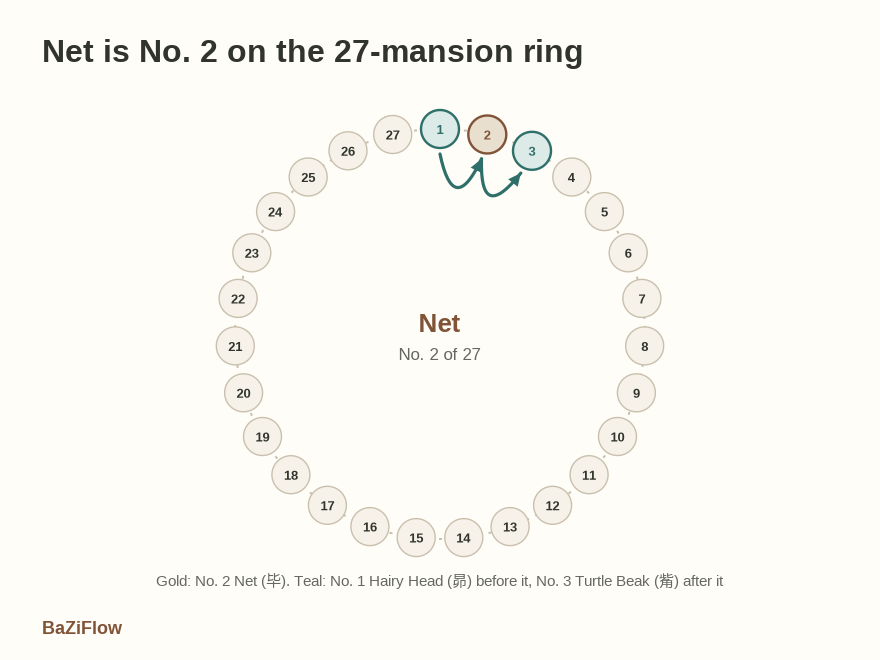
Net sits right after the starting point, Hairy Head, and is the answer to the month 2, day 5 example.
The sutra’s picture of Net reads "five shaped like half a carriage" (the text says "five mansions," which in the pattern of the other pictures means five stars), and Jingfeng’s note says Net has eight stars in Chinese astronomy. The star count differs between the two layers, just as on the Hairy Head page; a citation only has to say which layer it takes.
Two ways to count, one answer
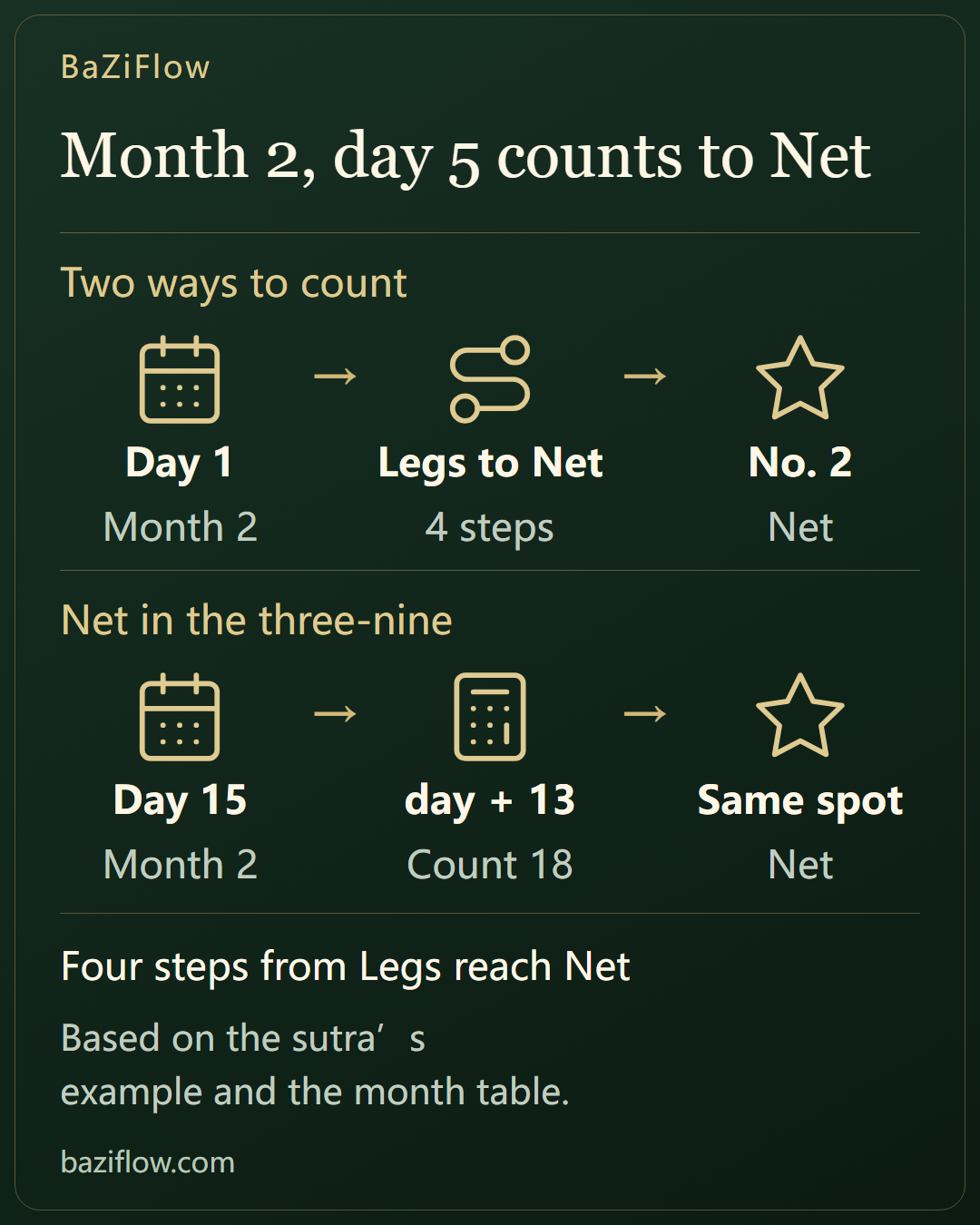
The site’s counting rule is explained on the Hairy Head page and is simply applied here: start from the mansion on the first day of the old-calendar month and move one place per day. Month 2 opens on Legs (奎), so day 5 is four places on: Legs, Bond (娄), Stomach (胃), Hairy Head, Net. That lands on Net, as in Jingfeng’s example.
Fascicle 2 of the sutra also has a "quick count" rule: write down the day number, add thirteen as a placeholder, then start from the full-Moon mansion of that month (the mansion on day 15) and count around the 27 mansions. The note on that rule works month 2, day 17: 17 plus 13 is 30, count from the month’s full-Moon mansion Horn (角), and 30 minus one lap of 27 leaves 3, so Horn, Neck, Root, ending on Root (氐).
Apply the same rule to month 2, day 5: 5 plus 13 is 18, and the 18th place counting from Horn is Net.
Enlarge diagram · scroll sideways to read
That two routes with different starts agree is no accident: the full-Moon mansion lies 14 steps after the day-1 mansion, and "add thirteen, count the first place as the start" folded back to the day-1 mansion is exactly the day number minus one. I compared all 360 old-calendar dates, 12 months of 30 days, and the two methods never differ.
Net inside the three-nine rows
Jingfeng’s example then works through the three-nine layout with Net as the "fate" mansion. He writes out all nine cells of the first row, the first three of the second (Chariot as Karma, Horn as Prosper, Neck as Decline) and the first two of the third (Girl as Womb, Emptiness as Prosper), then says the rest follow the same pattern. The table fills in all 27 cells from the engine, and every cell the commentator wrote out matches it:
Enlarge diagram · scroll sideways to read
The first nine starts at Net, followed by Turtle Beak (Prosper), Three Stars (Decline), Well (Ease), Ghost (Peril), Willow (Attain), Star (Break), Extended Net (Friend) and Wings (Kin). The second nine starts at the 10th cell counting from Net, Chariot (轸), which is Karma, and the third at the 19th cell counting from Net, Girl (女), which is Womb. The last cell is Hairy Head, Kin. One step further and the count is back at Net.
Seen the other way round, it is clearer: from Hairy Head, Net is Prosper one step ahead; from Net, Hairy Head is Kin 26 steps ahead. The two ends make one Prosper–Kin pair.
Net’s class: how far apart are the four steady mansions
The sutra also sorts the mansions into classes, and Net shares one with Wings, Dipper and Wall:
Net, Wings, Dipper and Wall are the "steady and heavy" mansions.
The four sit at positions 2, 10, 19 and 24 on the ring, with gaps of 8, 9, 5 and 5 steps, 27 in all. The four of a class are not spread evenly, and their three-nine relations differ too: from Net, Wings and Dipper are Kin and Wall is Peril; looking back at Net, Wings and Dipper are Prosper and Wall is Attain.
Enlarge diagram · scroll sideways to read
In the table of the seven luminaries, the Moon is paired with Net, and the sutra calls this pair and six others "Sweet Dew days." That is a separate table and has nothing to do with the class above.
Two days in a row on Net
In the engine, the day-1 mansion of month 4 is Net. In 2025 old month 3 has 30 days, so day 30 completes 29 steps and is back on Net, and day 1 of month 4 is Net again, giving two successive days on the same mansion. As Gregorian dates:
Enlarge diagram · scroll sideways to read
That year has 15 Net days against 14 Hairy Head days: day 1 and day 28 of month 4 are both Net. If month 3 had only 29 days, Hairy Head would run straight into Net and there would be no repeat, so a repeat depends on whether the month is long or short that year.
Find the day-1 mansion
Convert the Gregorian date to an old-calendar month and day, then look up the month’s day-1 mansion: Legs for month 2, Net for month 4.
Step the day number minus one
Day 1 takes no step and day 5 takes four; past 27 steps, wrap around to the start of the ring.
Check against the sutra’s case
Month 2, day 5 should be Net and month 2, day 17 should be Root; if either fails, check the starting point first.
One caution: Jingfeng’s “Tang month chart” in the sutra can also be read for day 5 of month 2, and there month 2 day 1 is Encampment (室) and day 5 is Stomach (胃), not Net. That chart uses a ring of twenty-eight mansions with its own starting point, while the worked example in the three-nine chapter and the site table both count from Legs (奎) on day 1 of month 2. Say which table you used when you quote it.
After Net comes position 3, Turtle Beak, and before it Hairy Head. The step from three rows to six relation types is worked through in the six relationship types; birth and daily mansions are told apart in birth mansion versus daily mansion.
Questions readers ask next
Is "born on month 2, day 5" in the Gregorian or the old calendar?
The month in the example is an old-calendar month. The site first converts a Gregorian date to a Japanese old-calendar month and day and then counts from the month-start table, so 5 February is not automatically Net. What you look up is the Gregorian date that corresponds to old-calendar month 2, day 5.
Why does the sutra tell you to add thirteen?
It is a shortcut that starts from the full-Moon mansion of day 15. That mansion lies 14 steps after the day-1 mansion, and "add thirteen" folds those 14 steps in, so the result equals stepping the day number minus one from day 1. It cannot give a different mansion.
Is Net always "Fate" in the three-nine rows?
Only when the rows are counted from Net. Counted from another mansion, Net lands on Prosper, Decline, Ease and the rest; for example, seen from Hairy Head, Net is Prosper, and seen from Net, Hairy Head is Kin.
Was this article helpful?
Sources & references
Continue reading
Hairy Head (昴): The First Place on the 27-Mansion Ring and Its Month Name ↗
Turtle Beak (觜): Three Stars, Last of the Six "Ahead" Mansions, Split Across Two Houses ↗