

Reading a BaZi chart for the first time: the four pillars and the Day Master
Content version · · Sources & references
Where the eight characters sit, why the day stem is called the Day Master, what to record before judging anything, and why BaZi is neither a zodiac animal nor a personality quiz.
Four pillars, each a stem over a branch, make eight characters. The day stem is the reference point; the zodiac animal is just one of them.
Find the reference point before interpreting the chart
A chart labelled Yang Fire does not mean that all eight characters are Fire. The label may refer only to the Day Master: the Heavenly Stem at the top of the Day Pillar. Locate the column labelled Day before reading any character description. Some charts run Year to Hour from left to right; others reverse that order. The column labels, not the position on your screen, settle which stem is the Day Master.
BaZi means eight characters. There are four date-related pairs—year, month, day and hour—and each pair consists of a Heavenly Stem above an Earthly Branch. A pair is called a pillar. The animal of the birth year is associated with just the year branch; it is not a summary of the other seven positions.
Try three labels without turning them into three people
Suppose three teaching examples have day stems Yang Fire (丙), Yin Metal (辛) and Yang Water (壬). All we have established is the reference element and polarity of each example. We have not established anyone's temperament, occupation or compatibility. Two charts can share Yang Fire and still differ in their month branch, roots and other stems.
This is why the method called Zi Ping uses a relationship rather than a personality type. A Water stem produces a Wood Day Master, but is produced by a Metal Day Master. The same character has a different role because the reference point changed. The relationship names are introduced in the Ten Gods; the five-element cycles supplies the direction of generation and control.
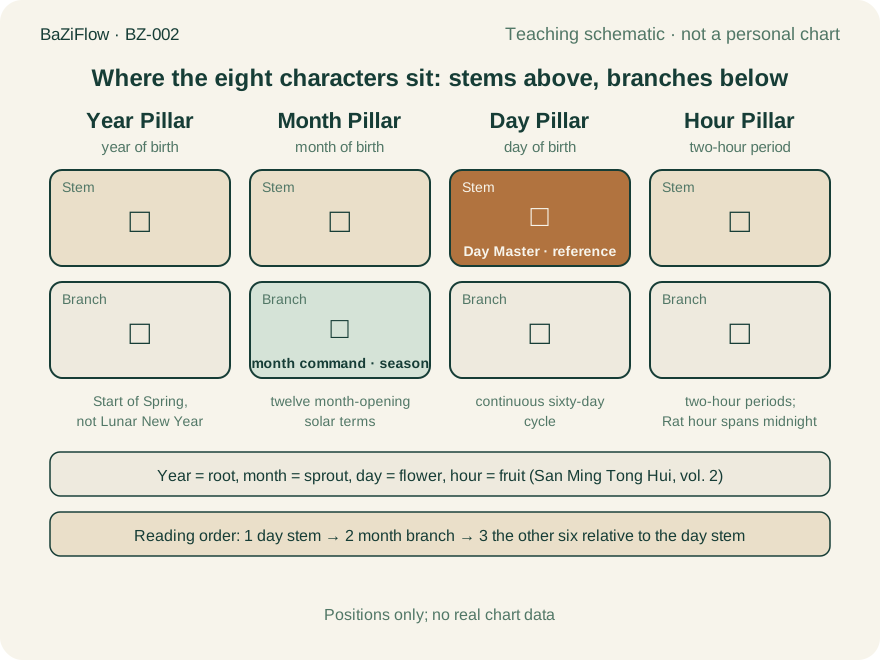
Original BaZiFlow teaching diagram; positions of the eight characters only, not a personal chart.
The diagram leaves every slot empty deliberately. It teaches the layout, not a birth chart that can be interpreted. The month branch is marked separately because the month provides a seasonal context; it is not a second Day Master.
Four columns do not use one calendar boundary
The Year Pillar commonly changes at Start of Spring. The Month Pillar follows the twelve month-opening solar terms. The Day Pillar advances through the sixty stem-branch pairs one day at a time, without restarting at a new month. The Hour Pillar uses twelve two-hour periods, with the Rat period crossing midnight.
These are conventions that must be recorded when comparing software. A Gregorian month number is not itself the month branch, and Lunar New Year is not automatically the year boundary in a BaZi calculation. Read solar terms and month pillars for the first distinction and the Rat-hour day boundary for the midnight issue.
A quick structural check is possible even before calculation: a yang stem pairs with a yang branch, a yin stem with a yin branch. Yang Wood over Ox is therefore not one of the sixty valid pairs. Passing this check does not establish that the date was converted correctly; it only catches one kind of invalid pair.
What the old books support—and what they do not
The day-as-reference method is stated in the day-master section of Yuan Hai Zi Ping and in volume two of San Ming Tong Hui. Both use plant imagery for year, month, day and hour. That imagery is useful for remembering the positions; it is not a measured ranking of their influence. The texts' accounts of the method's early history should not be treated as a settled attribution of invention.
Nor does the size of the formal combination space validate a reading. Multiplying 60 year pairs, 12 month branches, 60 day pairs and 12 hour branches gives 518,400 formal possibilities before checking which dates realise them. This is not a count of personality types, and a traditional chapter about character is not a validated psychological test.
Make a record that another reader can check
Write down the labelled four pillars, the Day Master's element and polarity, and the month branch. Then record the calculation settings before adding interpretations. A Rat month gives a traditional winter context; it does not by itself prove that the entire chart is cold or needs more Fire.
If a second chart differs, compare the birth data and boundary settings first. If only the prose differs while the eight characters match, that is a different question about interpretation. Once the positions are clear, continue with what stems and branches contribute.
Theme: Understanding yourself
Part of a learning path
Sources & references
Continue reading
What the ten stems and twelve branches each do ↗
Five Elements cycles: learn the relationships, not just the order ↗