

Yijing and Zhou Yi: names and scope
Content version · · Sources & references
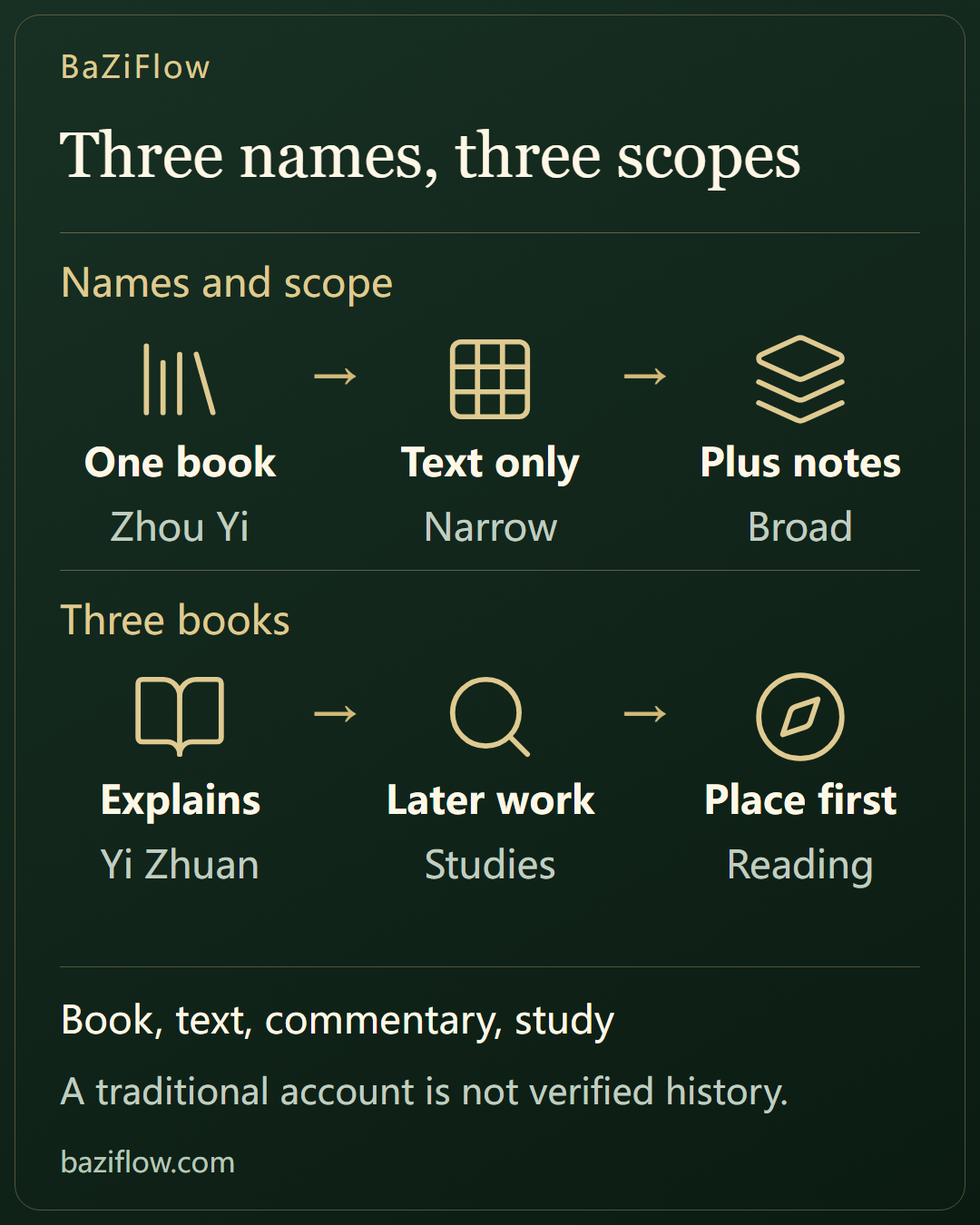
A comparison table separates Yi, Zhou Yi, Yijing, Yi Zhuan and Yi studies by how much each covers, then checks how the Rites of Zhou, the Zuo Zhuan, the Book of Han and the Book of Sui use the names.
The short version10 min read
Yi, Zhou Yi, Yijing, Yi Zhuan and Yi studies are often used interchangeably, yet one names the whole book, one only the figures and statements, one the explanations and one the later scholarship.
- Zhou Yi has a narrow and a broad sense: narrowly, the figures plus the statements; broadly, those plus the commentaries that explain them.
- The Rites of Zhou puts Zhou Yi last of three methods; the Zuo Zhuan has it carried in to be cast and also quoted as a book; the Book of Han catalogues a work as "Yijing, twelve sections".
- Old books do not agree on who made which layer, so such reports can be passed on only as traditional accounts, never as settled authors and dates.
Five names, five different scopes
Anyone starting on the Zhou Yi (周易) meets a string of names first: Yi (易), Zhou Yi, Yijing (易经), Yi Zhuan (易传) and Yi studies (易学). They are often treated as five labels for one thing. In fact one name covers the whole book, one only a part of it, one the explanations, and one the scholarship that came after.
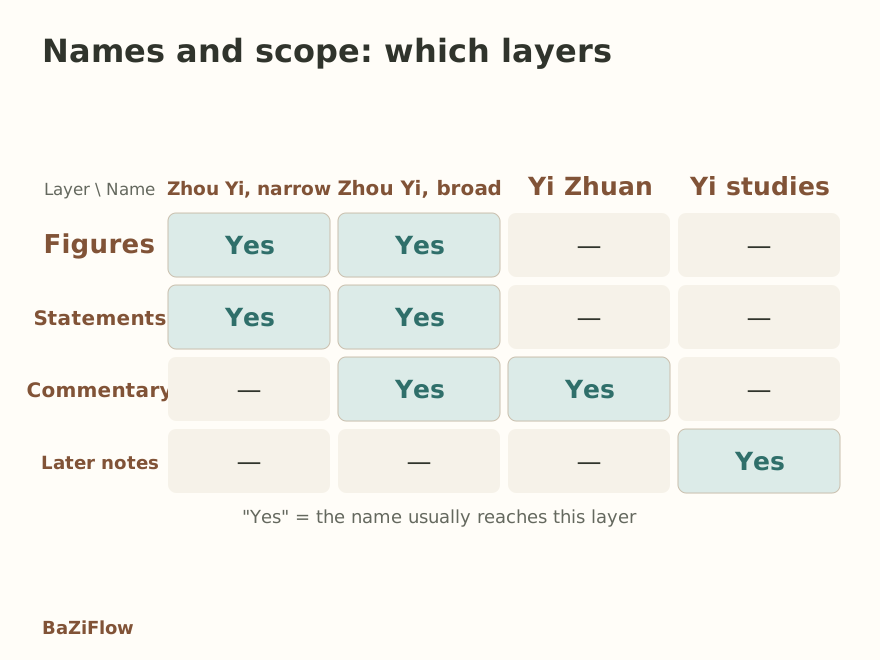
Sketch of names and scope: "Yes" means the name usually reaches that layer. Narrow and broad senses depend on the passage; there is no single standard.
Start with the four layers of material:
- Figures: the sixty-four shapes built from yin and yang lines; how the lines are drawn is in yin and yang lines.
- Statements: the Judgment (卦辞) attached to a whole hexagram and the line statement (爻辞) attached to each line; their division of labour is in Judgment and line statements.
- Commentaries: chapters that explain the figures and the statements.
- Later notes: annotations and subcommentaries that later scholars wrote for the whole book.
Now the four columns. The narrow Zhou Yi counts only the first two layers. The broad Zhou Yi adds the commentaries. Yi Zhuan means the commentaries alone. Yi studies means the later scholarship, and what it produced fills the fourth layer.
One page shows two scopes at once. On Wikisource's page for the hexagram Tai (泰), the section label "Yijing" (易经) covers only the Judgment and the six line statements, while the page as a whole is titled Zhou Yi, Tai and also takes in the blocks introduced by the formulas for the Commentary on the Judgments (彖曰) and the Commentary on the Images (象曰). That whole-page title is the broad sense.
The Rites of Zhou and the Zuo Zhuan: two places that write "Zhou Yi"
Two classical books write the name Zhou Yi, and how each one uses it tells more than a definition would.
Enlarge diagram · scroll sideways to read
In the Rites of Zhou (Zhou Li, 周礼), the Grand Diviner (大卜) is responsible for the "three Yi". The names Lianshan (连山) and Guizang (归藏) stand beside Zhou Yi:
The Grand Diviner: ... in charge of the methods of the three Yi: the first is Lianshan, the second Guizang, the third Zhou Yi. Their basic figures are all eight; their derived figures are all sixty-four.
The sentence puts Zhou Yi third of three methods, after Lianshan and Guizang. The "eight" and "sixty-four" that follow are usually understood as the eight trigrams and the sixty-four hexagrams, and the word for "all" speaks of the three together if read literally. The passage offers three names side by side and gives a meaning for none of them. The entry for the Diviner with the Stalks (筮人) in the same book also says "in charge of the three Yi" and lists the same three in the same order.
In the Zuo Zhuan (左传) the name turns up inside narrative:
Two passages in the Zuo Zhuan
A historian of Zhou brought the Zhou Yi to the lord of Chen
The lord had it cast and received "Guan (观) to Pi (否)", that is, the hexagram Guan turning into Pi. The Zhou Yi here is something carried in and used to cast.
Lady Mu Jiang: "In the Zhou Yi it says: Sui…"
The Zhou Yi here is a book with words that can be quoted. The words match the opening four terms of the Judgment of Sui (随) in the Wikisource text of the Zhou Yi.
Read together, the two books show the Zhou Yi as something used in casting and as a book that can be quoted. Neither says which layers it held at the time, so neither settles the narrow or the broad sense.
The Book of Han and the Book of Sui: a catalogue and traditional accounts
By the Han period a catalogue already lists "Yijing" as a book title. The Treatise on Arts and Literature (艺文志) in the Book of Han (汉书), under Yi in its section on the Six Arts, begins like this:
Yijing, twelve sections, in the three schools of Shi, Meng and Liangqiu. Yi Zhuan: by the Zhou family, two sections; the Fu family, two; the Yang family, two; Master Cai, two; the Han family, two; the Wang family, two; the Ding family, eight.
Here "Yijing" is a title in a catalogue. The Yi Zhuan entries that follow are listed family by family, each with its own number of sections. Further on, in its short preface to this group, the same treatise says how the books came to be:
King Wen, a lord who obeyed the mandate and followed the Way, ... thereupon doubled the six lines of the Yi and made the upper and lower sections. Confucius made for it ten sections of the kind called the Commentary on the Judgments, the Commentary on the Images, the Great Commentary (Xi Ci, 系辞), Wenyan and Xu Gua.
Enlarge diagram · scroll sideways to read
Two sections plus ten match the twelve of "Yijing, twelve sections". That is addition across two passages, and the text does not spell it out.
The Book of Sui (隋书), in its Treatise on Classics and Texts (经籍志), also tells where the name came from:
Down to the Three Dynasties there were in fact three Yi: Xia called it Lianshan, Yin called it Guizang, and what King Wen of Zhou made as Judgments was called Zhou Yi. The Duke of Zhou then made the line statements, and Confucius made the Commentary on the Judgments, the Commentary on the Images, the Xi Ci, the Wenyan, the Xu Gua, the Shuo Gua and the Za Gua ...
The Book of Sui ties the name Zhou Yi to the Judgments King Wen made and gives the line statements to the Duke of Zhou, which is not how the Book of Han divides the work.
Yi, Yi Zhuan and Yi studies: the book, the explanations and the scholarship
Beyond the names there are three more words to keep apart: the bare word Yi, Yi Zhuan and Yi studies.
Enlarge diagram · scroll sideways to read
How the text and the commentaries are read side by side is in core text and commentaries. Here only the three words are looked at.
The bare word Yi is often simply a book title in old texts. Zhuangzi, "All Under Heaven" (庄子·天下), lists six books side by side:
The Poetry speaks of aims, the Documents of affairs, the Rites of conduct, the Music of harmony, the Yi of yin and yang, the Spring and Autumn of names and roles.
The Xi Ci, part II, lets the same word name both a book and a Way:
As a book the Yi must not be kept at a distance; as a Way it keeps shifting.
The first half of the sentence speaks of a book, the second half of that book's Way.
The example of Yi studies here is the Zhou Yi Zhengyi (周易正义). Wikisource names Wang Bi (王弼) and Han Kangbo (韩康伯) for the annotation and Kong Yingda (孔颖达) for the subcommentary. Its contents run from Qian (乾) through Weiji (未济), the sixty-four hexagrams, and the Xi Ci (two parts) follows, then the Shuo Gua, the Xu Gua and the Za Gua. The "Zhou Yi" in its title is therefore the broad sense, while the book itself belongs to Yi studies.
How the three words are used
- Yi
- Alone it can name the whole book, as in Zhuangzi, or the Way the book speaks of, as in the Xi Ci; the surrounding text decides.
- Yi Zhuan
- In general the chapters that explain the text, such as the Commentary on the Judgments, the Commentary on the Images, the Xi Ci and the Shuo Gua; in the Han catalogue "Yi Zhuan" is instead the title of works handed down by various houses.
- Yi studies
- Later annotation and study of the book, whose products are annotations, subcommentaries and monographs.
Meeting a name: three questions to ask first
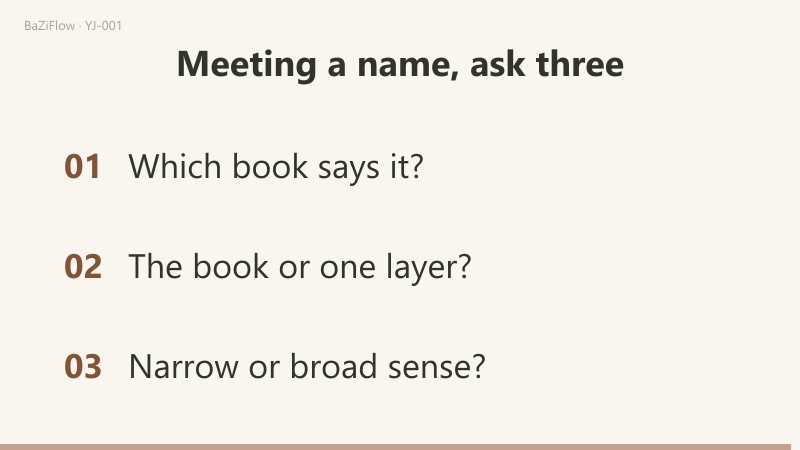
Put the earlier sources together and a routine appears: on meeting a sentence with Yi in it, place it first, understand it second.
Enlarge diagram · scroll sideways to read
Cover the last two columns and judge each sentence first. Row 1 is one of three names listed side by side, with no scope given. Row 2 quotes words from the opening of the Judgment of Sui, so it falls in the layer of the statements. Row 3 is a title in a catalogue. Row 4 comes from chapter 3 of Xi Ci part II, where the commentary says what the Yi is.
Ask the source
Is the sentence a title, a quotation, a catalogue entry or an explanation? Say which book it comes from first.
Ask the scope
Does it speak of the whole book, one layer of text, or later study? See what the same passage lists around it.
Ask the usage
Does the passage take the narrow or the broad sense? Different books can use one word differently, so do not carry the broad or narrow sense of one book straight into another.
Questions readers ask next
Are "Yijing" and "Zhou Yi" the same book?
Usually two names for one book, but the scope depends on context: sometimes only the figures and statements are meant, sometimes the commentaries too. Go back to the passage and see what its own surroundings list.
Is the Yi Zhuan part of the Zhou Yi?
That depends on which sense of Zhou Yi is meant. The narrow sense leaves the commentaries out; the broad sense takes them in, as in annotated editions such as the Zhou Yi Zhengyi, whose contents put the Great Commentary (Xi Ci, 系辞), the Shuo Gua and other chapters together with the sixty-four hexagrams.
Is it reliable to say King Wen wrote the Zhou Yi?
It is one traditional account, and books divide the work differently: the Book of Han and the Book of Sui disagree on what King Wen, the Duke of Zhou and Confucius each did. Quote them with their source and do not present any version as settled.
Was this article helpful?
Part of a learning path
Sources & references
Continue reading
Core Text and Commentaries: Telling the Zhou Yi from What Explains It ↗
Yin and Yang Lines: Two Strokes, Six Places, Read from the Bottom ↗
Yijing, Meihua and Liu Yao: Shared Hexagrams, Different Methods ↗
Judgment and Line Statements: Whole Hexagram or Single Line? ↗