

Hua Quan: ten stems and three sources
Content version · · Sources & references
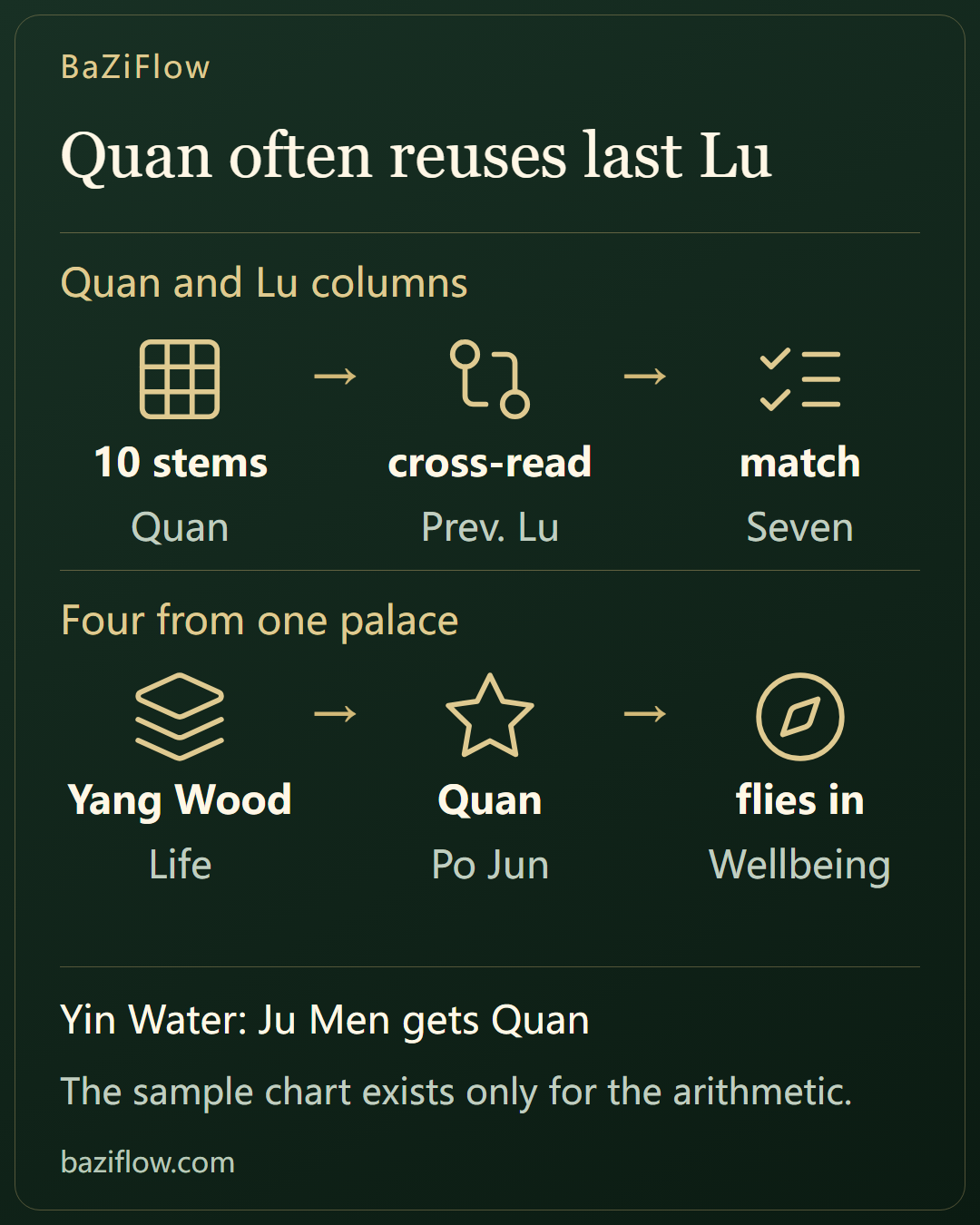
Read the Quan column against the previous stem's Lu column, then use an engine-computed sample chart for birth-year, palace-stem and self Quan, and separate the book's "meets Ju Men and Wu Qu" from the table look-up.
The short version7 min read
Shift the Quan column one stem against the Lu column and seven of the ten stems name the same star. Hua Quan (Quan for short) is the second mark that attaches to a star, and the book pictures it as a god who holds judgment.
- Set the Quan column one stem behind the Lu column and seven stems match; Yin Wood, Yang Water and Yin Water do not.
- The book says Quan likes to "meet" Ju Men and Wu Qu, a relation of position; the stems that hand Quan to those two stars are Yin Water and Yang Metal.
- One palace stem sends out all four marks at once; the sample chart's Life palace has Yang Wood, and its Quan points to the Wellbeing palace.
Read first
The Quan column: ten stars, read against the previous stem's Lu
Hua Quan (化权), "Quan" for short, comes second among the four marks and sits on a star just as Lu does; the book pictures it as the power to make decisions. When you look it up, the Quan column and the column for Hua Lu stand in a relation that makes the table easier to check.
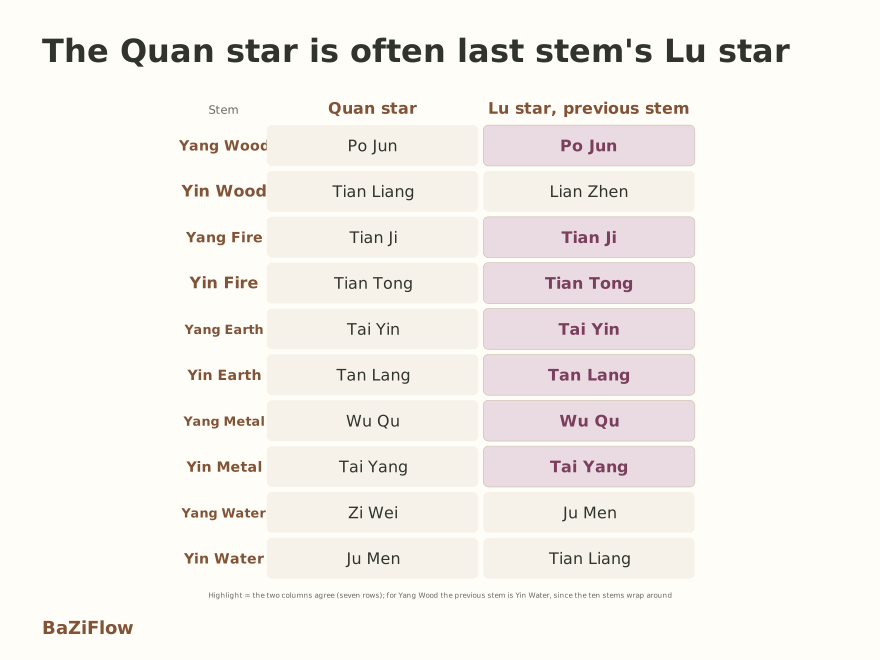
Both columns use the engine's four-transformation table (identical cell by cell to the iztro default); the right column is the Lu star of the stem before the one in the row, and for Yang Wood the previous stem is Yin Water.
The left column is the Quan star under each of the ten stems. The right column is the Lu star of the "previous stem", which means the Lu column moved down by one row; for Yang Wood the previous stem is Yin Water, because the ten stems run in a circle. In the seven highlighted rows both columns hold the same star.
Seven stems, one star changing its mark
Three of the seven rows laid out show the same pattern: one star passes from Lu to Quan between two neighboring stems.
Enlarge diagram · scroll sideways to read
The three rows that break the pattern are Yin Wood (Quan on Tian Liang, while the previous stem Yang Wood gives Lu to Lian Zhen), Yang Water (Quan on Zi Wei, previous stem Yin Metal gives Lu to Ju Men) and Yin Water (Quan on Ju Men, previous stem Yang Water gives Lu to Tian Liang). Cross-reading will not reveal these three, which have to be looked up directly.
What the book says about Quan: an image, and the word "meet"
The Quan Shu (紫微斗数全书), second juan, gives the image of Quan in the entry for the mark itself:
The Quan star is Wood, the god who holds the power of judgment over life and death.
The book assigns Quan to Wood and pictures a god who holds the authority to decide. A table that sorts the stars by element, further on in that juan, carries this line:
Hua Quan belongs to Wood and likes to meet Ju Men and Wu Qu.
It is easy to read this as "Ju Men and Wu Qu take Quan". The word "meet" is about position: the palace where Quan sits meets Ju Men and Wu Qu in its three-and-four-sides relation (see the three sides and four directions). Which star carries Quan is a different question:
Enlarge diagram · scroll sideways to read
The sample chart: birth-year Quan, and four sent from one palace
For a worked chart, take solar 18 May 2003, Rabbit hour, male; the lunar calendar calls it a Yin Water Goat year. It is a date picked to calculate with, not anybody's chart.
Birth-year Quan: the year stem is Yin Water, Quan goes to Ju Men, and Ju Men sits in the Health palace (the Rooster palace). The record reads "birth-year Quan, Ju Men, Health palace".
Palace stem: the Life palace is at the Tiger, and its stem is Yang Wood. Taking Yang Wood as the entrance, all four columns are read together and four marks go out at once. Lu is Lian Zhen, who sits in the Life palace itself; Quan is Po Jun, in the Wellbeing palace; Ke is Wu Qu, in the Career palace; Ji is Tai Yang, in the Friends palace.
Enlarge diagram · scroll sideways to read
Two side findings. The Partner palace also has Yang Wood, so it sends out the same four. The Children palace has Yin Water, equal to the year stem, so the four it sends are exactly the birth-year four, though the source is still a palace stem.
Self-Quan: when Quan lands back where it started
Self-Quan uses the same test as Lu: the palace stem picks a star from the Quan column, and the question is whether that star is in the palace itself. Three palaces in the sample chart give three different results:
Enlarge diagram · scroll sideways to read
The last row is the one to remember. The Health palace does hold Ju Men carrying the birth-year Quan, but that mark comes from the year stem, Yin Water. The palace's own stem is Yin Metal, which selects Tai Yang, and Tai Yang is in the Friends palace, so Health sends Quan to Friends and is not a self-transformation. One palace can show several sources at once, and each is recorded separately. Other definitions of the term are covered in self-transformations and schools.
After copying the table, three checks
Cross-read Quan against Lu
Once the table is copied, read the Quan column against the previous stem's Lu column. Seven rows agree and three differ, so a mismatch elsewhere signals a copying slip.
Find the star's palace in the chart
The table gives only star names. Which palace holds one comes from the chart; the Health palace shows that holding a Quan is not the same as sending one.
Record self and flying apart
A star found in the sending palace makes self; a star found elsewhere makes a flight into that other palace.
Two read-across checks
Under Yang Metal, which star takes Quan, and what is the Lu star of the previous stem?
Yang Metal gives Quan to Wu Qu, and the previous stem, Yin Earth, gives Lu to Wu Qu as well. The columns agree.
The book says Quan likes to meet Ju Men and Wu Qu. Under which stems do those two stars carry Quan?
Ju Men under Yin Water and Wu Qu under Yang Metal. As for "meeting", that has to be read from the sides of the chart.
After Quan comes the third column of the same table: Hua Ke.
Questions readers ask next
Why is the Quan star so often the Lu star of the previous stem?
It is something you see when you set the two columns side by side. The book never states it or explains it, and three rows break it, so it helps you check a copied table but does not replace the look-up.
The book says Quan likes to meet Ju Men and Wu Qu. Does that mean those two stars take Quan?
These are two different matters. "Meeting" is a relation among palaces in the chart, while which star takes Quan is a table look-up. Ju Men takes it under Yin Water and Wu Qu under Yang Metal.
If a palace holds a birth-year Quan, is that palace a self-Quan?
No. Self-Quan asks which star the palace's own stem selects and whether that star is inside the palace. In the sample chart the Health palace holds a birth-year Quan, yet its own stem selects a different star.
Was this article helpful?
Sources & references
Continue reading
Hua Lu (化禄): How It Differs From Lu Cun, and Its Three Sources ↗
Hua Ke (化科): Four Stems Pick Supporting Stars, and the Three Sources ↗