

Three of Swords: three blades, one heart
Content version · · Sources & references
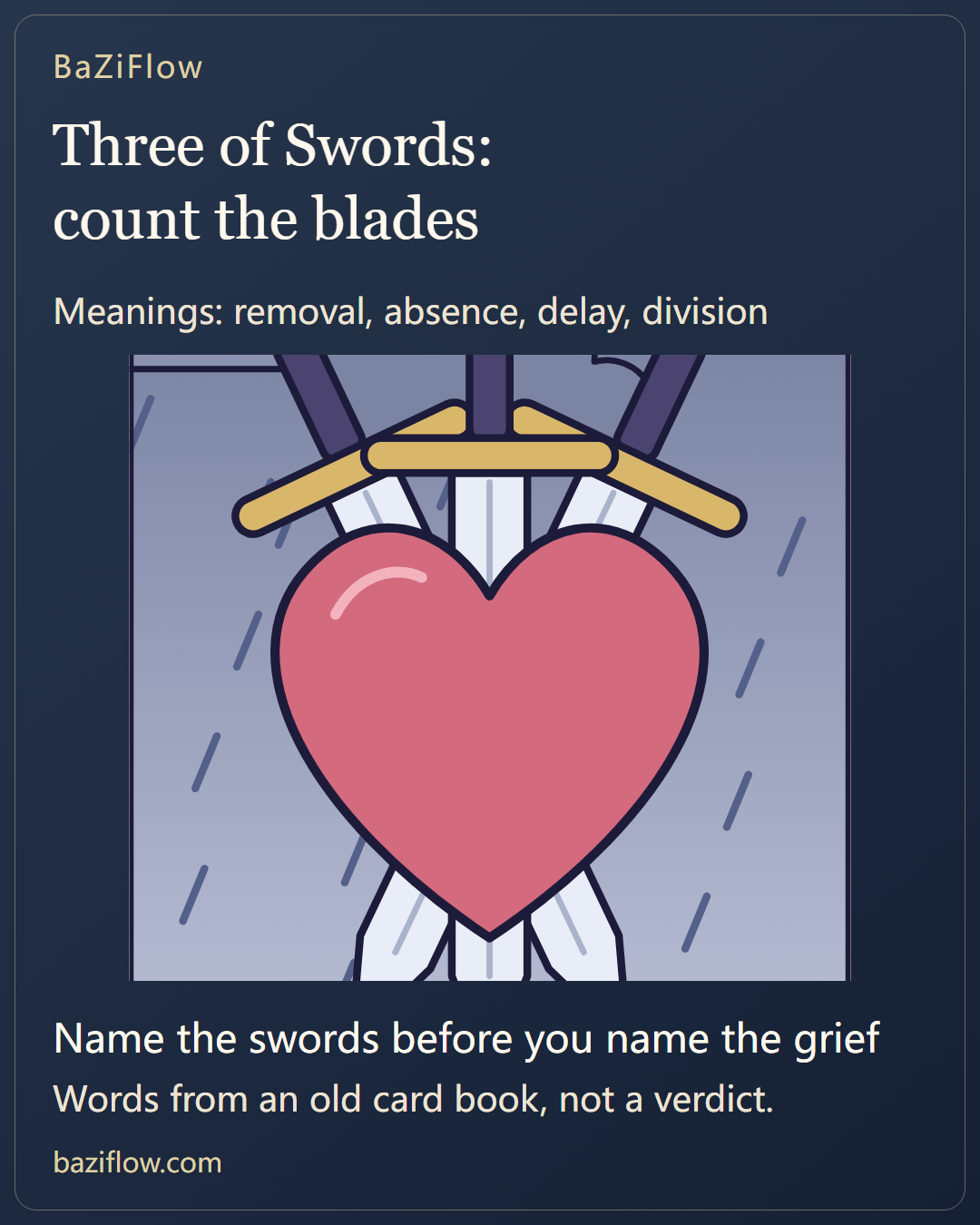
The Three of Swords shows three swords through a heart, with cloud and rain behind. See which words Waite actually lists, then sort the two weeks before a thesis defense by blades, words and rain.
The short version6 min read
The Three of Swords is easy to understand at a glance, yet Waite's word list is restrained: six words, all of them about how people and things go missing, wait or come apart.
- Waite's description is half a sentence, three swords piercing a heart with cloud and rain behind; the upright words are removal, absence, delay, division, rupture, dispersion.
- He closes the list by saying that all the picture signifies naturally is too simple and obvious to enumerate, so sorrow and heartbreak are not words he lists.
- The reversed words turn to mind and order: mental alienation (an old term), error, loss, distraction, disorder, confusion. The extras give "the flight of her lover" and, reversed, meeting someone the querent has compromised, or a nun.
Read first
Start with the picture: a heart, three blades, cloud and rain behind
Waite describes the Three of Swords briefly: three swords piercing a heart, with cloud and rain behind. The divinatory meanings come straight after: removal, absence, delay, division, rupture, dispersion, and then a remark that all the design signifies naturally is "too simple and obvious to call for specific enumeration".
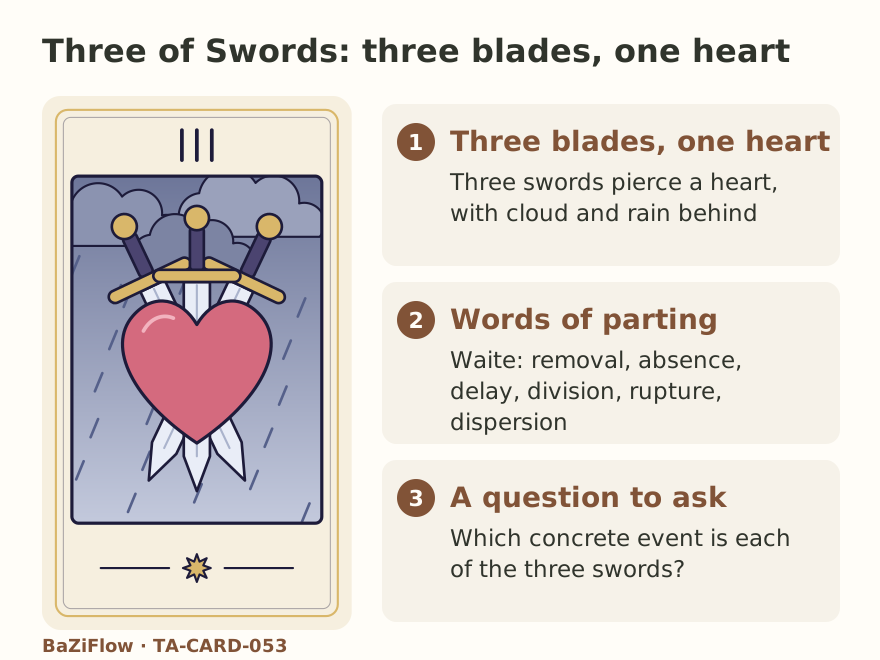
BaZiFlow original Three of Swords with three labels
On the Rider-Waite-Smith card a red heart sits at the center. One sword drives straight down into its middle from above, two more enter slanting from upper left and upper right, and the tips come out at the lower edge of the heart. Gray cloud presses on the upper half, and slanting rain lines run to the bottom of the card. In BaZiFlow's original card the three hilts are at the top, the blade tips show under the heart, and cloud and rain stand at the very back. From back to front, the picture has three layers:
Enlarge diagram · scroll sideways to read
What Waite lists: six words, all of them about absence and separation
Waite's upright list is removal, absence, delay, division, rupture, dispersion. Lay the six words out by meaning and only three kinds of content appear: who or what is no longer there, what has been put off, and what was joined and is now apart.
Removal, absence, delay, division, rupture, dispersion, and all that the design signifies naturally, being too simple and obvious to call for specific enumeration.
Enlarge diagram · scroll sideways to read
There is no word for a feeling in this list. The pierced heart makes you think of sorrow, but Waite hands that natural meaning of the picture over to the reader and writes down only structural words.
Heart, blades, cloud and rain: what is written down
Waite names the three things in the picture and explains none of them:
Three things, each in its own voice
- Heart
- Waite writes of "a heart" pierced. A heart shape standing for feeling is a common association, and he writes no word on that point.
- Three blades
- The number is three. Waite does not say what each blade corresponds to, nor does he put the three in order.
- Cloud and rain
- Waite writes "cloud and rain behind". Wet weather as a figure for gloom is common in literature; the word list has nothing that matches.
Enlarge diagram · scroll sideways to read
Reading the blades as "three concrete events" and the rain as "the mood around them" is a way of organizing the picture, and the next section uses it. It comes from the layers of the picture and is not in Waite's text.
How to read it: count the blades, match words, give the rain its own line
The card brings its own order of three layers: the heart in front, the blades in the middle, cloud and rain at the back. Carried to a concrete matter, that becomes three actions:
Blades: count three concrete events
The picture shows three blades, not one and not a tangle. Break the situation that hurts into at most three checkable events: who, which day, what was done. If there are only two, write two and do not pad.
Words: give each event a word of parting
Waite's list is ways of being absent, delayed or apart: removal, absence, delay, division, rupture, dispersion. Choose the closest one for each event. If none fits, the event may not be a parting at all, and be something of another kind.
Rain: put the feeling in the background
Cloud and rain are behind the swords, not in them. Write the feeling down as it is, but on the "rain" line, not mixed in with the lines for the blades.
An example: in the two weeks before a thesis defense three things happen one after another. The advisor travels and cannot be reached, the defense moves from Friday to the following Wednesday, and the other student in the same session drops out. Set them out:
Enlarge diagram · scroll sideways to read
After counting the blades, what you hold
Can read
- A painful stretch is really three events
- What each event touches
Cannot read
- Whose fault the three are
- That more will keep happening
Next step
- Pick the one you can move today
- Tell the rain to someone who listens
Reversed, additional meanings and neighbors: from "apart" to "astray"
Waite's reversed words are mental alienation (an old term), error, loss, distraction, disorder, confusion. The upright words tell how people and things outside come apart; the reversed ones turn inward, to the thread, the order, the judgment.
Enlarge diagram · scroll sideways to read
"Mental alienation" is 1910 wording and should not be used to describe anyone today. Teaching often reads this group as "losing the thread while looking at things", a choice of reading and not Waite's sentence. The extras, "the flight of her lover" and "a meeting with one whom the querent has compromised; also a nun", are period wording and plot as well.
Three neighboring cards, and what each does with the heart
Three maidens with cups raised
The list leans on plenty, perfection and merriment, and the three things make a ring.
A prostrate figure
Waite's list there adds pain, affliction, tears, sadness, desolation, and says violent death is not its special meaning. The Three of Swords list has no words of that kind.
The next card
The effigy of a knight at prayer upon a tomb; the list starts from vigilance.
Questions readers ask next
Is the Three of Swords just the heartbreak card?
With a heart pierced by blades it is easy to read it that way. Waite's upright list is made of words for parting, though: removal, absence, delay, division, rupture, dispersion, and none of them names a feeling. He leaves what the picture says by itself to the reader. "Heartbreak" is a layer you read into it; it can be used, as long as you know it is not in the list.
What does the Three of Swords mean reversed?
Waite's reversed words are mental alienation (an old term), error, loss, distraction, disorder, confusion. The weight moves from "who came apart" to "the thread is lost". The extras add "a meeting with one whom the querent has compromised; also a nun", again in period wording.
If I draw the Three of Swords, will a relationship end?
The list includes division and rupture, but the card describes a structure of parting and does not announce how any relationship ends. A more useful question is which specific thing has been removed from its place, and which specific thing has been put off.
Was this article helpful?
Sources & references
Continue reading
Two of Swords: a blindfold, two level blades, and a qualified harmony ↗
Four of Swords: a knight's effigy on a tomb, and a picture drawn from "tomb and coffin" ↗