

The Zhuangzi: inner, outer, miscellaneous
Content version · · Sources & references
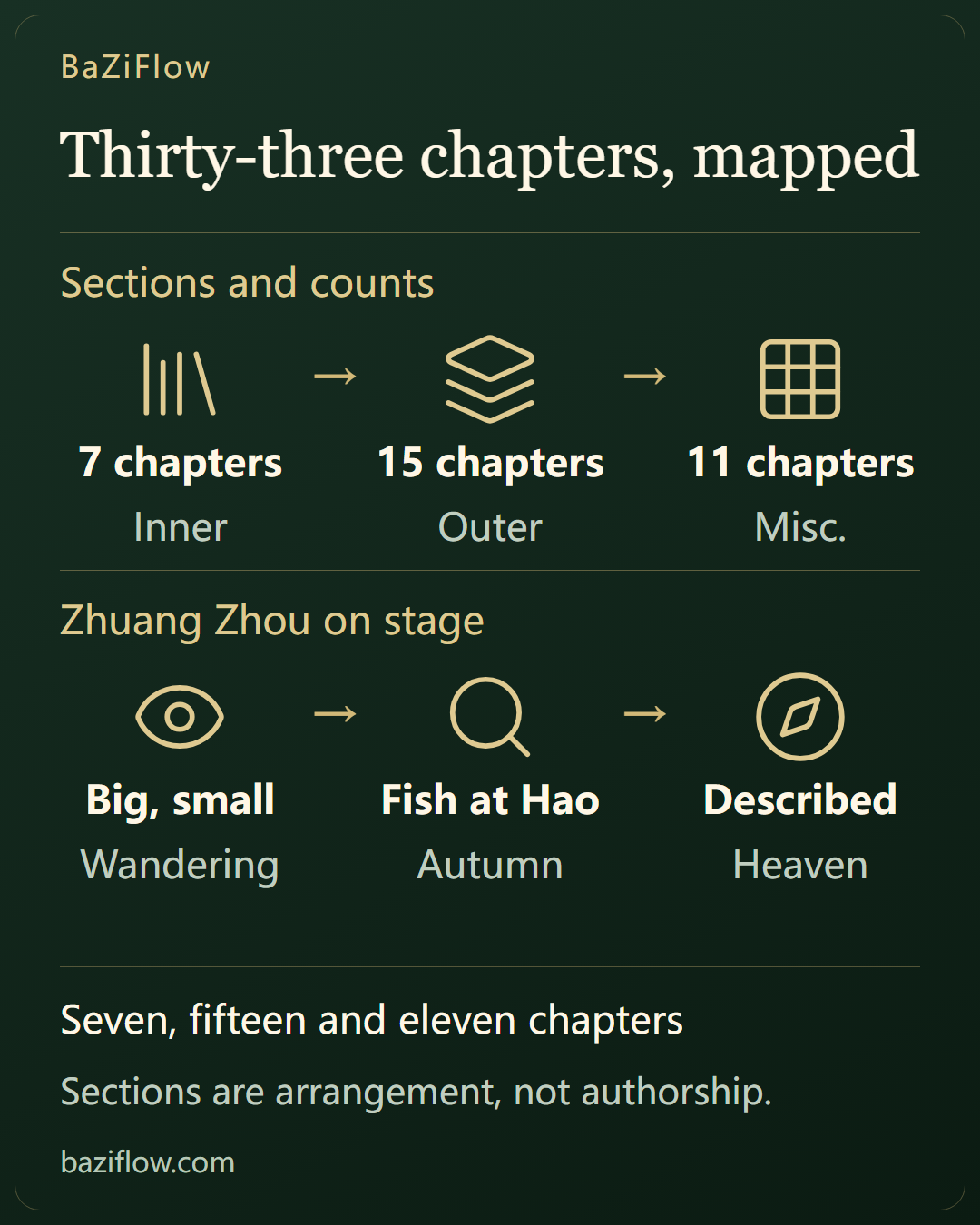
A map of the 33 received chapters separates the inner, outer and miscellaneous sections, then uses "Autumn Floods" and "All Under Heaven" to show how the book speaks of Zhuang Zhou.
The short version9 min read
The received Zhuangzi has thirty-three chapters in three sections: seven inner, fifteen outer and eleven miscellaneous. It does not speak in one voice, so before reading a line, find out which section it sits in and who is speaking.
- The order and the titles of the received text are fixed, so a quotation is best marked "section, chapter", for example inner section, "Free and Easy Wandering", and anyone can find it.
- All seven inner chapters have titles of three characters; the outer and miscellaneous titles mostly lift the opening words of the chapter or use the name of a person in it.
- Zhuang Zhou is both a speaker and a subject in the book: "Autumn Floods" and "All Under Heaven" both mention him, so the whole book is not one person speaking in one way.
Read first
Daoist Thought and Religious Daoism: Sorting the Books, the Name and the Religion ↗
Thirty-three chapters, three sections
The Zhuangzi most people read today is the received text, with thirty-three chapters grouped in order into seven inner chapters, fifteen outer chapters and eleven miscellaneous chapters. To quote a line, the safest way is to write "section, chapter", for example "inner section, Free and Easy Wandering".
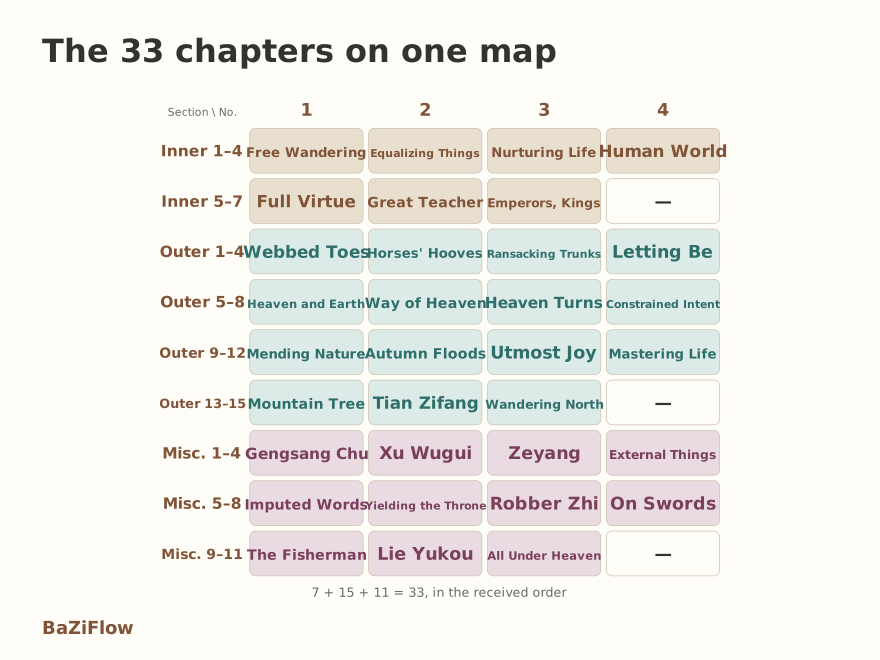
Chapter map in the order of the received text (the Guo Xiang edition). The sections are a later arrangement, not a ruling on authorship.
In the order of the received text, the chapters of the three sections are these (English titles are working translations, with the Chinese beside them):
- Inner (7): Free and Easy Wandering (逍遥游), Equalizing Things (齐物论), Nurturing Life (养生主), In the Human World (人间世), Signs of Full Virtue (德充符), The Great Ancestral Teacher (大宗师), Answering Emperors and Kings (应帝王).
- Outer (15): Webbed Toes (骈拇), Horses' Hooves (马蹄), Ransacking Trunks (胠箧), Letting Be (在宥), Heaven and Earth (天地), The Way of Heaven (天道), The Turning of Heaven (天运), Constrained Intent (刻意), Mending Nature (缮性), Autumn Floods (秋水), Utmost Joy (至乐), Mastering Life (达生), The Mountain Tree (山木), Tian Zifang (田子方), Knowledge Wanders North (知北游).
- Miscellaneous (11): Gengsang Chu (庚桑楚), Xu Wugui (徐无鬼), Zeyang (则阳), External Things (外物), Imputed Words (寓言), Yielding the Throne (让王), Robber Zhi (盗跖), Discoursing on Swords (说剑), The Fisherman (渔父), Lie Yukou (列御寇), All Under Heaven (天下).
This arrangement is traditionally attributed to the edition annotated by Guo Xiang (郭象) in the Jin period. The catalog of the Han period records a Zhuangzi of fifty-two chapters, many more than the present text, and the usual view is that later editors sorted and cut it down to the thirty-three that circulate today. "Inner, outer and miscellaneous" is therefore a later arrangement; the chapters themselves carry no such labels.
Seven inner titles, all three characters long
Every inner title is three characters long, and each reads like the main point of its chapter squeezed into one phrase.
Enlarge diagram · scroll sideways to read
The first three have articles of their own in this series: Free and Easy Wandering reads the quarrel between the great bird and the small birds, Equalizing Things reads the limits of right, wrong and speech, and the story in "Nurturing Life" is in Cook Ding carves the ox. Of the last four, "In the Human World" is about how to live among people, "Signs of Full Virtue" has characters who are bodily maimed yet full of virtue, "The Great Ancestral Teacher" speaks of life, death and the "true person", and "Answering Emperors and Kings" ends with the story of Chaos, whose seven openings are bored through.
The inner chapters already show two manners of writing. "Free and Easy Wandering" opens with the fable of the Kun and the Peng; "Nurturing Life" opens with an argument:
My life has a limit, but knowledge has none.
Both are inner chapters, yet one moves from story to argument and the other from argument to story. The manner is not uniform, which is a reminder that "inner section" is not one fixed genre.
Outer and miscellaneous chapters: where the titles come from, where Zhuang Zhou appears
Most outer and miscellaneous titles no longer state a theme. They lift the opening words of the chapter or use the name of a person in it. "Autumn Floods" begins with the words "when the autumn floods arrive", "All Under Heaven" with "of those who treat the arts of the world", and "Xu Wugui" and "Lie Yukou" are personal names.
Enlarge diagram · scroll sideways to read
"Autumn Floods" holds more than the River God's dialogue with Ruo of the Sea. It also has three short stories about Master Zhuang:
Master Zhuang in "Autumn Floods"
A tortoise that prefers the mud
Two officials come from the king of Chu. Without turning his head, Master Zhuang says a sacred tortoise would rather live and drag its tail in the mud than be honored as bones in a temple.
The phoenix and the rotten rat
Someone says Zhuang means to take Huizi's post. Zhuang tells of a bird of the south that flew past while an owl clutched a rotten rat and screeched at it.
"You are not a fish; how do you know?"
Zhuang says the minnows swim at ease and are happy; Huizi asks how he can know, and the two go back and forth.
In these stories Master Zhuang is a character, and his dealings with Huizi also appear at the end of the inner chapter "Free and Easy Wandering", in the huge gourd and the huge tree. Both sections write Zhuang Zhou as a person within the telling. Whether he is the writer of the whole book is a different question.
The words that "Autumn Floods" gives to Ruo of the Sea run close to the quarrel of big and small in "Free and Easy Wandering":
Seen from the small, the large cannot be taken in whole; seen from the large, the small cannot be made out clearly.
The same idea that what you see depends on where you stand is told in the outer section with a different cast and setting: the title is lifted from the first line, and the speakers are the River God and Ruo of the Sea instead of the Kun and Peng and the cicada and the dove.
"All Under Heaven": how the book speaks of Zhuang Zhou
The last miscellaneous chapter, "All Under Heaven", is a survey of the schools. It judges six groups in turn, and Zhuang Zhou stands fifth.
Enlarge diagram · scroll sideways to read
The first five groups are introduced by one formula: "the arts of the ancients lay in this ... and they heard of it and were glad", meaning each took a portion of the ancient way. When it reaches Zhuang Zhou, the writer describes how he spoke:
Goblet words (卮言) he lets flow on; weighty words (重言) he takes as true; lodged words (寓言) he takes as far-reaching.
Traditionally the three are read this way: goblet words are talk that flows on freely, weighty words borrow the standing of respected elders, and lodged words place a meaning in other people or things. What matters here is the position. "All Under Heaven" speaks of "Zhuang Zhou" in the third person and treats him as one school under review, not as the "I" who is speaking. Who wrote this chapter is not agreed in the tradition or among scholars; only its place in the text is used here.
In its opening survey, the line that the arts of the Way "are about to be torn apart by the world" treats every school as a fragment of an ancient whole. Read together with the order of the six groups, it can be set beside the survey of six schools in Daoism and religious Daoism.
Place a line before you read it
Put the pieces together and the book has at least three positions: a narrator telling a story, characters speaking inside it, and others talking about Zhuang Zhou. The same "Master Zhuang" carries different weight in each.
Enlarge diagram · scroll sideways to read
Go row by row. Row 1 opens the fable of the Kun and the Peng, told by the narrator. Row 2 is plain argument, with no character speaking. Row 3 is one of Ruo of the Sea's answers in his dialogue with the River God. Row 4 is the verdict of "All Under Heaven" on Zhuang Zhou, delivered by someone standing outside him.
With this map you can read chapter by chapter: begin with what the great bird and the small birds each say in Free and Easy Wandering, then see how Equalizing Things handles right and wrong, and finally return to Cook Ding carves the ox in "Nurturing Life".
Questions readers ask next
Were the inner chapters certainly written by Zhuang Zhou himself?
Tradition often treats the inner chapters as the part that best represents Zhuang Zhou, and gives the outer and miscellaneous chapters to later followers or others. Scholars disagree about who wrote which chapter and when, so this is a traditional way of reading, not a settled fact.
Where should a first-time reader of the Zhuangzi begin?
The inner chapters "Free and Easy Wandering" and "Equalizing Things" make a good start: the first unfolds through fables and the second through argument, and each is a clear example of its manner. The cook who carves the ox, in "Nurturing Life", reads well as a separate piece.
Who made the division into inner, outer and miscellaneous?
The usual view is that the division now in use comes from the annotated edition prepared by Guo Xiang in the Jin period. The Han catalog records a Zhuangzi of fifty-two chapters, a different number from today's, which shows that the arrangement of the book changed over time.
Was this article helpful?
Part of a learning path
Sources & references
Continue reading
Daoist Thought and Religious Daoism: Sorting the Books, the Name and the Religion ↗
Knowing Enough and Knowing When to Stop: "How Much" Versus "Where", Then Desire and Limits ↗
Free and Easy Wandering: What the Great Bird and the Small Birds Argue About ↗