

Birth-time uncertainty
Content version · · Sources & references
A small time error can cross a classification boundary or alter continuous coordinates. Trace its effect through each system and preserve what is stable, variable or unresolved.
The short version6 min read
Keep the candidate range and test the relevant boundary. Equal widths can produce different categories, while continuous positions may change even inside one category.
- Distance to a relevant boundary matters as well as uncertainty width.
- An approximate record, a wrong conversion and a different rule require different remedies.
- Stable means unchanged under tested conditions, not proven accurate; a recognisable story cannot select the input.
Read first
BaZi and Ziwei on One Question: Preserve Each Structure Before Comparing ↗
Six units of uncertainty, two different outcomes
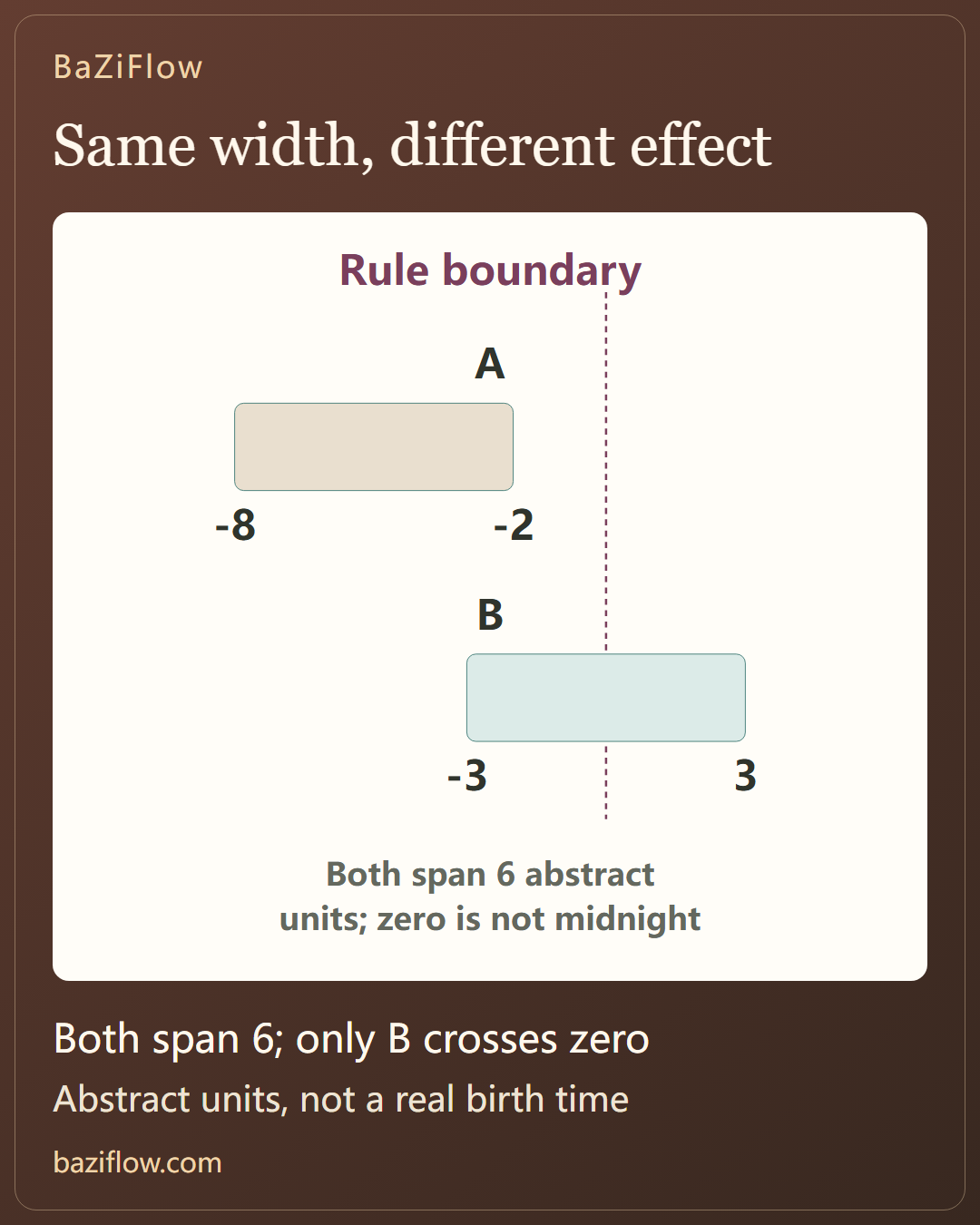
Consider an abstract boundary at zero. Interval A runs from minus eight to minus two. Interval B runs from minus three to plus three. Both are six units wide, but only B crosses the boundary. A classification rule can therefore remain stable throughout A and change within B, even though their uncertainty widths are identical.
This is why “How many minutes matter?” has no universal answer. The distance to a relevant boundary matters too. Continuous coordinates introduce a second issue: their numbers can change while the category name stays the same. Neither observation tells us that a life itself changes abruptly at a boundary.
The example is deliberately not a birth record. Its units are abstract and cannot be used to estimate a planet's speed, an Ascendant degree or a starting age. It demonstrates a way of handling uncertain input before interpreting a chart. Verifying birth data explains the separate task of organising the original records.
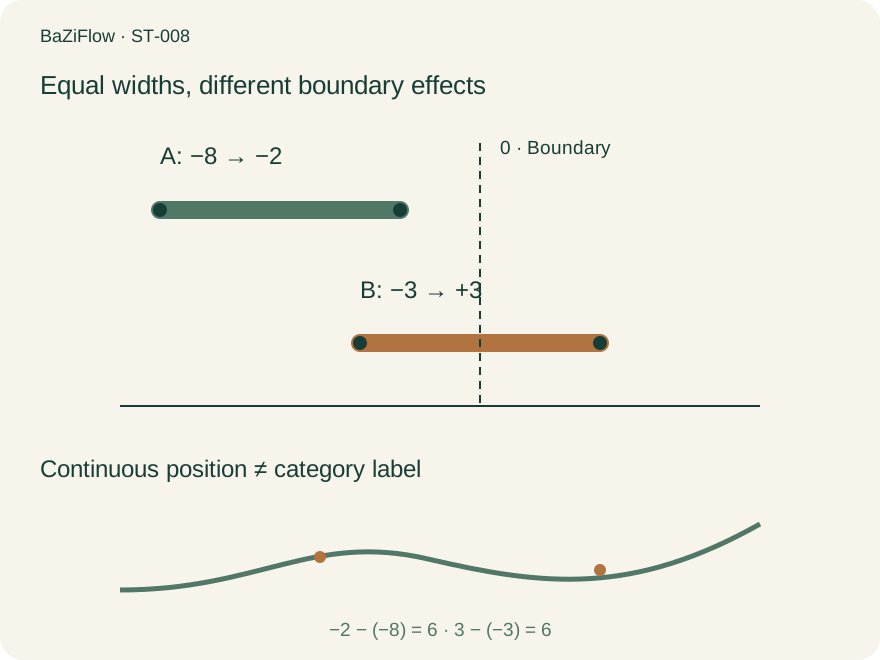
Original BaZiFlow schematic. Zero is an abstract rule boundary; the units are not a birth time or a planetary speed.
Rule boundary · 0
−10 ↔ 5
- A · -8–-2
- B · -3–3
Both span 6 abstract units; zero is not midnight
Locate the boundary before judging the range
- Input range
- The candidate interval supported by the record.
- Conversion error
- A wrong time-zone or similar processing setting.
- Method difference
- A different rule, such as a day-boundary convention.
An uncertain record is not the same as a wrong conversion
Start with the chain from record to conversion to rule to output. A remembered approximate time creates an input range. A wrong time-zone setting creates a conversion error. A different day-boundary convention creates a method difference. These problems need different remedies and should not all be described as an inaccurate birth time.
Keep the original clock notation alongside the converted value. Correcting a conversion does not prove that the original record was mistaken. Historical time-zone and daylight-saving arrangements need evidence for the relevant place and year; today's offset is not an adequate substitute. If that evidence is missing, mark the conversion as unresolved rather than supplying unsupported precision.
Two chart outputs can also differ because one program silently replaces an approximate time with an exact default. Before comparing interpretations, establish whether the inputs are actually equivalent. A polished result cannot recover uncertainty that was removed before calculation.
| Observed difference | First check | Preserve for comparison |
|---|---|---|
| A substantial fixed time offset | Zone and daylight-saving settings | Original notation and both conversions |
| A changed hour classification | Candidate interval and boundary rule | Both candidate labels |
| Changed angles or houses | Time, location and house settings | Outputs under matched settings |
| A much stronger narrative change | Which field triggered it | Field difference and original wording |
Each method has its own sensitive fields
The Bazi Hour Pillar involves a discrete hour classification. Near a day boundary or a relevant solar-term boundary, other pillar fields may also need checking. The time-field discussions in San Ming Tong Hui, volume 2, provide historical context for these distinctions. This article does not choose one disputed day-boundary convention for all schools. A changed minute does not automatically change all four pillars, but an unchanged hour label does not excuse ignoring the other settings.
Ziwei includes placement procedures that use birth month and hour, including those for the Life and Body Palaces. The placement instructions in Zi Wei Dou Shu Quan Shu, volume 2, are a traditional source for that dependency. When candidate times cross an hour boundary, trace the consequences through the actual rules. Do not claim that every star necessarily moves without checking which inputs each placement uses.
Western astrology uses time-dependent positions, angles and house calculations that cannot be reduced to a two-hour label. The Swiss Ephemeris house interface explicitly takes time, geographic latitude and longitude. Location therefore belongs in the comparison as well. Planetary positions and local angles need not respond to a time change at the same rate.
Avoid a fixed rule such as an Ascendant sign changing after an identical number of minutes everywhere. The particular position and geographic conditions matter. An average rate is not a substitute for a calculation at the relevant place and time. This article supplies no such calculation and does not rank traditions by sensitivity.
Discrete category
- A label may stay the same
Continuous coordinate
- Values may still change
Build a field comparison before requesting another reading
For a bounded candidate interval, calculate meaningful candidate points with the same settings and inspect relevant internal boundaries. The endpoints are a useful start, not a universal proof of stability: a rule could change within the interval and return to its earlier output. Select additional points because of a known boundary, not because another interpretation might sound more appealing.
Record three groups of fields. Stable fields did not change within the tested range and settings. Variable fields have named alternatives with reasons for the changes. Unchecked fields depend on missing information or an unverified rule. These are descriptions of the comparison, not accuracy scores. A stable field can still rest on a consistently wrong time zone.
An interpretation that depends on a variable field should preserve its condition. It may say that one reading applies under one candidate and another under the alternative, or leave that portion unresolved. There is no need to discard unrelated explanatory material merely because one field is uncertain. Equally, there is no justification for blending incompatible values into a single confident statement.
If the narrative changes far more dramatically than the chart fields, inspect that gap. A limited positional difference does not by itself justify a wholesale personality reversal. The author should identify the relevant dependency rather than using uncertainty as permission to produce any story.
Left endpoint
- State A
Interior
- State B
Right endpoint
- State A
Do not let a compelling story overwrite the record
Reading several candidate interpretations and selecting the one that feels most recognisable can create a misleading sense of precision. Personal recollection and broad statements offer many opportunities for a match. A good fit is not the same kind of evidence as a contemporaneous record, so it should not silently replace the documented range.
Traditional rectification practices also differ in their methods and supporting assumptions. If used, they should retain that label and their reasoning; they are not an automatic replacement for missing documentation. Later evidence can narrow a range, but the revision should record what changed and why.
The useful deliverable is a visible dependency map: these claims rely on stable fields, those remain conditional, and these inputs still need checking. It is not a claim that uncertainty has disappeared. If matched records still yield different charts, continue with settings to check when results differ before attributing the discrepancy to the person whose data is being entered.
New time document
- Revise the range?
- Verify and log the change
Recognisable story
- Revise the range?
- Keep as a response, not input proof
Compute the widths
For A, −2−(−8)=6; for B, 3−(−3)=6. The uncertainty widths are equal.
Check the boundary
Both endpoints of A are below zero. B has one negative and one positive endpoint, so it crosses zero.
Keep the conclusion narrow
The diagram tests classification only. It supplies no actual pillars, continuous coordinates or life event.
Questions readers ask next
Is there a universal safe number of minutes?
No. Examine the candidate range, relevant boundaries and continuous quantities under the actual settings.
Do equal endpoint outputs prove stability?
Not always. A rule can change inside the interval and return, so inspect relevant internal boundaries.
Can the most recognisable reading identify the time?
Recognition differs from documentary evidence. Preserve the range and label any rectification method and assumptions rather than silently replacing it.
Was this article helpful?