

Gu: wind beneath the mountain, taking charge
Content version · · Sources & references
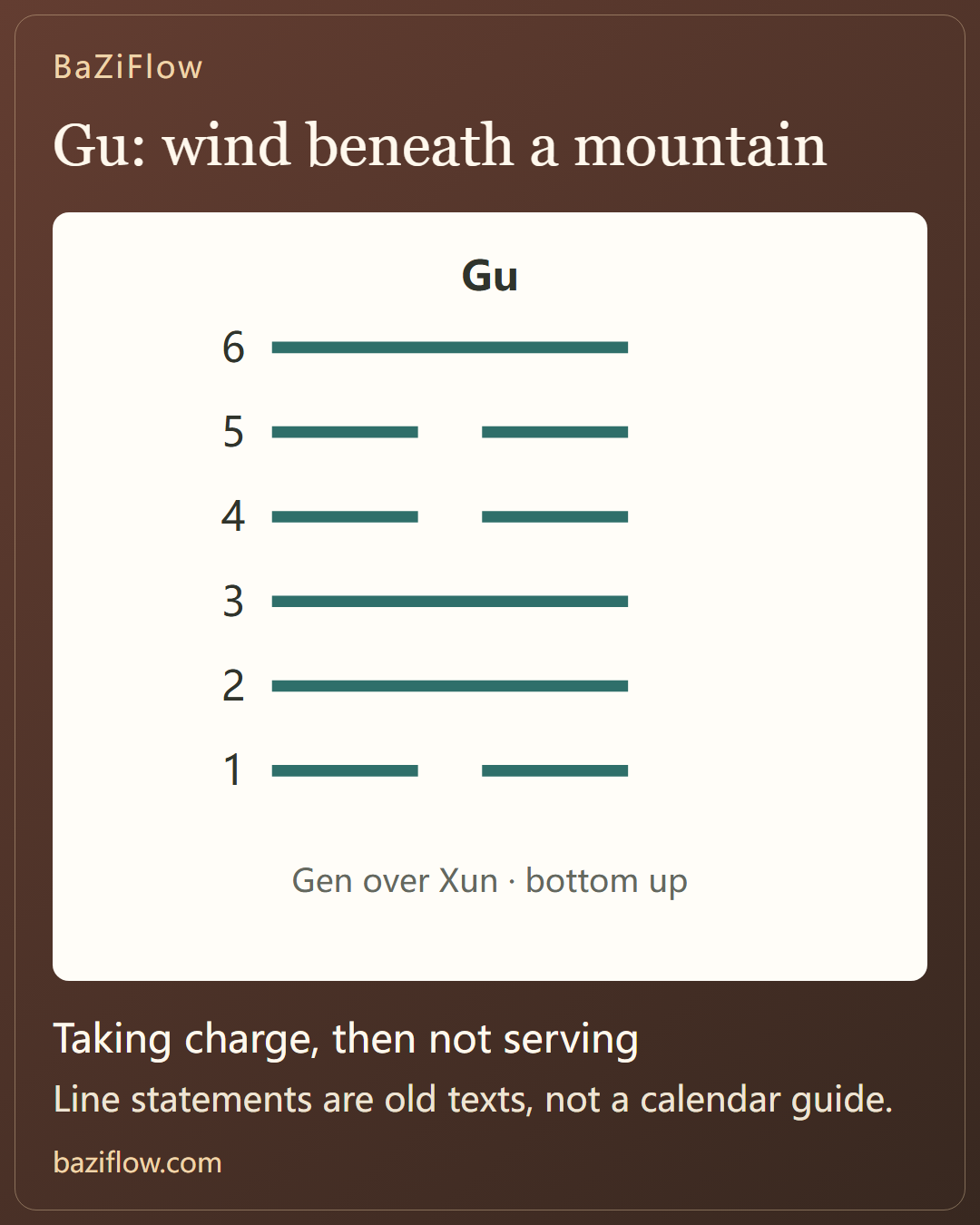
Gu is the 18th hexagram, wind beneath a mountain. "Three days before and after" can be counted on the ten stems, and the six statements run from taking charge of the father's affair to not serving kings.
The short version6 min read
The Xu Gua defines Gu in one word, "affair". The judgment counts three days either side of a stem day, and the six statements carry one verb, "take charge", up to the top line's "not serving kings and lords".
- Gu (蠱) is Gen (mountain) over Xun (wind), and the Commentary calls it "yielding and halting". Sui is both its inverse and its reversed form, and its nuclear hexagram is Guimei.
- The judgment's "three days before and after" counts on the ten stems as Yin Metal, Yang Water, Yin Water and Yin Wood, Yang Fire, Yin Fire; "the end brings a beginning" matches the cycle returning from Yin Water to Yang Wood.
- "Taking charge of the father's affair" appears three times, with one "mother's affair" and one "easing the father's affair"; only the top line contains the character for "affair".
Read first
The Sixty-Four Hexagrams: How Upper and Lower Trigrams Form One Figure ↗
Judgment and Line Statements: Whole Hexagram or Single Line? ↗
Wind beneath the mountain: the word "affair" first
Gu (蠱) is the 18th hexagram: Xun (wind) below, Gen (mountain) above, with the Great Image (大象) "beneath the mountain there is wind". Its yang lines are in places two, three and six; the other three lines are yin. Today the character is best known from words for bewitching, but the Xu Gua gives the name just one explanation: "Gu means affairs", things waiting to be handled.
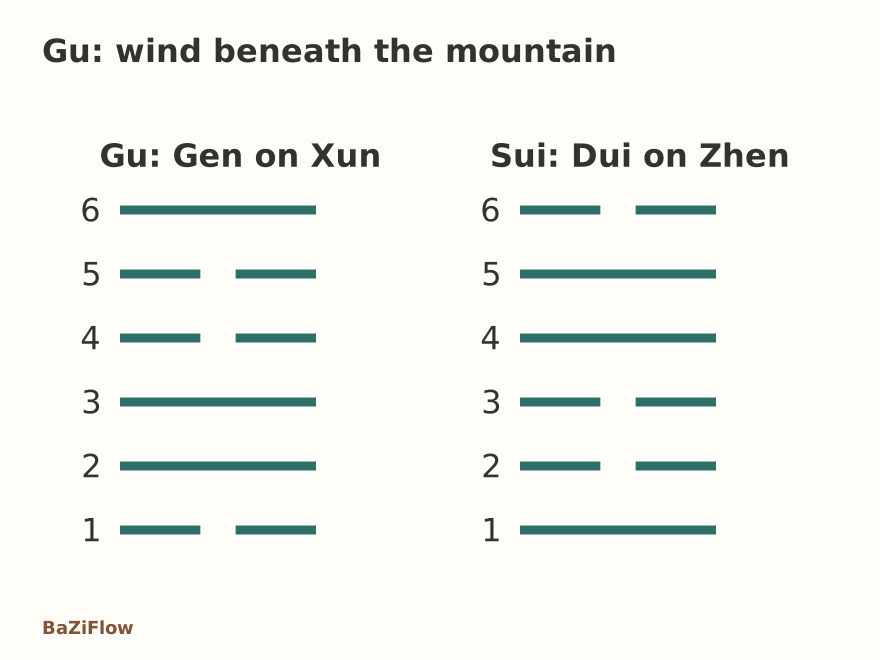
Gu and Sui: Sui is both the inverse and the reversed form of Gu.
Enlarge diagram · scroll sideways to read
Three terms before reading Gu
- Affair
- The Xu Gua says "Gu means affairs". In the statements, reading Gu as a matter to be handled stays closer to the text than reading it as decay.
- Xun and Gen
- The Shuo Gua says "Xun is entering" and "Gen is stopping", and the Commentary joins them as "yielding and halting": go in, then stop.
- To take charge
- A verb that keeps recurring in the statements: to manage, to handle, to set in order. "Taking charge of the father's affair" is to handle what the father left.
The Commentary on the Judgments (彖传) opens with "the firm goes up and the soft comes down", which the figure shows: the top line is yang (firm) and the bottom line is yin (soft).
The judgment: three days before, three days after
The judgment of Gu is "yuan heng; fitting to cross the great river; three days before Yang Wood, three days after". The first two clauses are easy; the last one has to be counted on the stems.
Gu: the firm goes up and the soft comes down; yielding and halting: this is Gu. Gu has great success, and the world is in order. "Fitting to cross the great river": to go is to have affairs. "Three days before Yang Wood, three days after": the end brings a beginning, which is heaven's movement.
Enlarge diagram · scroll sideways to read
The ancients counted days by the ten stems, which run in rounds of ten. Counting literally, the three days before a Yang Wood (甲) day are Yin Metal, Yang Water and Yin Water, and the three after are Yin Wood, Yang Fire and Yin Fire. The Commentary first explains "fitting to cross the great river": "to go is to have affairs". Then it explains the last clause: "the end brings a beginning, which is heaven's movement": Yin Water ends and Yang Wood returns, a round finishes and another starts.
The Great Image: rouse the people and nurture virtue
The Great Image of Gu is as short as the Great Image of Sui.
Beneath the mountain there is wind: Gu. The noble person stirs the people and nurtures virtue.
Enlarge diagram · scroll sideways to read
The first verb is usually read as to stir up or set in order, and the second as to nurture. In the image a mountain presses on the wind, and in the conduct there is one verb of stirring: the wind is held down, so people must do the stirring; and nurturing virtue lies the other way, inward. This is one reading; the text does not develop it.
The six statements: "take charge" all the way, then "not serving"
In the six statements, "take charge" appears four times, "ease" once and "not serving" once.
Enlarge diagram · scroll sideways to read
Line 1: "Taking charge of the father's affair: there is a son, the late father is without fault; danger, but good in the end." The punctuation of the middle part is disputed; the Small Image (小象) says "his intent is to carry on for the late father". Line 2: "Taking charge of the mother's affair: it is not to be held rigidly", and the Small Image says "he gets the middle way". Line 3: "Taking charge of the father's affair: a little regret, but no great fault"; the Small Image closes on "no fault in the end".
Line 4 changes the verb to "ease": "Easing the father's affair: going on, one will see shame", with "going on, he has not yet got it". Line 5: "Taking charge of the father's affair: praise is gained", with "he carries it on with virtue". The top line is written another way altogether: "Not serving kings and lords, holding his own affair lofty", and the Small Image says "his aim can serve as a rule".
Sui and Guimei: the neighbors of Gu, and why it follows Sui
Gu's inverse and reversed form are both Sui; how that works is explained in the article on Sui. Here we look at the nuclear hexagram: taking the second to fourth lines as the lower trigram (Dui) and the third to fifth as the upper (Zhen) gives Guimei (歸妹).
Enlarge diagram · scroll sideways to read
The Xu Gua sets Gu after Sui because following is sure to bring affairs:
A person who follows another gladly will surely have affairs on hand; therefore Gu comes next. Gu means affairs.
The hexagram after Gu is Lin, taken up in the next article.
Questions readers ask next
Does Gu not mean poison or bewitching?
That is how the character is often used elsewhere. Within the Zhouyi the Xu Gua explains the name in one phrase, "Gu means affairs", and the statements are about matters of father and mother to be handled. So it is best to read it first as affairs, not as poison or delusion.
Are you meant to pick one of those days?
The text only names three days before and three days after a stem day. Counting along the stems, the three before are Yin Metal, Yang Water and Yin Water, and the three after are Yin Wood, Yang Fire and Yin Fire; how that lands on actual calendar days has long been read in different ways, so say which reading you follow.
Why does line two, "taking charge of the mother's affair", say it is not to be held rigidly?
The word translated "held rigidly" means to hold firm, so the statement says this affair is not to be kept unchanged. The Small Image says he "gets the middle way", and line two is also the center of the lower trigram, which fits.
Was this article helpful?
Sources & references
Continue reading
Sui: thunder within the lake, from "tied to the youngster" to "held and bound" ↗
Lin: land above the lake, six modifiers for one word and a warning about the eighth month ↗
The Sixty-Four Hexagrams: How Upper and Lower Trigrams Form One Figure ↗
Judgment and Line Statements: Whole Hexagram or Single Line? ↗