

Direct Officer: one stem forms it, eight characters break it
Content version · · Sources & references
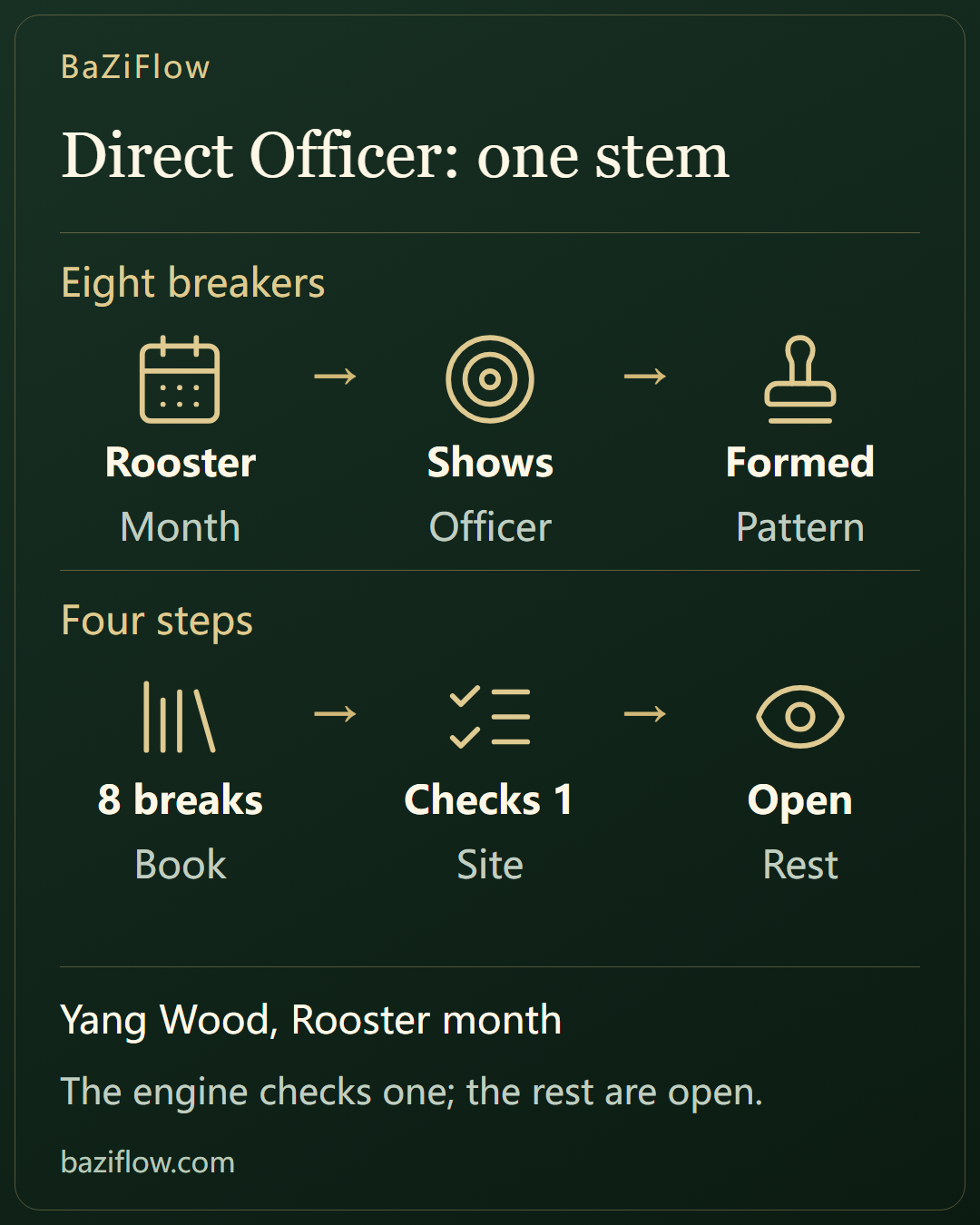
The Direct Officer pattern forms when the Officer hidden in the month branch shows on a stem. The Sanming Tonghui lists eight ways to break it; the site's engine checks only the Hurting Officer.
The short version9 min read
The Direct Officer pattern is named when the Officer hidden in the month branch also appears on a heavenly stem; every other character only matters as a check on whether that Officer was damaged.
- One condition forms the pattern: the Officer hidden in the month branch shows on a stem. With none showing, the site falls back to the main hidden stem in only eight clear-cut months, and marks it as not revealed.
- The Sanming Tonghui names eight characters for Yang Wood in a Rooster month. The engine's pattern step checks only the Hurting Officer; clashes, punishments, harms, combinations and Officer-plus-Killings do not lower it.
- For Officer and Killings together, the books offer "remove one, keep the other", and the same juan has a line that one need not cling to the month branch. Neither is the site's fixed rule.
Read first
BaZi patterns explained: how formation, disruption and assistance work ↗
Yang Wood in a Rooster month: one stem forms it, eight break it
In plain words first: a Direct Officer (正官) pattern means "the month branch hides an Officer star, and that Officer shows on a heavenly stem". For a Yang Wood Day Master the Officer is Yin Metal, and a Rooster month hides only one stem, Yin Metal. So Yang Wood born in a Rooster month with Yin Metal showing on a stem is the textbook Direct Officer pattern.
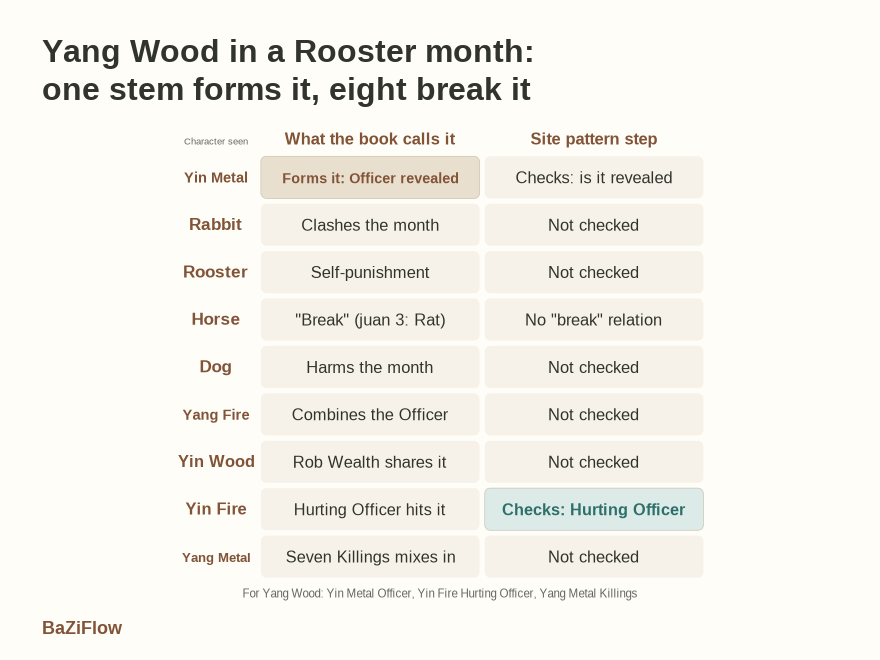
Nine characters for a Yang Wood Day Master in a Rooster month: the left column follows juan 5 of the Sanming Tonghui, the right is what the engine's pattern step really checks.
The table follows juan 5 of the Sanming Tonghui (三命通会), a Ming-dynasty compendium. The book calls the forming condition "hidden in the branch, revealed on the stem":
All of these are Officer stars in their proper qi; if one also shows among the heavenly stems, as Yang Wood meeting Yin Metal in a Rooster month, it is called hidden in the branch and revealed on the stem, and no further Officer should appear elsewhere.
"No further Officer elsewhere" means the Officer should stand in one place only. The book then lists the breakers in one breath: punishment, clash, break and harm; Hurting Officer and Seven Killings; greedy combining that forgets the Officer; Rob Wealth that shares the luck. For the Rooster month it names them one by one: the Rabbit is a clash, the Rooster a punishment, the Horse a break, the Dog a harm; Yang Fire combines, Yin Wood robs, Yin Fire hurts, Yang Metal mixes in.
How the site stamps the pattern
The engine first rules out the strict Follower and Exclusive patterns, then checks whether the month branch is the Day Master's Build Emolument or Yang Blade seat, and only then takes the pattern from the month: it looks among the month branch's hidden stems for one that shows on the stems. If none does, it falls back to the main hidden stem.
Enlarge diagram · scroll sideways to read
Two details matter. First, the Day stem does not count as showing: the person themself cannot be evidence for their own chart. Second, when a Yang Wood Day Master in a Rooster month shows Yang Metal but not Yin Metal, the site decides there is no evidence for Direct Officer versus Seven Killings and leaves the pattern undetermined, rather than forcing the main stem.
Officer and Killings together: remove one, keep the other
The character most likely to slip in beside the Officer is Seven Killings (Yang Metal for a Yang Wood Day Master). The note in juan 11 on the Xi Ji Pian (喜忌篇) splits the handling into two:
There is removing the Officer and keeping the Killings, and also removing the Killings and keeping the Officer.
How does one "remove"? The Ming Tong Fu (明通赋) in the same juan says the luck periods and years can clash it open or combine it away, and then the Officer is clear. The note gives a chart: Yang Water Rat, Yang Wood Dragon, Yin Earth Rabbit, Yang Water Monkey. For the Yin Earth Day Master, the month stem Yang Wood is Direct Officer. The Yin Wood hidden in the Rabbit day branch is Seven Killings, so Officer and Killings are both there. The Monkey hides Yang Metal, which combines with the Yin Wood and carries it off, leaving the Officer; the note calls the result noble.
The engine does none of this kind of rescue today. For Yang Metal Monkey, Yin Metal Rooster, Yang Wood Rat, Yang Fire Tiger, Yin Metal and Yang Metal both sit on the stems, and the engine still returns a Direct Officer pattern with purity "pure". The chart in the note, Yang Water Rat, Yang Wood Dragon, Yin Earth Rabbit, Yang Water Monkey, has none of the Dragon month's three hidden stems (Yang Earth, Yin Wood, Yin Water) showing, so the engine calls it undetermined, while the book files it under the Officer in the year-and-month position.
Di Tian Sui's measure of clear and turbid
The commentary under the "Clear and Turbid" essay of the Di Tian Sui (滴天髓) offers a wider ruler. Clear means a Direct Officer pattern whose Day Master is strong with Wealth, or weak with Resource, and with no Hurting Officer or Seven Killings; other Ten Gods may be mixed in so long as each has its place and does not wreck the pattern, and the chart still needs "spirit and momentum, neither dried out nor weak". Turbid is written like this:
A Direct Officer pattern with a weak Day Master: if Killings and Eating God are mixed in, they cannot hurt my Officer and instead quarrel with the Officer star; if Resource is mixed in, it cannot support me and instead fights the Wealth star. All of these make a turbid chart.
Three situations in the commentary
Strong with Wealth, weak with Resource
No Hurting Officer or Seven Killings; Companion, Eating God, Wealth and Resource may be present if each sits where it belongs.
Killings, Eating God or Resource mixed in out of place
They quarrel with the Officer star and fight the Wealth star, and the chart is unclear.
Clearing the turbid
One strong star, or a luck period that suits, sweeps the turbid qi away, and the commentary says wealth and rank can still come.
This ruler depends on Day Master strength: strong needs Wealth, weak needs Resource. The site's pattern step (pattern.ts) does not read Day Master strength; strength has a separate judgment. How the two read together is in how patterns form and break.
Dispute: the month alone, or wherever the Officer stands
Two sentences in the same passage of juan 5 point in opposite directions. The first says the pattern comes from the month; the second loosens it:
Enlarge diagram · scroll sideways to read
The later sentence reads:
To take the Officer star one need not cling to the month branch alone: the month stem, or any stem or branch of the year, day or hour, will serve, so long as it appears in one place and has not been damaged.
A second dispute is about Officer and Killings themselves. Juan 5 says that mixed Killings and Officer bring "poverty or an early death", and juan 11 says the mixture can be sorted by removal. The two can be read together as "mixed and left alone" against "mixed and dealt with", but neither gives the site a fixed answer on whether mixing alone should lower the grade, and the site has none either.
A chart from the book: Yang Earth Monkey, Yang Wood Tiger, Yin Earth Ox, Yang Fire Tiger
The note in juan 11 holds this chart up as an example of the month-command Direct Officer pattern. The engine agrees with the book: the Day Master is Yin Earth, the Tiger hides Yang Wood and it shows on the month stem, it is a Direct Officer pattern of purity "pure", and no Hurting Officer is on the stems.
Enlarge diagram · scroll sideways to read
One more detail. The year branch Monkey clashes the month branch Tiger, and the two also punish each other, while juan 5 puts clash and punishment first in its list of breakers. The note does not say how to treat this pair, and the site's pattern step does not lower the grade for it. Also, the Yang Metal hidden in the Monkey is Hurting Officer for a Yin Earth Day Master, but it sits only in a branch; the engine counts only Hurting Officer on the stems, so it gives no warning.
Find the Officer in the month
Whoever the Day Master is, the Officer is the stem that controls it with the opposite polarity; look for it among the month branch's hidden stems.
See whether it shows
It counts as showing on the year, month or hour stem; the Day stem does not count.
Then go down the breaker list
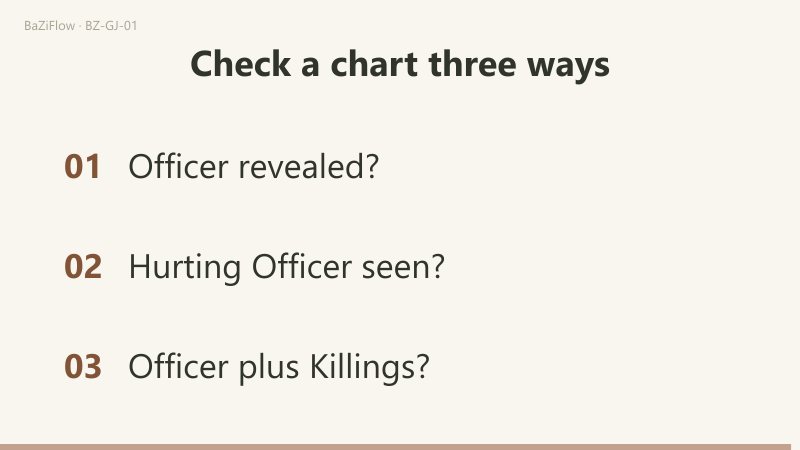
Hurting Officer, Seven Killings, combinations, Rob Wealth, clash, punishment and harm: note every item the book names, and which of them the engine checks.
The wider logic of patterns forming and breaking sits in how patterns form and break, and how favorable and useful gods are chosen is in the favorable, useful and unfavorable gods; where the Officer character itself comes from is in Direct Officer; the next Officer-line pattern is Seven Killings.
Questions readers ask next
Does a Direct Officer pattern mean an official career?
The pattern name answers one question: which Ten God is hidden in the month branch. The old books tied it to rank and status, which was the prediction language of their day; the engine gives the basis for the pattern and whether a Hurting Officer shows, and infers no career from it.
Is it still a Direct Officer pattern if no Officer stem shows?
The site keeps one fallback: when the month branch is Rat, Horse, Rabbit, Rooster, Tiger, Monkey, Snake or Pig, its main hidden stem is the Officer, and no Seven Killings stem of the same element shows, the main stem is taken and marked as not revealed. Dragon, Dog, Ox and Goat months must show a stem, or the pattern stays undetermined.
If Officer and Seven Killings both sit on the stems, is the pattern broken?
The books have two readings: juan 5 lists mixing among the breakers, while a note in juan 11 says one can be removed and the other kept. The site's pattern step does not lower the grade for it, so Yang Metal Monkey, Yin Metal Rooster, Yang Wood Rat, Yang Fire Tiger still reads as Direct Officer.
Was this article helpful?
Sources & references
Continue reading
Seven Killings Pattern: The Book's "Pure Killings" and the Engine's "Pure" Are Two Things ↗