

Yu: thunder from the earth, moving in accord
Content version · · Sources & references
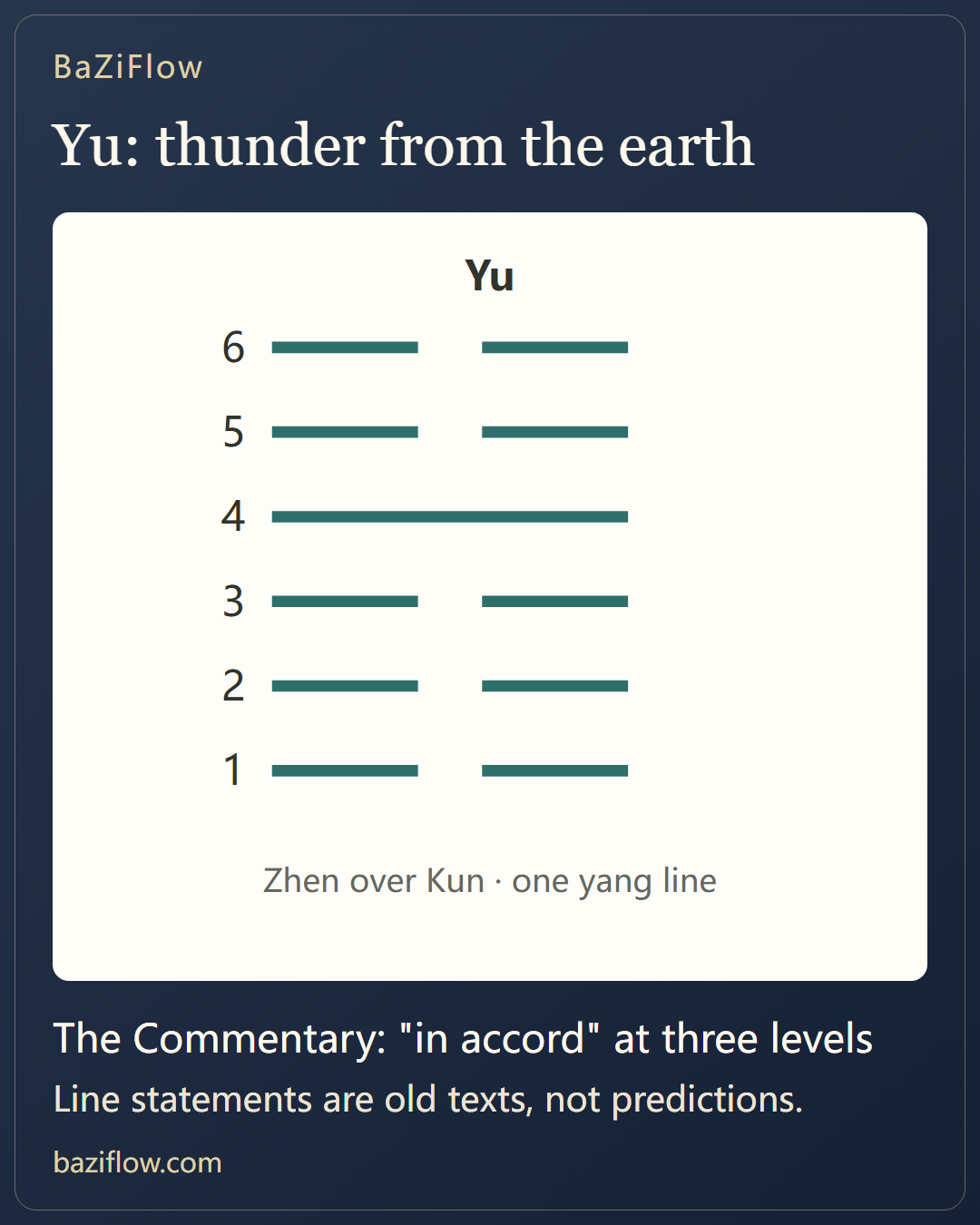
Yu is the 16th hexagram: thunder out of the earth, one yang line in the fourth place. The Commentary applies "moving in accord" at three levels, the Great Image answers with music, and Yu appears in four lines, not two.
The short version7 min read
The Commentary defines Yu in three words, "moving in accord", then repeats them for the hexagram, for heaven and earth, and for the sage, while the Great Image has the former kings answer thunder with music.
- Yu (豫) is Zhen (thunder) over Kun (earth). The Shuo Gua says Zhen is "moving" and Kun is "yielding", which gives the Commentary's definition; the fourth line is the only yang line.
- The Commentary applies "moving in accord" at three levels, the hexagram, heaven and earth, and the sage; the last two each bring a result: sun and moon do not overstep and seasons do not err, punishments are clear and people submit.
- The Great Image names the "former kings" and their acts: making music, honoring virtue, offering sacrifice. Lines 1, 3, 4 and 6 mention Yu; lines 2 and 5 do not.
Read first
The Sixty-Four Hexagrams: How Upper and Lower Trigrams Form One Figure ↗
Judgment and Line Statements: Whole Hexagram or Single Line? ↗
Thunder out of the earth: one yang line at the fourth place
Yu (豫) is the 16th hexagram: Kun (earth) below, Zhen (thunder) above. The fourth line is its only yang line, with three yin lines beneath it and two above it. The name is hard to carry into one English word, and the Commentary on the Judgments (彖传) defines it briefly: moving in accord.
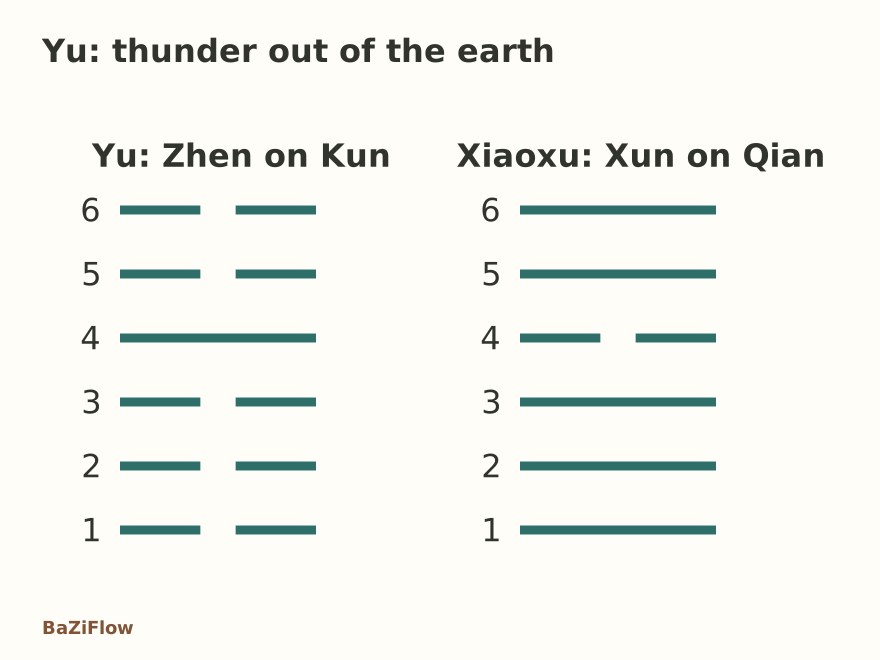
Yu and its inverse Xiaoxu: the lone yang line of one and the lone yin line of the other both sit in the fourth place.
Enlarge diagram · scroll sideways to read
Three things to hold on to
- Zhen and Kun
- The Shuo Gua says "Zhen is moving" and "Kun is yielding", and adds that thunder is what sets things in motion. One goes outward, the other gives way.
- Yu
- The Xu Gua sets it after "having much and being modest"; the Commentary defines it in one sentence: "moving in accord, this is Yu".
- The firm one
- The Commentary's opening, "the firm one is answered and its aim goes forward", refers to the fourth line: the yin lines answer it, and its aim finds a way through.
Kun below is accord and Zhen above is movement, so the two halves of the figure are the two halves of the Commentary's definition: to move by going along, not by pushing against.
The Commentary's "moving in accord": from hexagram to heaven and earth to the sage
The Commentary is long, but its skeleton is one phrase applied at three levels.
Yu is moving in accord, and so heaven and earth are like this, how much more in setting up lords and sending out armies! Heaven and earth move in accord, and so sun and moon do not overstep and the four seasons do not err; the sage moves in accord, and so punishments are clear and the people submit. The meaning of the time of Yu is great indeed!
Enlarge diagram · scroll sideways to read
The first level is the definition itself, and the Commentary repeats those words once more. The second widens it to heaven and earth: moving in accord, the sun and moon do not overstep and the four seasons do not err. The third level reaches human affairs: the sage moves in accord, so punishments are clear and the people submit. Between the first and second levels the Commentary asks "how much more in setting up lords and sending out armies", which picks up the judgment, "fitting to set up lords and send out armies". The last line is an exclamation of its own: the meaning of the time of Yu is great indeed.
The judgment and the Image: lords and armies, then music and virtue
The judgment is one clause: "fitting to set up lords and send out armies". The Great Image (大象) shifts the weight from government and war to music.
Thunder comes out of the earth and stirs: Yu. The former kings made music to honor virtue, offering it in splendor to the Lord on High with the ancestors alongside.
Enlarge diagram · scroll sideways to read
Most Great Images name the noble person as the actor; Yu names the former kings, and what they do is on a large scale: making music, honoring virtue, a sacrifice offered in splendor, with the ancestors ranked alongside. In the image there is a sound rising from the earth, and in the conduct there is music, so both ends are sound. That echo is visible in the wording, though the text itself does not point it out.
The six statements: Yu in four, silent in two
Lines 1, 3, 4 and 6 each carry the word Yu, with a different word before it: ringing, gazing up, comes through, in the dark. Lines 2 and 5 leave it out altogether.
Enlarge diagram · scroll sideways to read
Line 1: "Ringing delight: ill fortune". To announce the delight aloud is the fault, and the Small Image (小象) says "his aim is spent". Line 2: "Firm as stone; he does not wait out the day; staying on course brings good fortune", and the Small Image says "because he is centered and correct". Line 3: "Gazing up for delight: regret; delay brings regret as well". The verb is to look up with eyes wide, and the comment is "his place is not fitting".
Line 4: "Delight comes through him: a great gain. Do not doubt. His friends […]". The clause about friends has a character that is also written another way, and readers have understood it differently, so it is best held as uncertain. The Small Image's "his aim is carried far" answers the Commentary's "its aim goes forward". Line 5: "Persistently ill, yet constantly not dying"; the Small Image says this is because it "rides on a firm line", sitting right on top of the yang line, and "the center has not perished". Line 6: "Delight in the dark: it may be completed, yet it changes; no fault", with "how can it last?" as its comment.
Qian, Xiaoxu, Jian: the neighbors of Yu, and where the Xu Gua places it
Turn Yu upside down and you get Qian (謙, "modesty"), whose lone yang line has dropped from the fourth place to the third; the two are each other's reversed hexagram. The inverse is Xiaoxu (小畜), the right-hand picture at the top of this article: Yu's five yin lines and one yang line all reverse, giving five yang lines and one yin line, still in the fourth place.
Enlarge diagram · scroll sideways to read
The nuclear hexagram is Jian (蹇): the middle four lines are regrouped, with the second, third and fourth lines forming the lower trigram, Gen, and the third, fourth and fifth the upper, Kan. Lines three and four are each used twice, so the single fourth line of Yu becomes two yang lines in Jian.
The Xu Gua sets Yu after modesty, and goes on to say that from Yu there must be following, so the next hexagram is Sui:
Having great holdings and yet being modest, one is sure to be at ease; therefore Yu follows.
Questions readers ask next
Does Yu mean joy, readiness or ease?
The text never gives a single word. It has only the Commentary's phrase "moving in accord", acting in step with the situation. The Xu Gua places it after "great holdings and modest", and the Great Image brings in music, so it is safest to keep both gladness and readiness in view.
Why do two of the six lines leave out the word Yu?
Line 2 speaks of being firm as stone and not waiting out the day, and line 5 of a persistent illness that does not kill. Neither has Yu as its subject. They sit between "ringing" and "gazing up" below and "comes through" and "in the dark" above, and are easy to skip.
How should the phrase in line four, about friends, be read?
One character in it has a variant written with a different form, and its meaning has long been disputed. What stands firm is "delight comes through him; a great gain; do not doubt" and the Small Image's "his aim is carried far". Mark the friends clause as uncertain rather than filling it in.
Was this article helpful?
Sources & references
Continue reading
Qian (謙): a mountain within the earth, and what the Commentary says four times ↗
Sui: thunder within the lake, from "tied to the youngster" to "held and bound" ↗
The Sixty-Four Hexagrams: How Upper and Lower Trigrams Form One Figure ↗
Judgment and Line Statements: Whole Hexagram or Single Line? ↗