

The Magician: one hand up, one down
Content version · · Sources & references
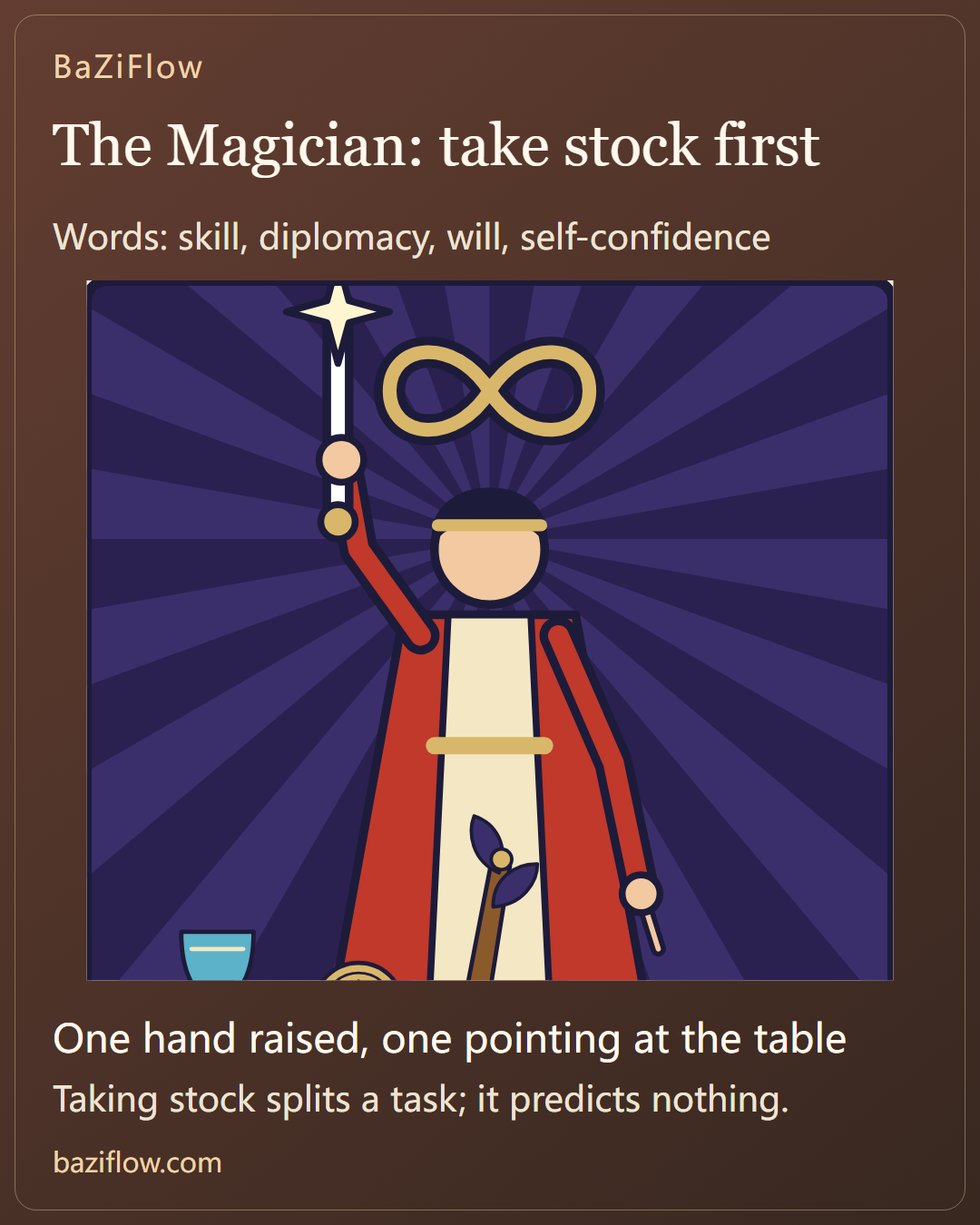
The Magician raises a wand with one hand and points to the ground with the other, four suit symbols laid out on a table. Separate Waite's picture, word list and symbols, then take stock of a handcraft job.
The short version7 min read
The Magician is a picture of hands: one raised to heaven, one pointing to earth, a table of laid-out things between them. Waite's word list also runs two ways: skill and will first, then sickness and the snares of enemies on the same line.
- Waite's picture: a youth in a magician's robe, a horizontal 8 above his head, a serpent for a girdle; a wand raised in the right hand, the left pointing to earth; the four suit symbols on the table, roses and lilies beneath.
- The divinatory list is packed into one line that holds both ability and will, and sickness, loss and enemies' snares; the reversed column likewise sets skilled roles beside troubles. Waite does not pick one half as the correct reading.
- As a practice it separates what you want to make from what is on the table: one line for the finished piece, an item-by-item count of what you hold, then the one thing that is missing.
Read first
Start with the picture: one hand to heaven, one to earth, a table between
Waite writes the Magician in the dense manner of Part II: a youthful figure in the robe of a magician, with the countenance of divine Apollo, a smile of confidence and shining eyes. Above his head is the sign he calls the mysterious sign of the Holy Spirit, the sign of life, like an endless cord, forming the figure 8 in a horizontal position. About his waist is a serpent-cincture, the serpent appearing to devour its own tail. In his right hand is a wand raised towards heaven, while the left hand points to the earth. On the table in front of him are the symbols of the four Tarot suits, and beneath are roses and lilies.
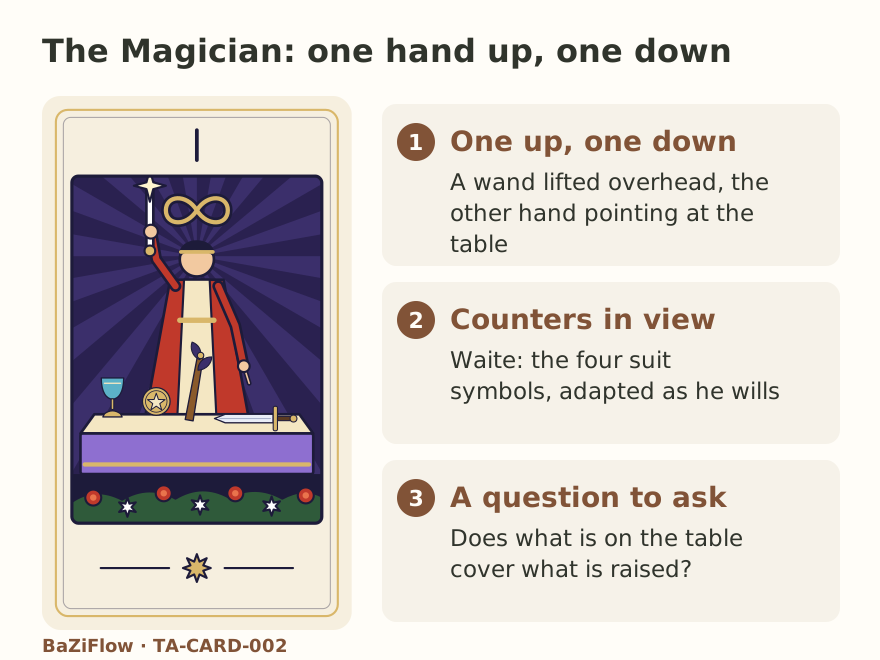
The Magician: BaZiFlow's original card with three prompts
Most of this can be seen on the Rider-Waite-Smith card itself: the Roman numeral I at the top and a yellow ground; a figure in a red robe over a white tunic, one hand holding a white wand high, the other pointing down; the horizontal 8 hovering overhead; on the table a cup, a coin with a five-pointed star and a sword; a vine of red roses hanging from above, and red roses and white flowers in the bed below. Break the picture into three layers from top to bottom: the sign of endlessness overhead, the two hands, one up and one down, in the middle, and the things laid out on the table below.
Enlarge diagram · scroll sideways to read
What Waite lists: ability and will, and on the same line sickness and snares
The Magician's divinatory meaning is a single line, and its words point several ways: skill, diplomacy, address, subtlety; sickness, pain, loss, disaster, snares of enemies; self-confidence, will; and the Querent, if male. The reversed list is: physician, Magus, mental disease, disgrace, disquiet.
Skill, diplomacy, address, subtlety; sickness, pain, loss, disaster, snares of enemies; self-confidence, will; the Querent, if male.
Enlarge diagram · scroll sideways to read
No word in the line is named as the correct one: skill sits beside disaster, self-confidence beside snares. The reversed list mixes in the same way: a physician and a Magus are skilled roles, yet mental disease and disgrace are in the same column.
The horizontal 8, the two hands, the table: who said what
The Magician carries a lot of symbols, and Part II spends a long passage tying them to "the Powers and Gifts of the Spirit". Setting what Waite states apart from what was borrowed later leaves three groups worth looking at.
Three groups of symbols and where each comes from
- Horizontal 8 and serpent girdle
- Waite calls the horizontal 8 an endless cord. The serpent devouring its tail is a familiar sign of eternity, which here he says indicates "the eternity of attainment in the spirit". He adds that Christian Gnosticism speaks of rebirth as a change "unto the Ogdoad", and that in Martinism 8 is the number of Christ.
- One hand up, one hand down
- Waite says this dual sign is known in very high grades of the Instituted Mysteries and shows the descent of grace, virtue and light, drawn from things above and derived to things below.
- The four things on the table
- The symbols of the four Tarot suits, which Waite says signify the elements of natural life, lying like counters before the adept, who adapts them as he wills. The roses and lilies beneath are wild flowers "changed into garden flowers" to show the culture of aspiration.
Enlarge diagram · scroll sideways to read
Reading the four things as "the tools and resources at hand" and the two hands as "an idea coming down to practice" is a modern analogy. It works, but Waite writes about spiritual gifts, so when you use it, say that it is borrowed.
How to read it: the raised hand names the piece, the pointing hand counts the table
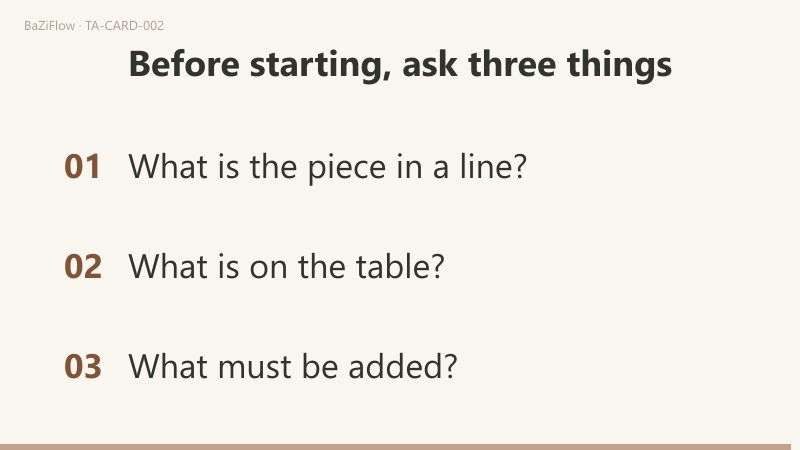
The card carries its own practice form: one hand raised above, one pointing below, and a table whose contents are laid out to be counted and "adapted as he wills". Carried over to a handcraft job it becomes three questions.
The raised hand: what is the piece?
The wand points to heaven. Before starting, write the finished piece in one line, with its use: for whom, where it will sit, what it is for. If it cannot be one line, the piece is not yet decided.
The pointing hand: what is on the table now?
The other hand points at the table. Put materials, tools and the hours you can actually free onto it, one item at a time. What can be counted counts; what you "plan to buy" does not.
What can be adapted?
Waite says he adapts these things as he wills. After the count, look at two things: which item will do after a small change, and which is truly missing and has to be added or asked for.
An example: you want to hand-stitch a leather card holder and give it to a friend by the weekend. The three questions turn "I want to make it" into three rows you can check:
Enlarge diagram · scroll sideways to read
After the count
Can be written down
- The piece in one line
- A list of what is on the table
Still unknown
- Whether you will like it
- How the friend reacts
Do next
- Add the missing item
- Test-stitch an offcut
Reversed and neighboring cards: physician, Magus, and three cards that also work with the hands
The reversed words follow straight on from the upright line:
Physician, Magus, mental disease, disgrace, disquiet.
The column has no "abuse" or "deceit"; those were added by later methods.
Three cards and where each puts the hand
A bag on the staff
The card just before. Waite has him holding a rose in one hand and a wand in the other, an embroidered wallet hanging from it; his things are kept in the bag and he is paused at the edge.
A craftsman at the bench
Waite writes an artist in stone at his work, which he exhibits as trophies; the list runs work, employment, commission, craftsmanship, "perhaps in the preparatory stage". Craft here is the daily labor.
A hand from a cloud grasping a wand
Waite writes a hand issuing from a cloud and grasping a stout wand; the list runs creation, invention, enterprise, a starting point. The wand is in the hand, and the table is not in the picture.
Enlarge diagram · scroll sideways to read
Questions readers ask next
Is the Magician simply the "capable, gets things done" card?
That is a common teaching summary and it catches only part of the list. In Waite's single line, skill, self-confidence and will sit beside sickness, loss and snares of enemies, and he does not pick one half as the correct reading.
What does the Magician mean reversed?
Waite's reversed words are physician, Magus, mental disease, disgrace, disquiet: skilled roles and troubling conditions side by side. Phrases like "abuse of power" or "deception" come from later methods, so say whose rules you are using.
What do the four things on the table stand for?
Waite says only that they are the symbols of the four Tarot suits, signifying the elements of natural life, lying like counters before the adept. Matching them to tools, materials and time is a modern teaching borrowing.
Was this article helpful?
Sources & references
Continue reading
The Fool: one step held at the edge, and two voices from Waite about one card ↗
Reversals are not a universal minus sign ↗
Numbered scenes and court figures: compare what the cards actually do ↗