

The four tarot suits
Content version · · Sources & references
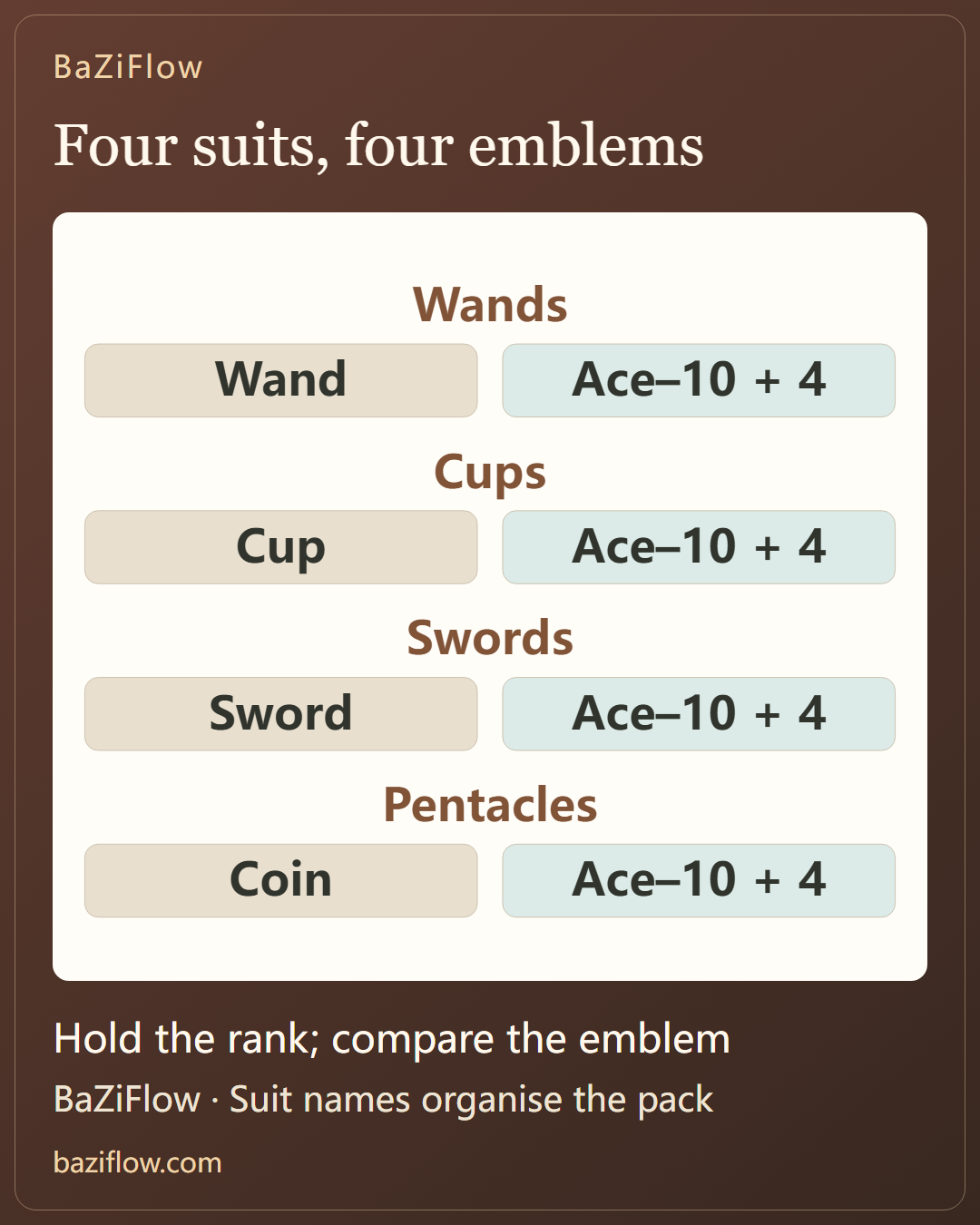
Wands, Cups, Swords and Pentacles each hold Ace through Ten and four court cards. Compare the four Aces, test slogans against the text and run a book-exchange exercise, treating suits as an index.
The short version6 min read
A suit helps you find a family of related images; it does not decide that a life question belongs to one group. Start with the object, ask a question, and look for the answer in real life.
- Wands, Cups, Swords and Pentacles each contain Ace through Ten and four court cards; a suit is an index to images, not a way to cut life into four.
- All four Aces show a hand, holding different objects; write "what the picture shows" before "what the author makes of it", and never merge the two steps.
- "Wands are career, Pentacles are money" is far narrower than Waite's own entries; in a review write what the exercise drew your attention to, not which suit you are.
Read first
A suit is an index, not a box
A study group sorts three selected cards and notices that none is a Cup. Before discussing anyone's personality, write the smallest statement the selection supports: no Cups appeared in this particular group.
Enlarge diagram · scroll sideways to read
Here the suit works as an index. Wands, Cups, Swords and Pentacles each contain Ace through Ten and four court cards. A suit helps you find a family of related images, but it does not decide that a given life question belongs to only one of them.
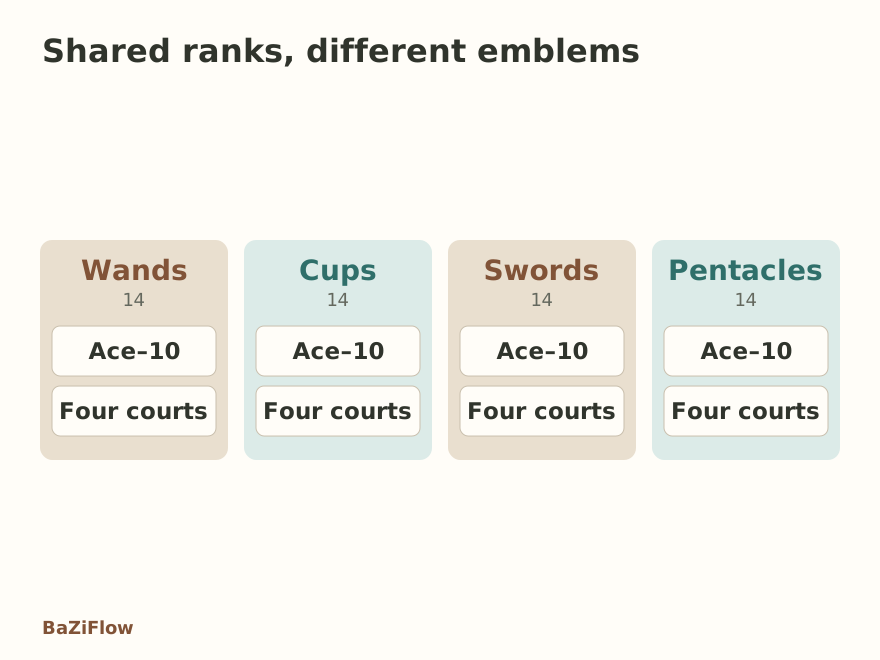
Suit sketch: equal columns mean parallel categories, not four areas of life, and imply no strength.
A more modest review might read: "This exercise pulled my attention toward arrangements and resources; I have not yet asked the people involved what they prefer." That sentence describes the reader's attention and names a practical omission. It does not turn a temporary selection into an identity label.
Put the four Aces side by side: each hand holds something different
A comparison works best when one condition is held steady and only the variation is observed. Set the four Aces side by side. In Waite's descriptions each has a hand, and what the hand holds differs:
Enlarge diagram · scroll sideways to read
A shared hand does not mean the four cards are one picture with the object swapped; each composition and each original entry still differs. Write what the image describes before writing what the author assigns to it.
Slogan against text: how much narrower is it?
Many mnemonics squeeze each suit into one word: Wands are career, Cups are love, Swords are communication, Pentacles are money. Waite's entries are wider than the slogans:
Enlarge diagram · scroll sideways to read
A rule that Wands can never concern resources, or that Pentacles can only concern cash, does not match the author's full text. These are observations about the writing. They do not establish his divinatory claims as facts about a reader's life.
A useful comparison sheet has three columns: what is visible, what the author says, and your proposed application. Leave a gap where nothing supports the connection. Four suits and four elements share a count, and a shared count is not evidence of a shared origin; if you add an element table, label it as the rule of the tradition you chose.
One situation, four entry points
This is an original practice case. A community library is preparing a book-exchange shelf. One volunteer offers to organise it, but the borrowing rules and the available space are still undecided. Take each object as an entry point and ask one question:
Enlarge diagram · scroll sideways to read
These prompts are a teaching exercise. They are not presented as the unique traditional meanings of the suits, and they cannot replace the details of a particular card. The four answers come from the volunteer, the readers and the library's real arrangements. A Cup does not speak for the readers, and a Pentacle does not announce a donation.
Compare within a suit and across a rank
Enlarge diagram · scroll sideways to read
If an interpretation survives when the card is replaced by any other member of its suit, look at the image again. Two cards do not have to be forced into opposite verdicts; they may add different observations about one problem. Numbered and court cards shows how to read their different materials.
When the four keywords will not stay in memory, go back to the objects in the four Aces and the differences in their entries, then read the structure of the 78 cards. Let the classification be a tool for finding material, not an answer that limits thinking.
Questions readers ask next
What does it tell me when a suit is missing from a draw?
Only that this particular selection had none. How many cards you draw, from what pool and by what handling all shape which combinations can appear, so the count alone is no evidence that someone lacks a kind of experience.
Are the four suits and the four elements the same set?
No. Both have four items, and equal counts do not prove a shared origin. If you use an element table, label it as the correspondence rule of the tradition you chose.
Does each suit cover only one kind of matter?
No. Waite's Ace entries are wider than the slogans: Wands also has an account involving money and Pentacles also speaks of contentment. A question can borrow material from several suits.
Was this article helpful?
Part of a learning path
Tarot: from the question to the review · Step 2 of 2 available