

Sword Edge Metal: Yang Water Monkey and Yin Water Rooster
Content version · · Sources & references
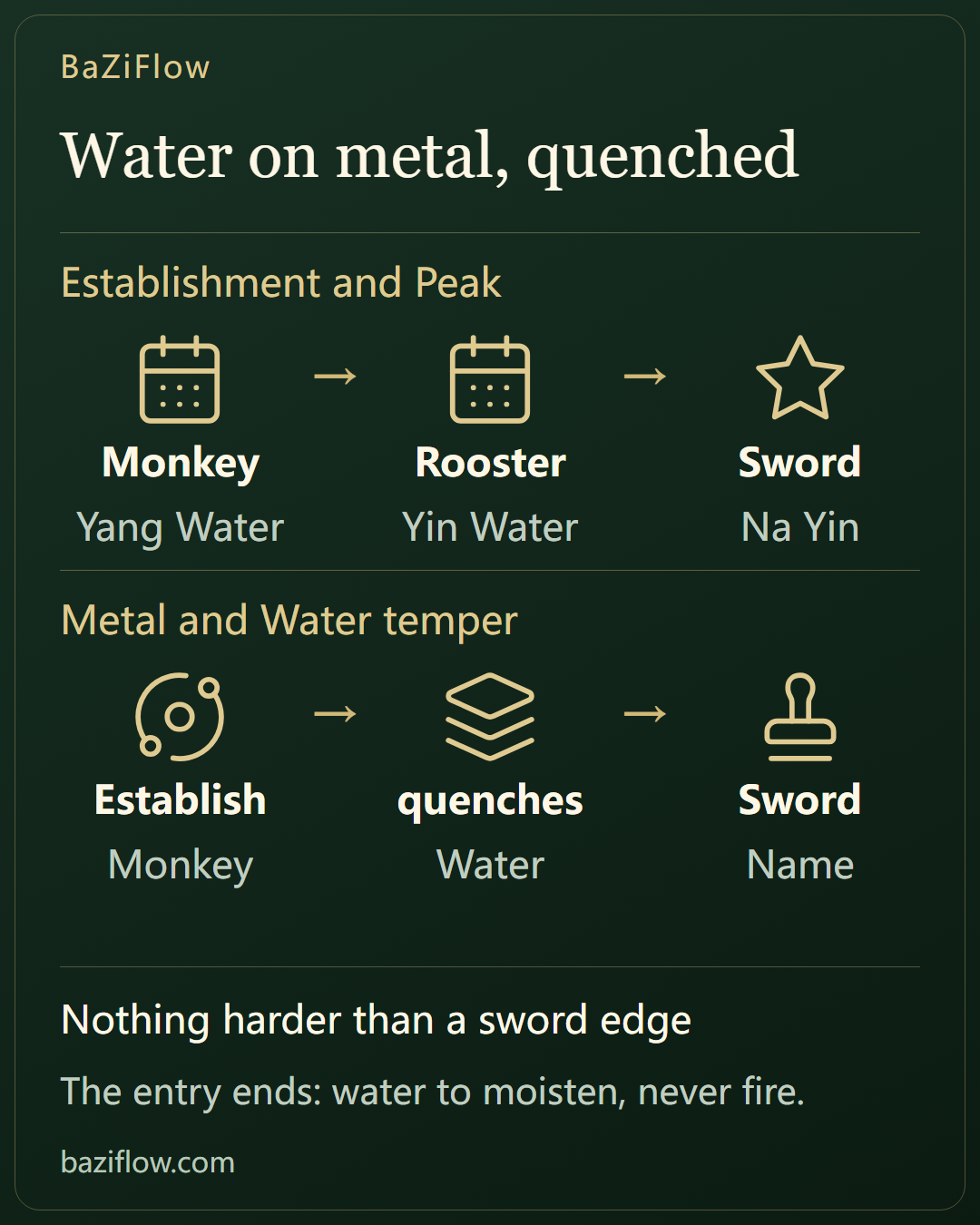
Yang Water Monkey and Yin Water Rooster share Sword Edge Metal. Check "Establishment on the Monkey, Peak on the Rooster" on the stage table, read the quenching image and its water-not-fire terms, and test the pairings.
The short version9 min read
"Nothing is harder than a sword edge": the Na Yin name of Yang Water Monkey and Yin Water Rooster rests on two layers, Metal at Establishment and Peak on the Monkey and Rooster, and the Water stems quenching it, so the whole entry turns on moistening by water and harm from fire.
- Both pillars are Water on Metal: Yang Water on the Monkey is at Growth and Yin Water on the Rooster at Weakening. The "metal" of the Na Yin shares an element with the branches but comes from a look-up of the whole pillar.
- The Sanming Tonghui calls the Monkey and Rooster the true place of Metal, at Establishment and Peak; metal that strong is hard, and nothing is harder than a sword edge. The stage table shows exactly those two positions.
- The entry says this metal "cannot be born without water" and suits moistening, not fire's punishment; its named pairings, Yang Water Dragon, Yin Water Snake, Yin Earth Ox and Yang Earth Rat, all find a counterpart in the harmony and Officer-star tables.
Read first
What is Na Yin in BaZi? Why Yang Wood Rat Gold in the Sea does not replace Yang Wood ↗
The keenest part of the blade: Yang Water Monkey and Yin Water Rooster
Yang Water Monkey (壬申) and Yin Water Rooster (癸酉) make up the fifth group on the Na Yin list, named Sword Edge Metal (剑锋金). The stems Yang Water and Yin Water sit on the branches Monkey and Rooster, which are Metal: each pillar is metal holding up water, and yet the name takes "metal", the keenest part of the blade.
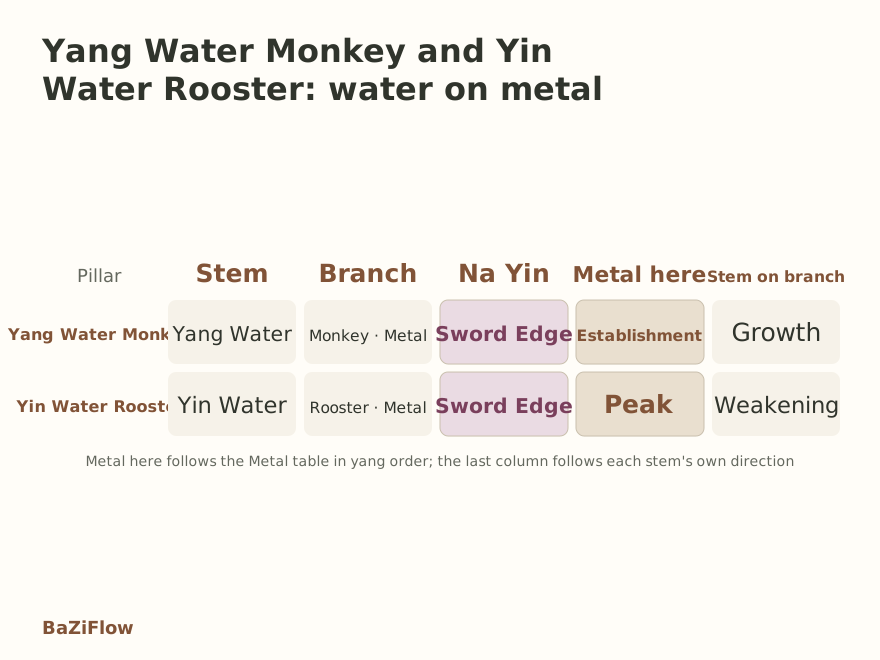
"Metal here" looks up Yang Metal in the site's twelve-stage table and "Stem on branch" looks up the Water stem itself; the Na Yin name follows the Sanming Tonghui.
The column "Metal here" gives the stages of the Yang Metal stem: Establishment on the Monkey, Peak on the Rooster. The column "Stem on branch" looks at the Water on top: Yang Water on the Monkey is at Growth and Yin Water on the Rooster at Weakening. The first column bears on where the name comes from, and the second on how the two halves of each pillar relate.
The true places of Monkey and Rooster: two strong positions, one keen edge
The Sanming Tonghui (三命通会) words the image for Yang Water Monkey and Yin Water Rooster like this:
Yang Water Monkey and Yin Water Rooster: the qi is full and things have reached their limit, ready to be gathered in; a blade breaks free with a sharp point. The Monkey and Rooster are the true place of Metal, the stems are Yang Water and Yin Water, and Metal and Water temper each other, so the image is the sword edge, and the use of Metal is at its utmost.
Three layers sit in this sentence: qi at its fullest has to be gathered into form; the Monkey and Rooster are Metal's true place; and the stems are Water, which tempers, like a blade that has been ground. A little further on the book reports the calendar specialists (日家), who put the same "true place" in the language of the twelve stages:
Yang Water Monkey and Yin Water Rooster: the Monkey and Rooster are the true place of Metal, with Establishment on the Monkey and Peak on the Rooster. Metal that is born and strong is indeed hard, and nothing is harder than the sword edge, hence Sword Edge Metal.
"Establishment on the Monkey, Peak on the Rooster" can be checked directly on the table: Metal is at Establishment on the Monkey and at Peak on the Rooster, its two strongest positions. When it is that strong, nothing is harder than a sword edge, which is the specialists' reason.
Enlarge diagram · scroll sideways to read
The book also sets this pair beside the group opposite it:
Yang Water Tiger and Yin Water Rabbit against Yang Water Monkey and Yin Water Rooster: gold foil and sword edge, the distinction of metal from wood, the difference of soft from hard.
Yang Water Tiger and Yin Water Rabbit are Gold Foil Metal. Metal is at Severance on the Tiger and at Conception on the Rabbit, its two weakest positions, while on the Monkey and Rooster it is at Establishment and Peak, its two strongest. The stems, Yang Water and Yin Water, are the same, the branches sit half a circle apart, and one is soft where the other is hard.
Metal bears water, water tempers metal: the book asks for water first
The entry opens by describing the sword as something that has to be worked:
Sword Edge Metal: the White Emperor holds power, its hardness comes from a hundred forgings, its red glow shoots to the Dipper and Ox, its white edge congeals like frost. This metal is made so that without water it cannot be born.
"The White Emperor holds power" says Metal is in season; "hardness from a hundred forgings" says the hardness is the result of repeated working; and "without water it cannot be born" is the condition that governs the whole entry: water is needed. That links back to the "Metal and Water temper each other" of the naming. The Water stems of the pillars are themselves that water, and the Monkey is Yang Water's place of Growth.
Further down, the entry sorts what Sword Edge Metal meets into water, fire and earth:
Enlarge diagram · scroll sideways to read
The last line is the summary:
In general the sword edge is the keenest of metals; it suits moistening by water and not the punishment of fire.
A blade turning into a dragon, and a punishment that must not be complete
These are the pairings the entry names for which the engine's tables have an answer:
Enlarge diagram · scroll sideways to read
What the tables show: Yang Water Monkey and Yang Water Dragon carry the Monkey and the Dragon, two of the three in the Monkey-Rat-Dragon water union; Yang Water Monkey and Yin Water Snake have the Snake and Monkey in a six harmony, which is at the same time a punishment, one pair of the Tiger-Snake-Monkey triple; and Yin Earth is the Direct Officer of Yang Water while Yang Earth is that of Yin Water. For Yang Water Dragon "turns into a green dragon" and Yin Water Snake "also fits" the book gives no reasons; the tables show one half union and one pairing that both harmonizes and punishes. The clause that follows in the original, "this sword cannot adapt", can be punctuated more than one way, so it is not credited to Yin Water Snake here.
The closing lines add "meeting the Tiger and Snake as a full triple punishment is very bad". That punishment group is Tiger, Snake and Monkey, and all three branches must be present to count as full. Yang Water Monkey carries the Monkey itself, so a Tiger and a Snake would complete it; the Rooster of Yin Water Rooster is no member of that group.
Spring 1993 begins at 03:37: Monkey gives way to Rooster
Yang Water Monkey belongs to 1992 and Yin Water Rooster to 1993; the cycle returns in 1932 and 1933 and again in 2052 and 2053. Each year pillar begins at a Start of Spring, and for these two the moments are (Beijing time):
Enlarge diagram · scroll sideways to read
Spring and the triple punishment
Born at 2 a.m. on 4 February 1993: Monkey year or Rooster year?
The turn of the year comes at 03:37, so 2 a.m. still belongs to Yang Water Monkey; from 03:37 on it is Yin Water Rooster, and both carry Sword Edge Metal.
A chart has Yang Water Monkey and a Tiger but no Snake. Is the triple punishment complete?
No. It needs Tiger, Snake and Monkey together, and only the Tiger and the Monkey are here, with the Snake missing.
Of the six Metal names this is the hardest; the softest, which the book sets against it, is Gold Foil Metal. In the sixty-cycle it comes after Earth by the Road and before Fire on the Mountain. Why the Na Yin layer is kept apart from stems and branches is explained in the Na Yin layer and the ordinary five elements.
The half union and six harmony in the table are told apart in harmony relations among the branches, and the triple punishment has its own page in clash, punishment, harm and destruction.
Questions readers ask next
Does a name like Sword Edge mean people with this pillar are sharp-tempered?
Sword Edge Metal is the traditional class name of the whole year pillar. The image comes from Metal holding strong positions on the life-stage table and does not describe the temperament of anyone born then. Counting the elements still treats the stems as Water and the branches as Metal, with Na Yin as a separate layer.
The stems are Water. Why is the name "metal"?
Because Na Yin is named from a traditional table for the whole pillar and not from the stem's element. The book's reason is that the Monkey and Rooster are the true places of Metal, which is at Establishment and Peak there, and the Water stems quench it, hence Sword Edge Metal.
What does the "triple punishment" have to do with Sword Edge Metal?
The closing line of the entry says that meeting the Tiger and Snake as a full triple punishment is very bad. That group is Tiger, Snake and Monkey, and all three branches must be present to count as complete. The Monkey of Yang Water Monkey is one of them; the Rooster of Yin Water Rooster is not in the group. This is a structure the table can check and no prediction about anyone.
Was this article helpful?
Sources & references
Continue reading
Earth by the Road (路旁土): Why Yang Metal Horse and Yin Metal Goat Carry This Na Yin Name ↗
Fire on the Mountain (山头火): Why Yang Wood Dog and Yin Wood Pig Carry This Na Yin Name ↗
Five Elements cycles: learn the relationships, not just the order ↗