

Encampment: month 1, day 1 and month 7
Content version · · Sources & references
Encampment (室) is position 23 on the 27-mansion ring. The site’s month table opens old-calendar month 1 with it, the sutra names month 7 after it, and the house table cuts it in two. Dates check each claim.
The short version7 min read
Encampment (室, Shitsu in Japanese) is position 23 on the site’s ring, after Rooftop and before Wall. It turns up in three places: the first day of old-calendar month 1 in the site’s table, the name of month 7 in the sutra, and the house table, which cuts it into three feet and one.
- The Japanese old calendar (new moon fixed by Tokyo time) opens month 1 on Encampment: new year fell on 10 February 2024, 29 January 2025, 17 February 2026 and 7 February 2027, all Encampment; the day before can be Rooftop or Encampment.
- The sutra names a month after the mansion holding the full Moon on day 15. In the site’s table month 7 opens on Extended Net, and 14 steps later is Encampment, which matches the sutra’s "month 7 is the Encampment month".
- In the house table Encampment has four feet, three in the Vase house and one in the Fish house, the only one of the six mansions from Rooftop to Stomach that a house boundary cuts.
Read first
What is Sukuyō astrology? How a birth mansion is found ↗
Sukuyō 27 mansions vs the 28 lunar mansions: what is the difference? ↗
The first day of the year starts the table at Encampment
The site’s day-by-day mansions come from a table that names the opening mansion of each old-calendar month and then steps forward one place per day. Its first entry is month 1, whose first day belongs to Encampment (室). “Old calendar” here means the Japanese one, with each new moon fixed by Tokyo time; it sometimes differs from the Chinese lunar calendar by a day, and the text says so where it matters.
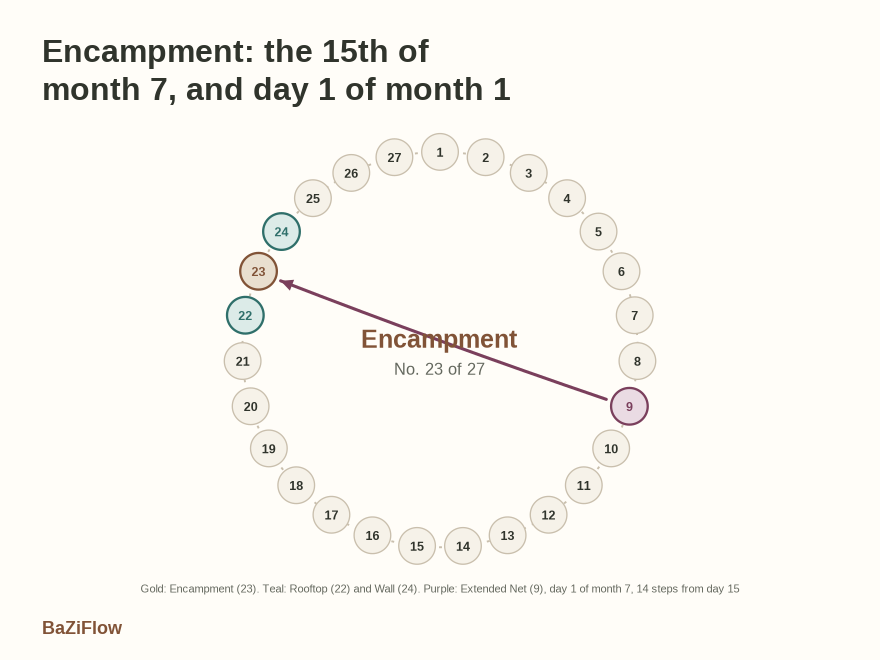
The ring lists the 27 mansions in the sutra’s order with even spacing, which says nothing about their widths in the sky; the number on the arc counts steps.
The gold circle is Encampment, position 23 on the ring, with Rooftop (危) before it and Wall (壁) after it. The purple circle, Extended Net (张), and the arc are used in the next section.
In Gregorian dates the old new year fell on these mansions: 10 February 2024, 29 January 2025, 17 February 2026 and 7 February 2027. All four first days of month 1 are Encampment.
One year needs a warning. In 2027 the new moon came at 23:56 Beijing time on 6 February, which was already 00:56 on the 7th in Tokyo, so the Japanese old new year is 7 February while Chinese New Year is 6 February. In 2024, 2025 and 2026 the two coincide. In the Japanese calendar 6 February 2027 is still day 30 of month 12, and it is also Encampment.
The mansion of the day before depends on how long month 12 is. Month 12 opens on Emptiness (虚); 29 steps on is Rooftop and 30 steps on is Encampment. In 2026 old month 12 had 29 days, so 16 February was Rooftop and Encampment followed; in 2024 it had 30 days, so 9 February was already Encampment and 10 February was Encampment again, two days running.
Enlarge diagram · scroll sideways to read
Why month 7 is the Encampment month
The sutra’s method for naming months is written in the passage on finding a day’s mansion:
To know the mansion of a day among the twenty-seven, first know the mansion of the full Moon of the month.
The list of month names puts the seventh month like this:
The seventh month is called the Encampment month.
The site’s table can check that. Month 7 opens on Extended Net, position 9; day 15 is 14 steps on, and 9 + 14 = 23, which is Encampment.
Enlarge diagram · scroll sideways to read
The sutra works out an example of its own:
Suppose the fifteenth of the second month is a Horn day: the fourteenth is a Chariot day and the thirteenth a Wings day ... the sixteenth is a Neck day and the seventeenth a Root day.
Month 2 opens on Legs (奎), and the site’s table gives Wings, Chariot, Horn, Neck and Root for the 13th to the 17th, day for day what the sutra’s example says. The other ten months are compared in the article on Hairy Head.
Enlarge diagram · scroll sideways to read
A house line cuts Encampment: three feet in the Vase house, one in the Fish house
At its start the sutra divides the sky into twelve houses of nine feet each. A mansion counts four feet, so 27 mansions make 108 feet, exactly nine for each of twelve houses. Encampment appears in two neighboring entries:
Seventh: Emptiness two feet, Rooftop four feet, Encampment three feet; Saturn sits there; its figure is a vase, so it is called the Vase house.
Eighth: Encampment one foot, Wall four feet, Legs four feet; Jupiter sits there; its figure is a fish, so it is called the Fish house.
Put the two entries on one axis of feet and the four feet of Encampment straddle the line between houses: the first three belong to the Vase house and the last one to the Fish house.
Enlarge diagram · scroll sideways to read
Among the six mansions from Rooftop to Stomach, only Encampment is cut: Rooftop lies entirely in the Vase house, Wall and Legs in the Fish house, and Bond (娄) and Stomach (胃) in the Ram house. The whole table of twelve houses is laid out in the article on Star.
The Encampment picture, and its days in each old month
The Encampment picture opens briefly:
Encampment has two stars, shaped like a cart shaft.
Jingfeng’s note also says two stars. It is one of the ten mansions whose two layers agree; the comparison is in the article on Rooftop.
In the site’s table Encampment falls on these days of each old-calendar month:
| Old month | Opening mansion | Encampment days |
|---|---|---|
| 1 | Encampment | 1 and 28 |
| 2 | Legs | 26 |
| 3 | Stomach | 24 |
| 4 | Net | 22 |
| 5 | Three Stars | 20 |
| 6 | Ghost | 18 |
| 7 | Extended Net | 15 |
| 8 | Horn | 12 |
| 9 | Root | 10 |
| 10 | Heart | 8 |
| 11 | Dipper | 5 |
| 12 | Emptiness | 3, and 30 in a 30-day month |
Day 15 of month 7 is the full-Moon day of the previous section; the other months slide 2 to 3 days sooner each time.
Two exercises
Which mansion is day 10 of old month 9?
Month 9 opens on Root, position 14; nine more steps, 14 + 9 = 23, give Encampment.
Which mansion is day 30 of old month 12?
Month 12 opens on Emptiness, position 21; 29 steps give 21 + 29 = 50, minus 27 is 23, Encampment. Only a 30-day month 12 has this day.
Just before Encampment on the ring is Rooftop, and just after it is Wall.
Questions readers ask next
Is day 1 of month 1 always Encampment?
In the NAOJ month table the site uses, yes. The Great Tang month chart Jingfeng built into the sutra instead writes Emptiness at day 1 of month 1. The two tables differ, and a separate article explains why, so check which table is meant first.
Is the Encampment month a month for people born in Encampment?
It has nothing to do with a person. The sutra names a month by the Moon: the mansion holding the full Moon on day 15 gives its name. On day 15 of month 7 that is Encampment.
What does it mean that Encampment sits in two houses?
The house table cuts the sky into nine feet per house while each mansion counts four feet, and the two scales do not divide evenly. A boundary therefore passes through some mansions, and for Encampment it leaves three feet on one side and one on the other.
Was this article helpful?
Sources & references
Continue reading
Rooftop (危): Two Meanings of One Character in the 27-Mansion System ↗
Wall (壁): Last of the Northern Mansions and the One Paired with Mars Day ↗