

Stem Combinations: A Pair Is Not Yet a Transformation
Content version · · Sources & references
The five stem pairs are easy to identify; transformation is a separate conditional claim. Check the pairing table, preserve the original stems, and state which chart layer and rules are involved.
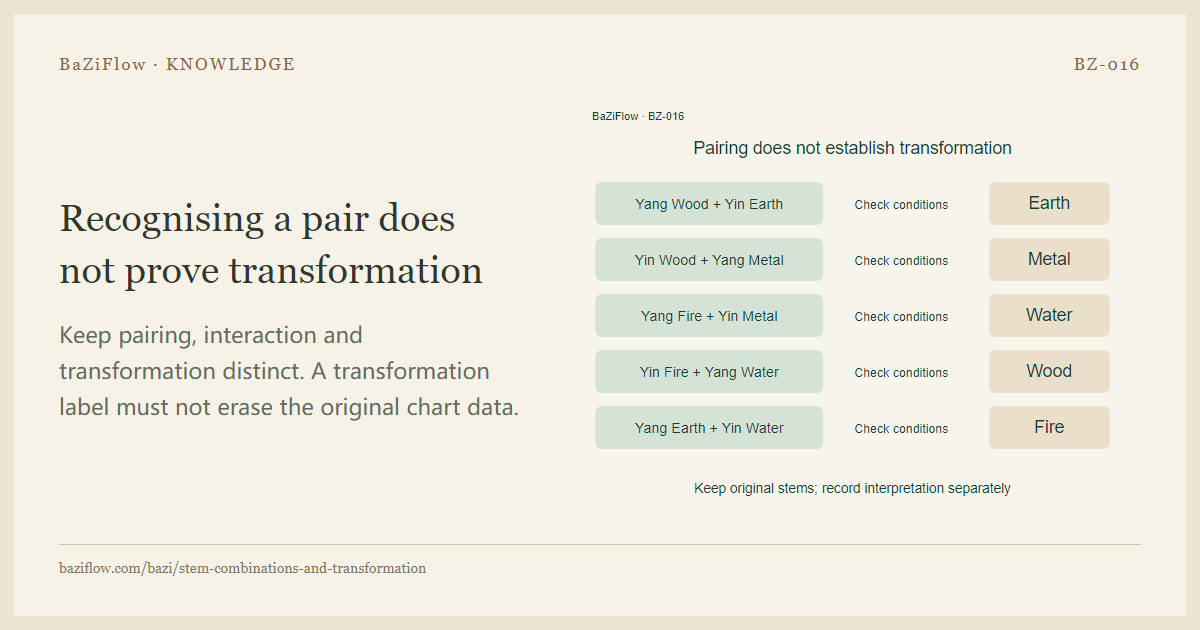
Keep pairing, interaction and transformation distinct. A transformation label must not erase the original chart data.
Read first
What the ten stems and twelve branches each do ↗
Five Elements cycles: learn the relationships, not just the order ↗
Do not overwrite the source record
Suppose an interpretation says that Yang Wood and Yin Earth transform toward Earth. Should a chart editor delete Yang Wood and replace it with Earth? No. The original stem and its position remain source data. Any combination or transformation belongs in a separate interpretive record, so that another reader can reconstruct the reasoning.
This distinction becomes especially important when two schools reach different conclusions. If one interpretation has already rewritten the stems, the second reader is no longer examining the same input. The result can contaminate Ten God labels and other relationships as well as the combination itself.
Five fixed pairs, five traditional directions
The Heavenly Stems follow a ten-item sequence. The Hong Kong Observatory's calendar material provides a reference for that sequence. The traditional pairings and their transformation directions are discussed in San Ming Tong Hui, volume 2. Aligning the first five stems with the last five gives each stem exactly one partner in the pairing table.
| First stem | Paired stem | Traditional transformation direction |
|---|---|---|
| Yang Wood | Yin Earth | Earth |
| Yin Wood | Yang Metal | Metal |
| Yang Fire | Yin Metal | Water |
| Yin Fire | Yang Water | Wood |
| Yang Earth | Yin Water | Fire |
Numbering the stems from one to ten gives pairs 1–6, 2–7, 3–8, 4–9 and 5–10. The five-position gap is a convenient check on memorisation. It is not a physical explanation or proof that transformation must occur. Each pair contains opposite polarities, but not every arbitrary yin–yang pair belongs to this table.
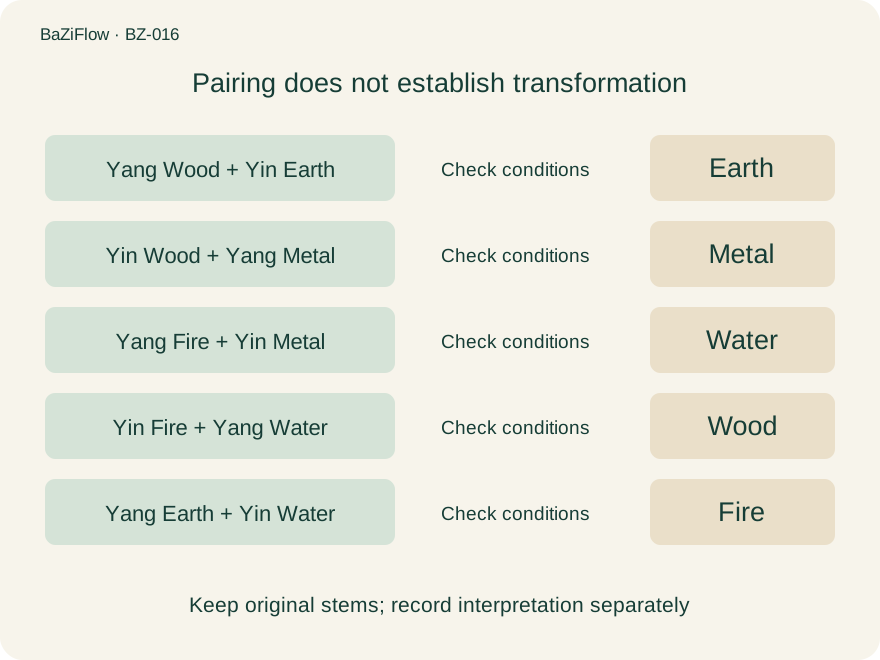
Original BaZiFlow diagram of five pairings and their conditional transformation directions; not an automatic replacement rule.
Which assertion has actually been established?
Recognition establishes that two identified stems belong to a listed pair. A further interpretation may discuss how they engage or constrain one another. Transformation asks whether the conditions for the corresponding transformed phase are satisfied under a particular method. Collapsing all three into the word “combine” hides how much work remains.
San Ming Tong Hui separates its discussion of stem combination from its discussion of transformation and includes seasonal and other conditions in the latter. Modern teaching also distinguishes a pairing from binding or restraint and from transformation, though the details and terminology vary. Placement, separation, roots, competing partners and supporting or obstructing factors may be treated differently across approaches.
This article does not turn one source's detailed conditions into a universal checklist. Nor does it nominate a single favourable condition as sufficient on its own. A software implementation needs to identify the rule version it uses, especially if it claims to decide transformation automatically.
“Transformation not established” also does not mean “no pair exists.” It does not prove that no interaction occurs. A more informative note is “the Yang Wood–Yin Earth pairing is present; conditions for Earth transformation have not yet been confirmed.” The wording preserves the established observation and the unresolved interpretation separately.
The same two names in three contexts
First, put Yang Wood and Yin Earth on two unlabelled cards. Their pairing is recognisable, but positions and time layers are unknown. Second, identify them as two visible stem positions in one natal chart. A chosen method can now investigate placement within that chart. Third, make Yang Wood natal and Yin Earth an annual layer. That is a different relationship; the annual stem must not be quietly inserted into the natal record.
If there are several instances of either stem, specify which positions are being related. Connecting every matching character to every other one may duplicate relationships without establishing additional transformations. The same caution applies to separate people: a stem in a comparison chart is not a stem in the current chart.
These examples contain no complete birth data and therefore offer no verdict that transformation occurs. They are an evidence exercise: identify the participants, their positions, their chart ownership and time layers, then apply a named rule. A diagram full of lines is less useful than a small number of correctly scoped relationships.
Read the tradition without inheriting every analogy
Classical explanations often use marriage imagery and attach period-specific gender or character judgments to the combinations. Learning the structural pairing does not require adopting those judgments. It certainly does not establish a modern person's character or guarantee a romantic outcome whenever two stems appear together.
The original record should remain readable even if an interpretation is later revised. Preserve the stems and add the proposed relationship, its supporting conditions and any uncertainty. That approach allows a disagreement to be located in the evidence or rule, rather than concealed in a changed input.
Branch combinations are another set of structures, not a different name for these five stem pairs. Continue with six harmony, three harmony and directional assemblies, and use the generation and control cycles when checking phase directions. Pairing, transformation direction and ordinary generation or control should remain separate questions.