

Calculate day-group void and month clash separately
Content version · · Sources & references
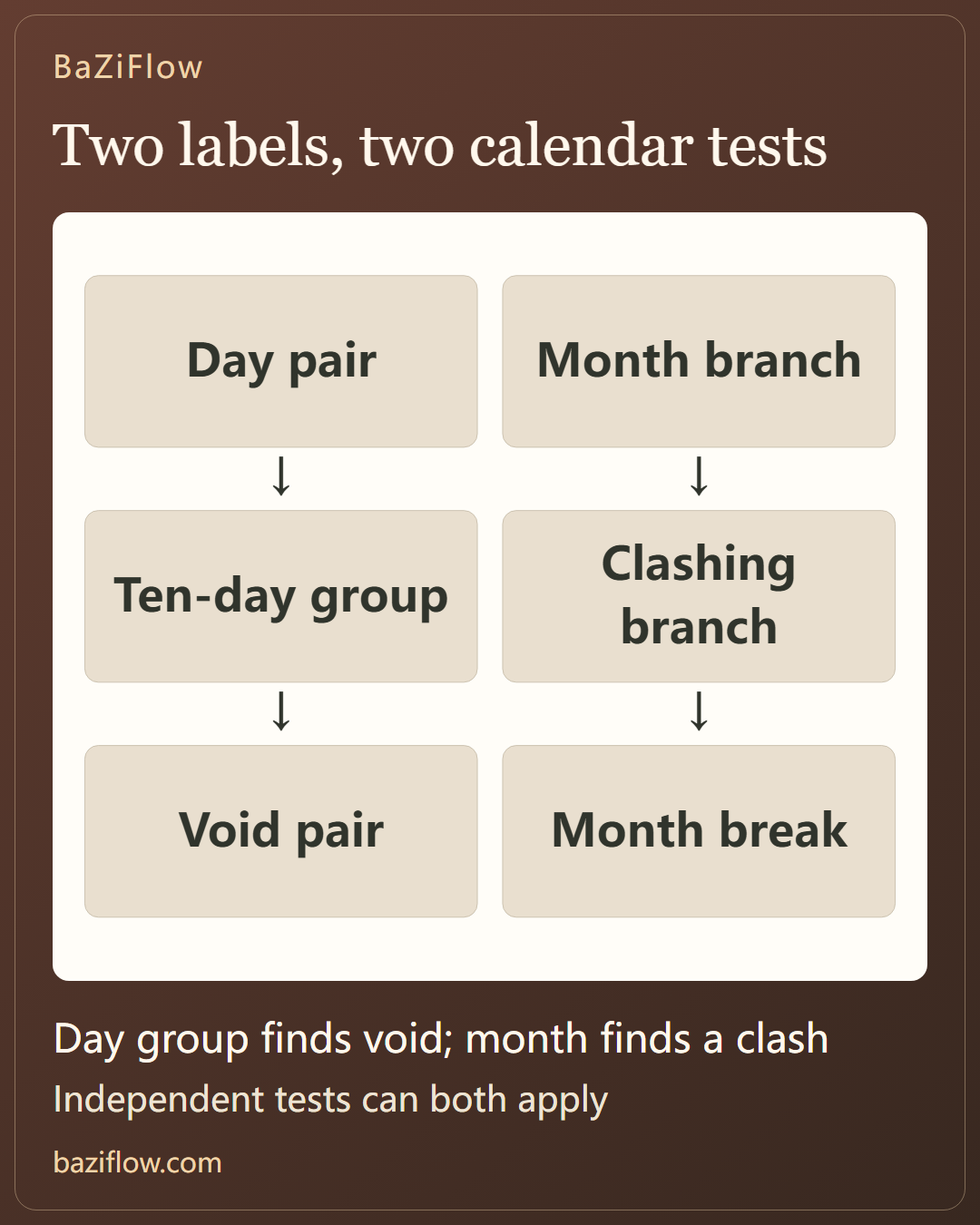
Compare supplied Dragon-month inputs on Yin Wood Ox and Yang Wood Dog days to separate the day-group void pair from month clash without inventing an outcome.
The short version7 min read
Cycle void comes from the day’s ten-pair group; month break comes from the branch that clashes with the month. Dog receives both labels in Dragon month on Yin Wood Ox day, but only month break on Yang Wood Dog day. Separate inputs make the difference reproducible.
- Use the complete day pair to locate its group and identify the two omitted branches.
- Month break requires month-branch clash, which is distinct from phase control or day clash.
- Keep calendar assignment separate from strength assessment, and check group and month boundaries independently.
Read first
Month and day effects: preserve the evidence behind strength ↗
The two labels need different inputs
Cycle void and month break are independent classifications in the Liuyao approach used here. Cycle void is derived from the ten-day stem-branch group containing the casting day. Month break is derived from a clash between a line's branch and the month branch. One line can satisfy both tests, just one, or neither.
Keeping two fields matters. Replacing both with a generic “weak” label loses the information needed to check the calculation. Nor does either label, on its own, prove that an object is absent or that a real undertaking has failed.
This lesson follows Zengshan Buyi's day-cycle and month-branch conventions. The examples supply traditional calendar labels directly. They are not claimed conversions of particular modern dates, and no complete hexagram or personal question is supplied. Day, month, and strength introduces their wider interpretive roles.
Why a Yin Wood Ox day belongs to a Dog-Pig void group
Start a group at Yang Wood Rat (甲子) and advance stems and branches together for ten days. The first entry is Yang Wood Rat, the second is Yin Wood Ox (乙丑), and the tenth is Yin Water Rooster (癸酉). Each step advances both cycles by one place. The stems have completed their ten-item cycle, while the branches have covered Rat (子) through Rooster (酉). Dog (戌) and Pig (亥) have not appeared.
Those two missing branches are the void branches for the Yang Wood Rat group. Yin Wood Ox is its second day, so a line bearing Dog or Pig receives the day-cycle void label in that example. The source's cycle-void chapter explains the construction and provides all six groups.
| Group begins with | Void branches |
|---|---|
| Yang Wood Rat | Dog and Pig |
| Yang Wood Dog (甲戌) | Monkey (申) and Rooster |
| Yang Wood Monkey (甲申) | Horse (午) and Goat (未) |
| Yang Wood Horse (甲午) | Dragon (辰) and Snake (巳) |
| Yang Wood Dragon (甲辰) | Tiger (寅) and Rabbit (卯) |
| Yang Wood Tiger (甲寅) | Rat and Ox (丑) |
The relevant group is not the first, middle, or final third of a Gregorian month. The complete day stem-branch pair identifies it. A day stem alone, or a day branch alone, is insufficient. This article also does not substitute a year or hour group for the stated day group.
Yang Wood Rat group
- Dog / Pig absent
Yang Wood Dog group
- Monkey / Rooster absent
Month break comes from a clash, not missing branches
Now give the example a Dragon month. Dragon clashes with Dog, so a Dog line meets the month-break test. Pig does not clash with Dragon. Although Dog and Pig share the same void group on Yin Wood Ox day, they do not both become month-broken.
The source's month chapter defines month break through the month branch clashing with a line. Its clash chapter lists the six pairs: Rat–Horse, Ox–Goat, Tiger–Monkey, Rabbit–Rooster, Dragon–Dog, and Snake–Pig.
A useful counterexample is Horse month and a Rooster Metal line. Horse Fire controls Metal, but Horse does not clash with Rooster. The branch that clashes with Horse is Rat. Month control and month clash must therefore remain distinguishable. A clash involving the day branch is also not automatically month break; the source treats day-induced conditions separately.
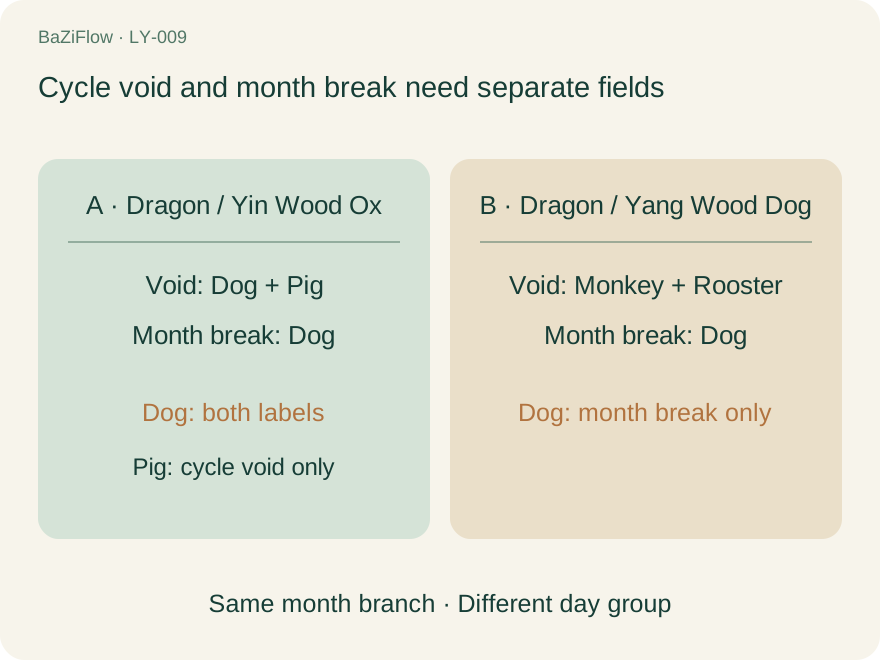
BaZiFlow comparison of two independent supplied calendar inputs. The cards compare classifications, not complete predictions.
Pig shares voidness, not this clash
Change the day group while preserving the month test
In a second independent example, retain Dragon month but specify Yang Wood Dog day. Yang Wood Dog begins a group whose absent branches are Monkey and Rooster. Dog is therefore not void by this day-group test. Yet Dragon still opposes Dog, so the Dog line remains month-broken.
| Supplied input and line | Cycle void | Month break |
|---|---|---|
| Dragon month, Yin Wood Ox day: Dog | Yes: Yang Wood Rat group | Yes: Dragon clashes with Dog |
| Dragon month, Yin Wood Ox day: Pig | Yes: Yang Wood Rat group | No: Dragon does not clash with it |
| Dragon month, Yin Wood Ox day: Dragon | No: not in Dog–Pig pair | No: matches the month |
| Dragon month, Yang Wood Dog day: Dog | No: Yang Wood Dog group omits Monkey–Rooster | Yes: Dragon clashes with Dog |
The second card does not assert that both dates fall inside one particular historical Dragon month. It supplies a separate input to isolate the changing field. The Dog line's phase has not changed; its day-group membership has. Likewise, a “No” in either column says only that this particular test is not met. It does not certify the line as free of every other constraint.
Yin Wood Ox day
- Dog: void + broken
Yang Wood Dog day
- Dog: broken only
Interpretive qualifications should not erase the calculation
The cycle-void chapter discusses conditions such as strength, movement, and support when considering whether voidness is effective. The month chapter, however, warns against simply erasing the within-group condition because a line matches the month. Reading one short maxim from each passage can create an apparent contradiction. The cycle-void chapter also counts month break among the situations it calls void; this lesson still stores the two labels in separate columns so that each calculation can be traced to its own source, without denying that usage.
A transparent record can distinguish the calendar classification from the named school's assessment of available strength and timing. It can say that a branch belongs to the day's void pair, then separately explain why an author discusses support, delayed use, or ineffective action. This distinction is a reading discipline; it is not a claim that all historical disputes about true and false voidness have been settled.
The source also describes repeated casting as part of its response to difficult cases. That historical method should be identified honestly, without turning this exercise into instructions to keep casting until a preferred answer appears. The calculation table itself does not require another cast.
Before connecting either state to an outcome, establish the question and selected useful line. Then retain the relevant movement, support, and constraints. Two state labels cannot substitute for those missing inputs or be converted into an invented fixed score.
A ten-day group ends within the sexagenary sequence. A month branch changes at the boundary adopted by the calendar convention. Those events need not coincide. Real dates close to a day or solar-term boundary require a stated timezone and conversion convention; the first day of a civil month cannot stand in for every boundary.
Here, no year, clock time, or complete casting record is supplied, so no future date is manufactured. Nor does crossing a boundary guarantee success in the world. The verified result remains specific: Dog is both void and month-broken in the first input, while it is month-broken but not void in the second. Later interpretation can add conditions without rewriting that original comparison.
Questions readers ask next
Can the stem Yin Wood alone identify the Dog–Pig void pair?
No. Yin Wood occurs in several different ten-day groups. The branch completes the pair needed to locate the correct group. A missing branch must be supplied before calculation; a previous reading’s group cannot fill that gap.
Does absence of month break mean no monthly influence?
No. It only rules out this particular month-clash test. The month may still generate or control the line’s phase. A negative result for one classification is not evidence that every monthly relation is absent.
Does leaving the ten-day group remove month break?
No. That boundary calls for recalculating the day group. Whether the month branch changes requires a separate calendar check. Preserve the before-and-after inputs and their labels instead of treating one boundary as a substitute for the other.
Was this article helpful?
Sources & references
Continue reading
Choosing the useful god: define the subject and retain candidates ↗
Return generation and control: direction before interpretation ↗