

Saving evidence and uncertainty
Content version · · Sources & references
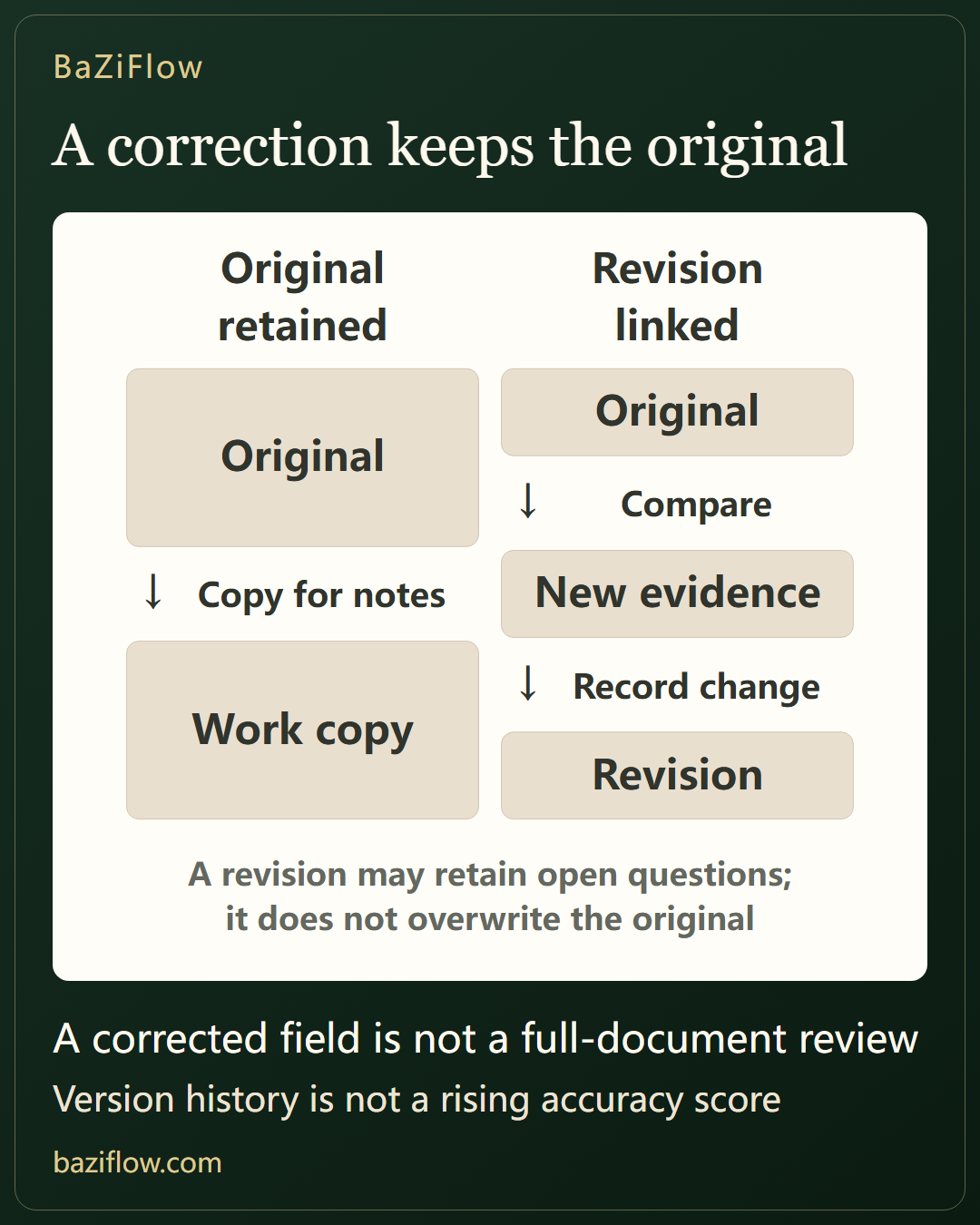
Organize a reading around recoverable claims, source locations, processing choices and unresolved questions. Preserve the old version when new evidence changes a field or interpretation.
The short version6 min read
If a setting is corrected next month, can you identify the claims that depend on it? A connected record of source, processing and conclusion makes that question answerable.
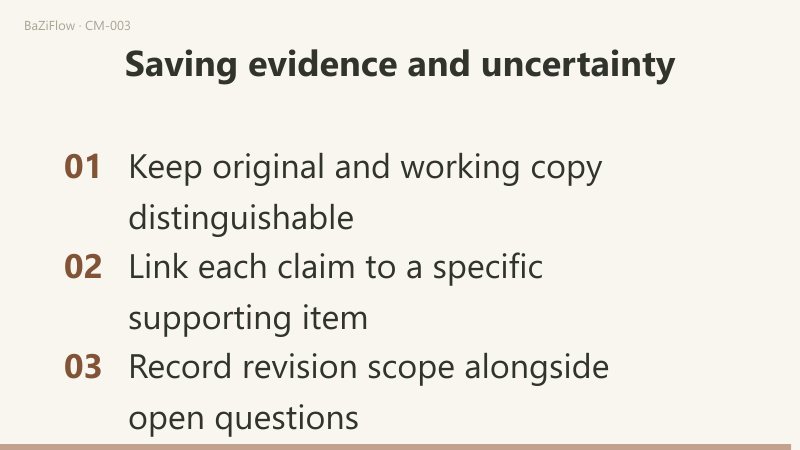
- Keep the original separate from annotation and sharing copies.
- Attach a claim to an actual field or passage, retaining the intervening reasoning.
- State old and new values, evidence and impact; unreviewed parts stay unreviewed.
Read first
Imagine that one input is corrected next month
Your saved reading contains a chart, several interpretations and a practical suggestion. Later you learn that a time setting was wrong. Can you tell which statements depend on that setting? If the only surviving record is a cropped sentence, the answer may be impossible to reconstruct. Designing a useful evidence trail starts with this future correction, not with collecting the largest possible archive.
Keep the original result and its relevant context. Then make a separate working copy for notes. A correction belongs in a new record connected to the original: what changed, why it changed, when you changed it, and what still needs checking. Replacing the old value without a trace makes a corrected output look as though it had always been correct.
Original output
- Capture date and context
New correction
- Evidence and changed field
Connect the old output, revision and open questions
- Revision basis
- The new material supporting a particular changed value.
- Unreviewed
- Not inspected in this check, rather than automatically passed or found wrong.
Follow a claim backwards
Choose one sentence you may want to rely on. Identify its subject and time scope, then ask what supports it. A displayed chart field, a traditional symbolic association and an action you are considering are different kinds of material. A source for the association does not by itself justify the action. The intervening interpretation needs to remain visible.
For example, a screenshot can establish that a particular tool displayed a particular house number under the recorded settings. It cannot alone establish that the calculation was correct, that a symbolic meaning applies to you, or that a future event will occur. Each additional claim needs its own support. The distinction is developed in facts, symbols, inferences and advice.
The W3C PROV overview describes provenance in terms of things, activities and participants involved in producing information. You do not need to implement its technical formats for a personal notebook. The relevant habit is to preserve the path by which a statement reached your record. A known path helps assessment; it does not certify truth.
| Question | A useful saved item |
|---|---|
| What was actually shown? | The original output with enough surrounding context |
| Under what conditions? | Relevant input meaning, settings and version |
| Where does the explanation come from? | A specific passage or field, not only a homepage |
| What did you add? | Your interpretation and the date of that note |
Uncertainty needs a next action, not a decorative number
An unknown birth time, conflicting date records, an undocumented convention and a disagreement about interpretation are not interchangeable. The first may require an original record; the second needs a comparison of sources; the third may remain unknown; the fourth requires examination of the arguments. A single label such as eighty percent confident hides these different tasks.
Write the limitation locally. For instance: the date has been checked, but the tool's day-boundary convention is not documented. That preserves the checked date without pretending that the whole calculation is settled. Conversely, one uncertain item should not automatically erase every independent fact in the record.
NIST's discussion of quantitative techniques places quantified uncertainty within statistical testing. A private impression of confidence does not acquire that meaning just because it is expressed as a percentage. Without defined data and a suitable model, use ordinary statements about what is missing, disputed or untested. They are easier for another reader to act on.
Missing record
- Different next action
- Find the original
Conflicting sources
- Different next action
- Compare provenance
Undocumented rule
- Different next action
- Leave method unknown
Interpretive dispute
- Different next action
- Examine arguments
Connect versions without overstating the review
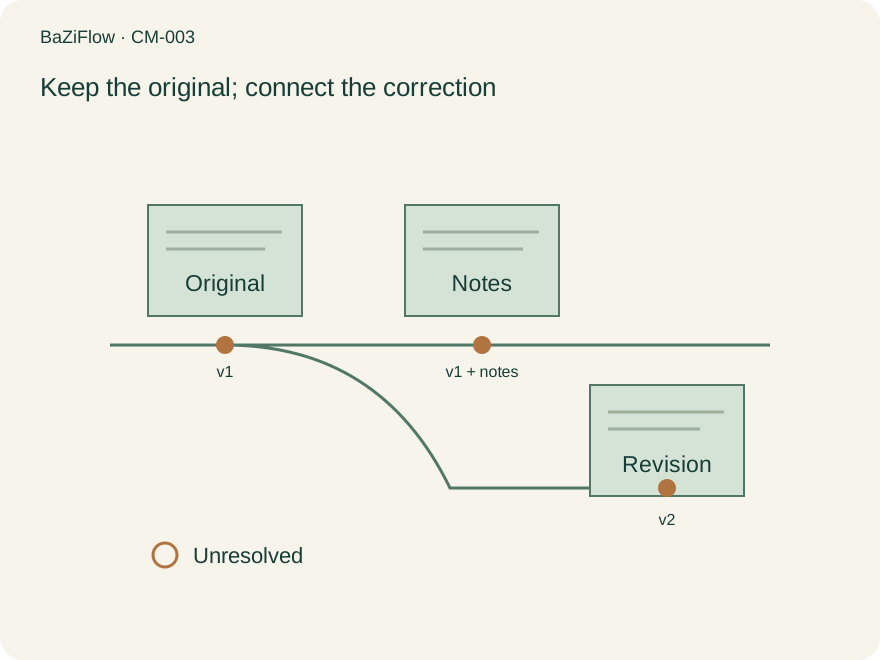
Original BaZiFlow version-history diagram. A branch records a correction, not an increase in predictive accuracy.
In the diagram the original survives on the timeline and the revision is attached as a branch. This is a history of evidence, not a graph of increasing accuracy. A newer file can still contain an unresolved mistake. The hollow markers remind the reader that revision and uncertainty can coexist.
When correcting the time setting, record the old and new values and the basis for the change. List the affected fields. Then inspect interpretations that relied on those fields. Do not mark the entire reading as verified merely because one calculation has been corrected. A paragraph that was not reviewed remains unreviewed, even when it happens to sit beside a corrected number.
If the change only fixes punctuation, say so. If it changes an input or a method, a vague updated label is not enough. The settings comparison guide can help distinguish an input difference from an interpretive one before you decide what must be revisited.
Time setting corrected
- Action or review state
- Recompute dependent fields
Dependent explanation
- Action or review state
- Review that passage
Unrelated paragraph
- Action or review state
- Not reviewed this time
Make the trail usable by its intended reader
A private record and a shared example need different amounts of personal context. Keep a separate sharing copy containing only what is necessary to understand the claim. Check filenames, image edges and annotations as well as the main text. Evidence about someone else's reading is not permission to publish their birth details or personal narrative.
You can begin with a small entry: record identifier, capture date, original location, one claim, its support, one unresolved question and a next step. Add detail when it resolves a real ambiguity. More screenshots do not necessarily improve traceability if no one can tell which version or assertion they support.
The practical test is simple: could another careful reader find the original, understand the transformation, and see where your judgment stops? A useful trail supports that limited task. It should not imply that storing an interpretation proves it, or that a carefully documented tradition has thereby acquired demonstrated predictive validity.
Private record
- Necessary personal context
Sharing copy
- Only context needed for the claim
Name the corrected item
Record the earlier time setting and the documented replacement without painting over the original image.
Follow its dependencies
List UTC fields needing recalculation, then the explanations that used them.
Separate completed checks
If UTC alone was checked, record that field as checked and its dependent prose as awaiting review.
Questions readers ask next
Is a bigger screenshot archive better?
Useful preservation lets a reader locate the original context, precise support and version relationships. Extra images without those connections may add little.
Should an unknown be assigned a confidence percentage?
Not without defined data and an appropriate statistical model. A specific missing record or undocumented convention communicates the actual task more clearly.
What belongs in a correction record?
Retain the previous and revised values, the supporting material and date, and affected calculations or passages. Leave untouched review states explicit.
Was this article helpful?
Theme: Parenting