

Tail: the mansion on two luminary tables
Content version · · Sources & references
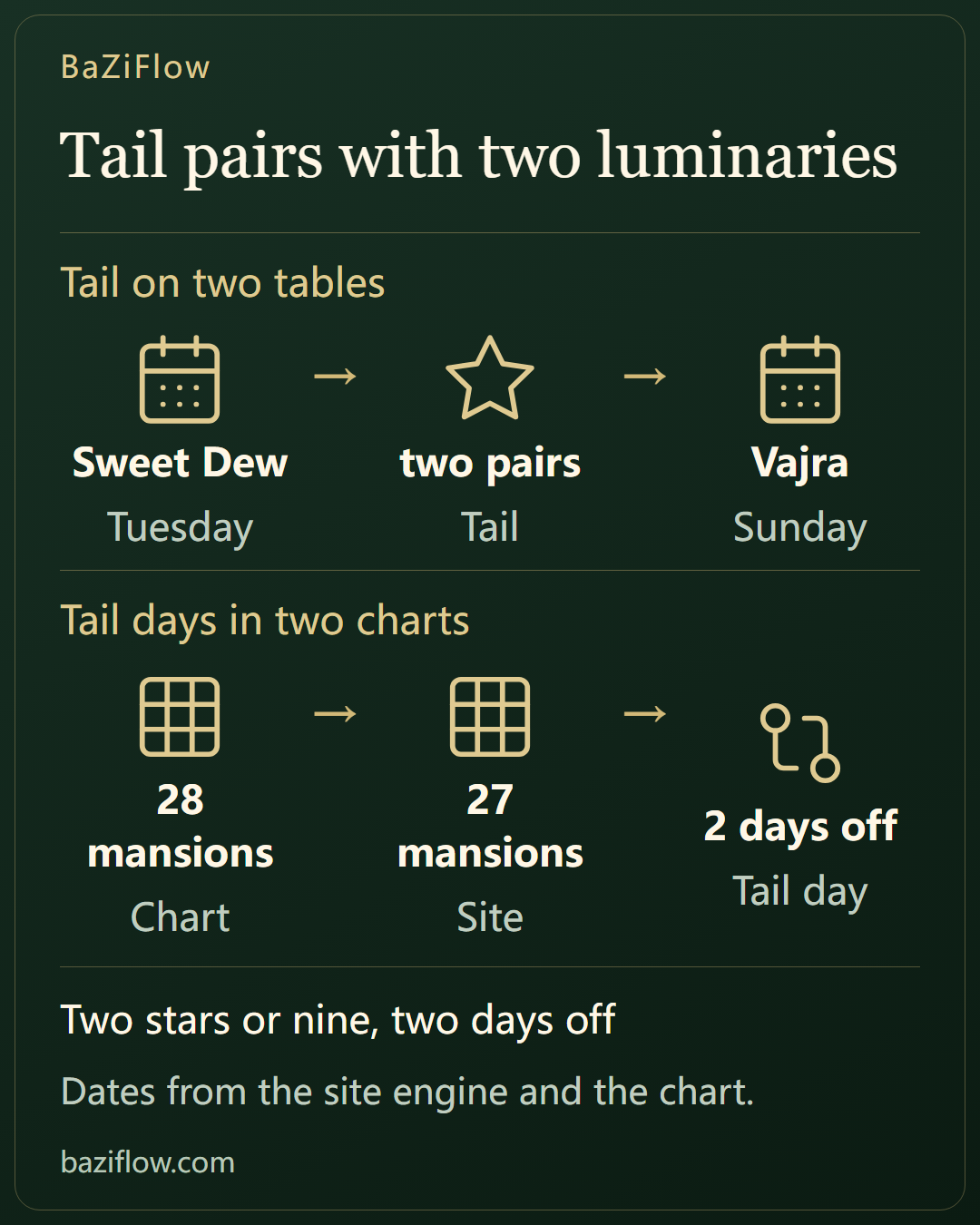
Tail is the seventeenth of the twenty-seven mansions, on two of three luminary tables (Mars and the Sun); the picture says two stars, the note nine. In months 1 to 10 the sutra month chart runs 2 to 4 days later.
The short version7 min read
Tail is the seventeenth of the twenty-seven mansions, with Heart before it and Winnowing Basket after it. In the Sukuyō Sutra's luminary tables it is one of the few mansions listed twice, with Mars (Sweet Dew days) and with the Sun (Vajra Peak days).
- Tail is on two of the three luminary pairing tables, with Mars and with the Sun; Heart is on one of them and Winnowing Basket on none.
- The Tail picture says two stars shaped like a lion's crest; the annotator's note gives nine in Chinese astronomy. For the neighbors Heart and Winnowing Basket, picture and note agree.
- In months 1 to 10 the sutra month chart puts Tail days 2 to 4 days later than the site table; in months 11 and 12 the two tables’ Tail days fall in different laps, so they are not subtracted. Its ring has 28 mansions and the start moves two places a month.
Read first
What is Sukuyō astrology? How a birth mansion is found ↗
Sukuyō 27 mansions vs the 28 lunar mansions: what is the difference? ↗
Position seventeen, and a mansion that two tables list
Start with the ring. Tail (尾) is the seventeenth mansion counted from Hairy Head (昴), with Heart (心) before it and Winnowing Basket (箕) after it, and the annotator tags all three as mansions of the east. The colors in the picture tell a different story. The first fascicle's chapter on secret miscellaneous divinations sets out three tables of the form "this luminary goes with that mansion", seven pairs each. Tail is on two of them, level with Willow and Ghost as the only mansions listed twice.
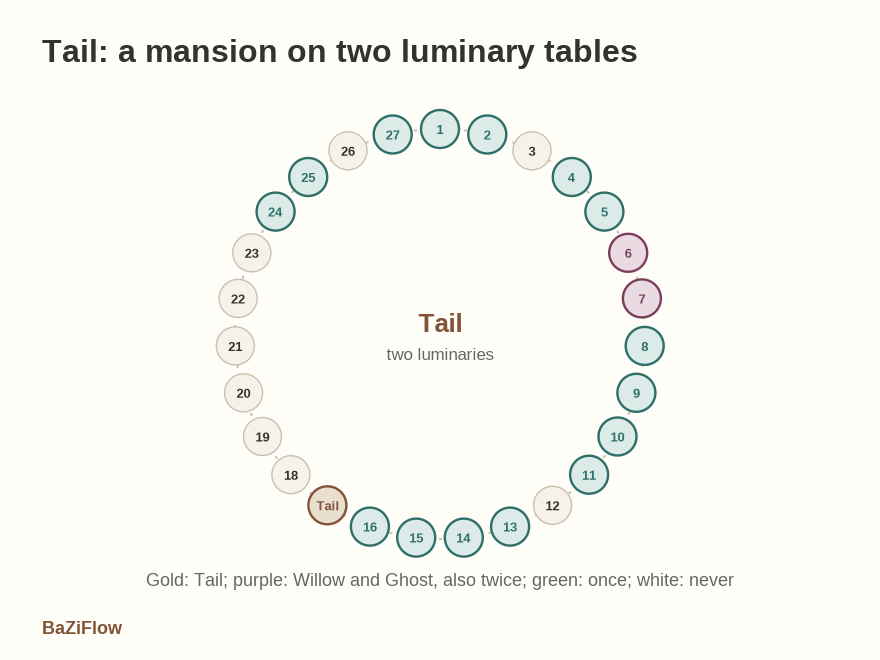
Position sketch: the twenty-seven names are spaced evenly in their order, with Hairy Head as No. 1; color shows how many of the three luminary tables list the mansion, and even spacing is typography, not sky width.
Gold is Tail, purple is Willow (柳) and Ghost (鬼), which are also listed twice, the fifteen mansions in green are listed once each, and the nine in white appear on no table. Tail's neighbors are easy to tell apart: Heart is on one table and Winnowing Basket on none. How the three tables fit together is covered in Extended Net; this page looks only at Tail.
The picture of Tail: two stars like a lion's crest, nine in the note
The entry for Tail begins in the usual order, stars and shape first, then deity and clan:
Tail has two stars, shaped like the tuft on a lion's head. Its deity is Nirṛti (儞律). Its clan name is Jia-di-na (迦底那).
At the end of the entry the annotator adds a line from Chinese astronomy:
In Chinese astronomy Tail has nine stars and presides over the rear palace; it is a mansion of the east.
Enlarge diagram · scroll sideways to read
The gap is seven stars, and among these three mansions it is the one place where the picture and the note disagree. The book does not say how two was counted and does not alter the picture; the annotator's habit is to append the Chinese-astronomy figure after the entry. So when saying how many stars Tail has, first say whether the figure comes from the picture or from the note.
Tuesday and Sunday: Tail takes one cell on each of two tables
Tail's two tables are the first two. The Sweet Dew table says "Tail, Mars rules", and the Vajra Peak table opens with Tail:
Tail, the Sun rules. Heart, the Moon rules.
Enlarge diagram · scroll sideways to read
On the Sweet Dew table Tail takes Mars and on the Vajra Peak table the Sun, which on the modern week are Tuesday and Sunday. The third table, the rakshasa days, has no Tail.
Tail days on the site calendar
Using the day mansions from the site engine, which follows the NAOJ month-start table, there are sixteen Tail days from November 2026 to December 2027, and six of them satisfy a pairing:
Enlarge diagram · scroll sideways to read
The Sundays of 3 January, 31 January and 28 February 2027 come one after another, 28 days apart, which is exactly four weeks, so the weekday does not move. How a weekday slips back as the gap changes is worked through day by day on the page for Extended Net. The day mansions here are the engine's, and the sutra keeps a separate month chart, and the next section sets the two side by side.
One more word on 28 February: it is month 1, day 22 in the Japanese old calendar but day 23 in the Chinese lunar one, because the two new years in 2027 are a day apart. Run on the Chinese month starts, the same table would put the Tail day on Saturday 27 February, and the run of three Sundays would not hold.
One Tail, two month charts: how many days apart
The "Tang month chart" that Jingfeng built into the sutra also lists Tail days. Each column is a month and each row a day number, and each cell holds the mansion of that day, in a ring of twenty-eight that includes Ox. Taking the cells that hold Tail and setting them beside the Tail days the site table gives for each month of the Japanese old calendar (new moon taken at Tokyo time):
Enlarge diagram · scroll sideways to read
In the chart the Tail day comes exactly two days earlier each month: its ring has twenty-eight cells, and the starting mansion of each month moves on by two places. The site table's ring has twenty-seven cells and its starting mansion moves on by two or three places, so the Tail day comes two to three days earlier. For the first six months the two tables stay two days apart, and from month 7 the gap widens to 3 and then 4. So in a month labeled ten, one table puts Tail on day 6 and the other on days 2 and 29.
None of this shows which table is the better one; it shows how to look things up. Before quoting a line about "the day Tail rules", find out which month table the day came from. Before and after Tail on the ring stand Heart and Winnowing Basket.
Questions readers ask next
The Tail picture gives two stars, so why does the note say nine?
They are two layers of text. The picture is the star chart that came with the sutra and says two; the annotator then added, from Chinese astronomy, a line that says nine. The book does not explain how two was reached. When quoting a star count, say whether it comes from the picture or from the note.
Is a Tuesday that falls on a Tail day the sutra's Sweet Dew day?
The pairing holds in the sutra's terms, but whether the day is a Tail day depends on which mansion table you use. The site engine uses the NAOJ month-start table and calls 10 November 2026 a Tuesday and a Tail day, which is true in that table only; Jingfeng's month chart in the sutra may name a different mansion for the same date.
Do the sutra's month chart and the site table use rings of the same length?
No. The month chart runs a ring of twenty-eight mansions that includes Ox, and its starting mansion advances exactly two places each month. The site table runs twenty-seven mansions without Ox and advances two or three places a month. Different starts and different ring lengths make the same mansion drift apart in the same-numbered months.
Was this article helpful?
Sources & references
- Taishō T1299, Sukuyō Sutra (CBETA 2023.Q4): mansion pictures, the three seven-luminary lists, the Tang month chart ↗
- Wikisource: Sukuyō Sutra (Wenshushili pusa ji zhu xian suo shuo jixiong shiri shan e xiuyao jing) ↗
- National Astronomical Observatory of Japan: 28/27 mansions, calendar assignment table ↗
Continue reading
Heart (心), Mansion No. 16: the Heart Month and Two Places in the Month Table ↗
Winnowing Basket (箕), Mansion No. 18: End of the East, a Water-God Picture, Six Neighbors ↗