

Why a birth chart needs both time and place
Content version · · Sources & references
Separate historical clock conversion from local-horizon geometry, and identify which chart features remain uncertain when a record is incomplete.
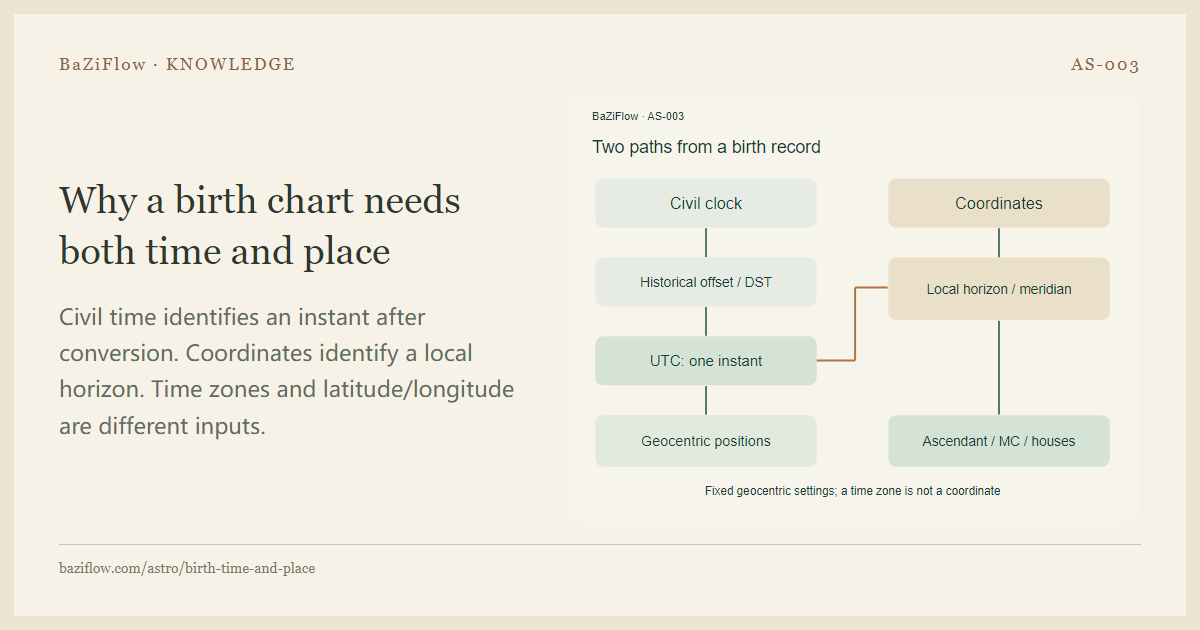
Civil time identifies an instant after conversion. Coordinates identify a local horizon. Time zones and latitude/longitude are different inputs.
Read first
There are two jobs behind one input form
A place field often supplies both a time zone and coordinates. Those values do different work. Historical civil-time rules help identify the instant recorded on a local clock; latitude and longitude help establish the local horizon and meridian at that instant. A problem in either path can change a chart, but the correction is not the same.
We use ordinary geocentric zodiac positions here, with local angles and houses. A topocentric or other coordinate setting adds qualifications and should be named. For the underlying vocabulary, see planets, signs, houses and aspects.
Resolve the recorded clock first
A city's current UTC offset may not be the offset used on the birth date. Historical daylight-saving and political time-zone changes matter. Around clock changes, a local time may occur twice or not occur at all. The IANA database records civil-time history, although older local records can remain uncertain.
As a simple arithmetic example, 10:00 at UTC+8 corresponds to 02:00 UTC; 10:00 at UTC+9 corresponds to 01:00 UTC on the same date. These are not interpretive alternatives to choose by preference. The applicable historical rule decides which conversion is justified. Keep the original record alongside the conversion so a later correction can be traced.
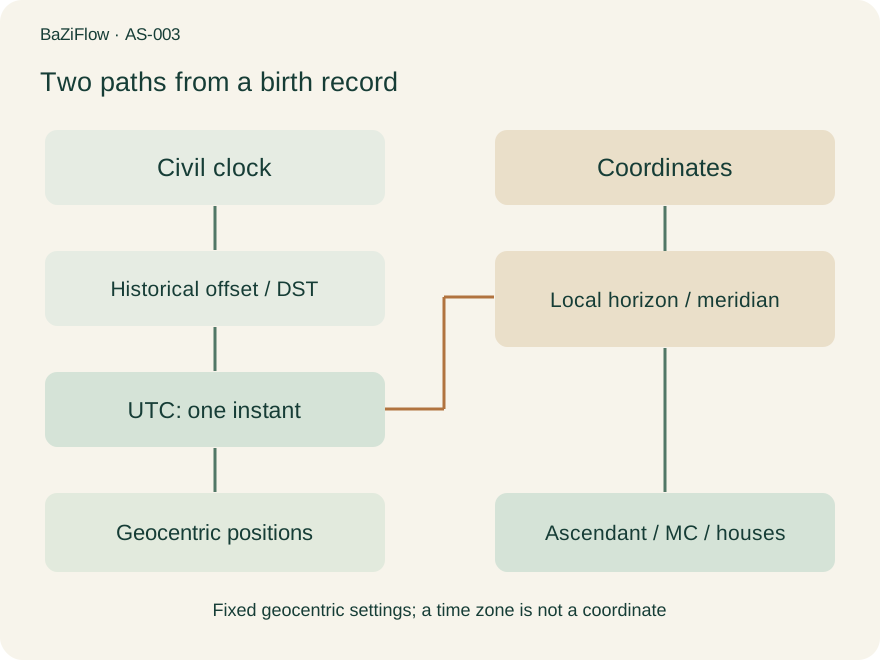
Original BaZiFlow teaching diagram; schematic, not a personal chart.
Now locate the horizon
At a fixed instant and fixed geocentric settings, a planet's zodiac longitude does not change just because a different birth city is selected. Local geometry does change: coordinates determine the horizon and meridian used for the Ascendant, Midheaven and houses. The Ascendant is an eastern intersection of the ecliptic and horizon, not a physical planet.
Two people recorded at “10:00 local time” need not be simultaneous. Two locations at the same UTC provide the cleaner comparison. Changing a place may change both the historical offset and the geometry, so inspect those effects separately. A program should not quietly replace the birthplace with a national capital.
Run three different sensitivity checks
If place is certain but time has an error range, hold place fixed and compare times within that range. Mark changing angles or house assignments. If UTC is known but the location has two candidates, hold UTC fixed and examine local geometry. If even the date is uncertain, revisit planetary positions as well; do not assume the Sun and Moon are automatically unchanged. A body near a boundary can cross it within the allowed interval.
The familiar “one rising sign every two hours” is a rough average, not a boundary algorithm. Latitude and the geometry of the ecliptic affect rising rates. Nor can the Earth's rotation of roughly one degree per four minutes be substituted for a constant rate of Ascendant longitude.
Preserve uncertainty in the output
An auditable record includes the source clock time, its reliability, historical time-zone basis, coordinates, converted instant and unresolved range. A noon placeholder for an unknown time is still a placeholder. It does not establish a reliable Ascendant or houses, and other placements should be checked across the relevant range.
Swiss Ephemeris documents calculation conventions; IANA supports time-zone lookup. Reproducible astronomy does not itself verify astrological claims about a life. Continue with Sun, Moon and rising, or—once inputs match—with house systems to understand why house boundaries may still differ without a birth-data error.