

Hua Lu: three sources, and why it is not Lu Cun
Content version · · Sources & references
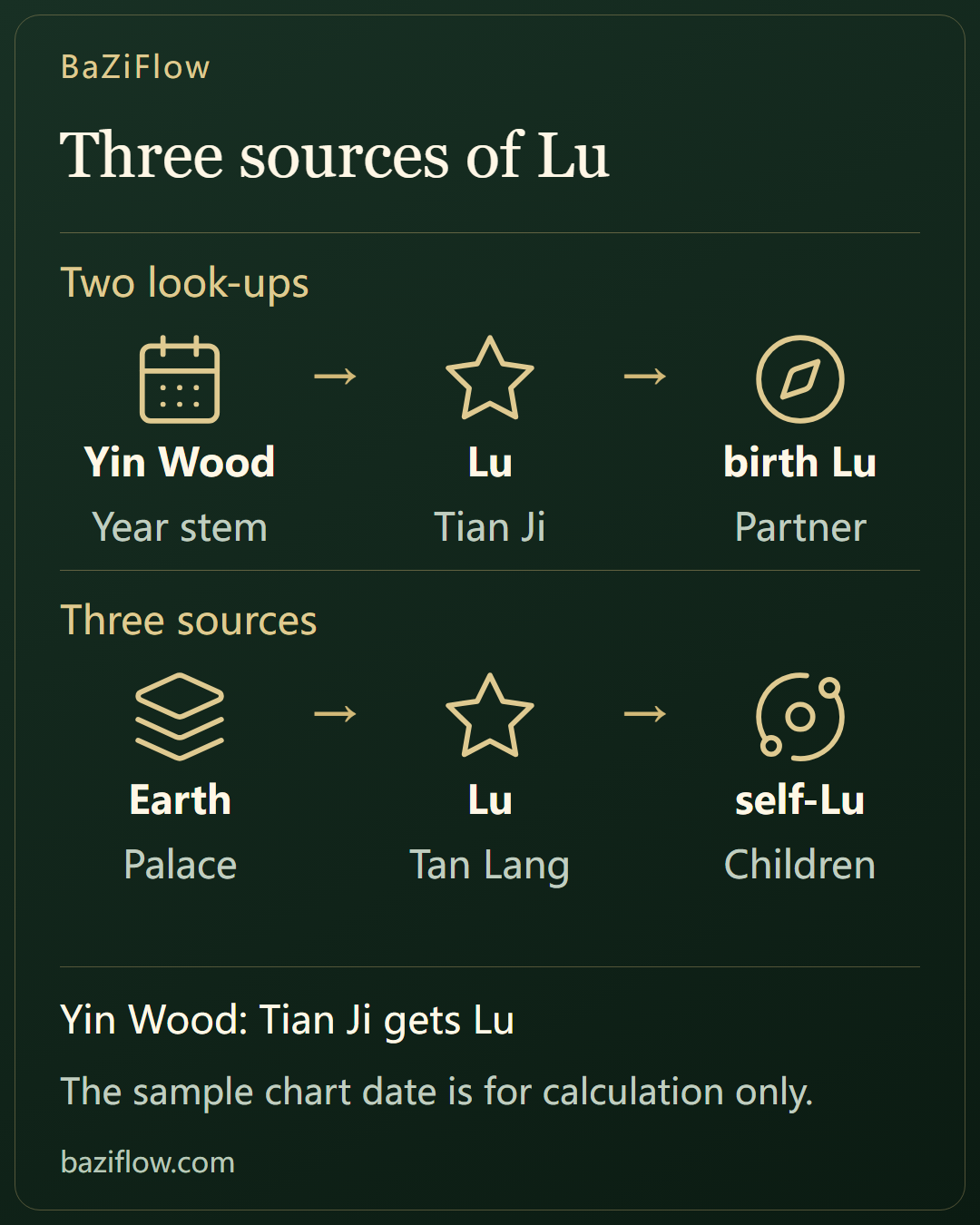
A sample chart worked step by step shows the three sources of Hua Lu (birth-year stem, palace stem, self-transformation) and keeps it apart from Lu Cun, which also comes from the year stem.
The short version9 min read
Hua Lu (written Lu below) is a mark attached to one star, and the stem looked up in the table decides which star. That stem can come from the birth year or from a palace, so the first question about any Lu is where it came from.
- Across the ten stems the Lu column names ten different stars; in this table Zi Wei, Tian Fu, Tian Xiang and Qi Sha never receive Lu.
- Lu Cun is also set by the year stem, but it returns a branch while Lu returns a star, and the star still has to be located in the chart.
- In the sample chart each of the twelve palaces sends out one Lu, and exactly two of them land back in the palace that sent them; only those two are self-transformations.
Read first
One stem, two different look-ups
In plain words first: Hua Lu (化禄), "Lu" for short, is a mark attached to one star, and the stem you look up decides which star gets it. What it is most easily confused with is another thing that the year stem also decides, Lu Cun (禄存).
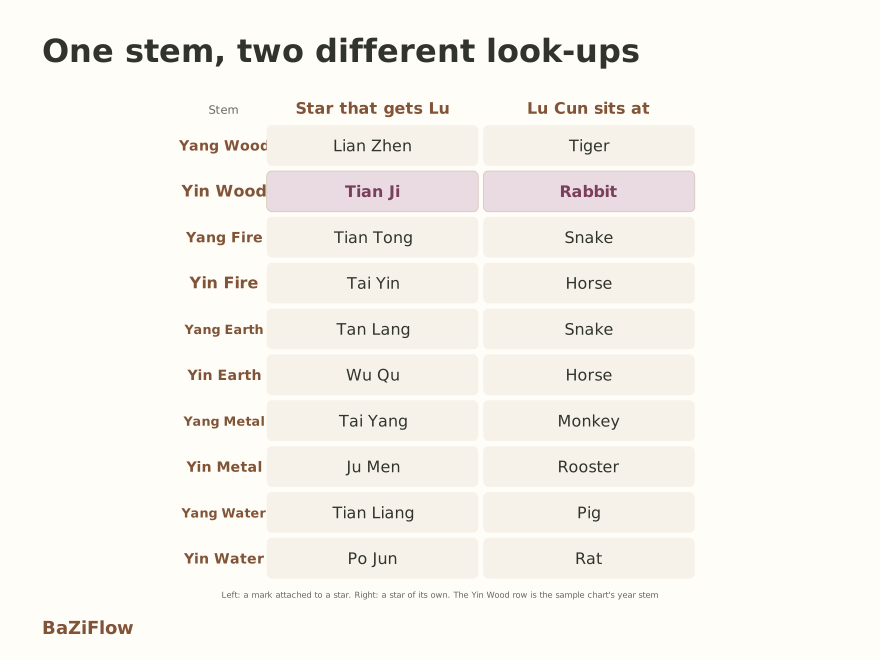
The left column uses the engine's four-transformation table (identical cell by cell to the iztro default); the right column follows the Lu Cun placement rule. The highlighted Yin Wood row is the sample chart's year stem.
Each stem in the picture returns two things. The left column is the Lu star from the four-transformation table: ten stems, ten different stars. The right column is the branch where Lu Cun sits. Ten stems land on only eight branches: Tiger, Rabbit, Snake, Horse, Monkey, Rooster, Pig and Rat, with Yang Fire and Yang Earth sharing the Snake, and Yin Fire and Yin Earth sharing the Horse.
The left column shows one more thing. Among the fourteen major stars, Zi Wei (紫微), Tian Fu (天府), Tian Xiang (天相) and Qi Sha (七杀) never appear. Whether the stem comes from the birth year or from a palace, this table cannot select them, so those four stars never carry Lu.
How the book writes them side by side
The classical text used here is the Quan Shu (紫微斗数全书). In its second juan it first gives Hua Lu an element:
The Lu transformation star is Earth, a god of fortune and virtue.
The book's table of star elements in the same juan also has a line saying that Hua Lu is Earth and likes to meet Lu Cun, so the book itself writes the two next to each other. Then come two placement rhymes. The one for the star, Lu Cun, reads:
Born under Yang Wood, Lu Cun is in the Tiger palace; Yin Wood is in the Rabbit; Yang Fire and Yang Earth are in the Snake.
The one for the marks gives one line per stem. For Yang Wood it reads:
Yang Wood: Lian, Po, Wu and Yang keep company.
Its first name is short for Lian Zhen (廉贞), who takes Lu under a Yang Wood stem; the rest are Po Jun with Quan, Wu Qu with Ke and Tai Yang (the final "Yang") with Ji. Both rhymes start from the year stem, yet the answers are of different kinds:
Enlarge diagram · scroll sideways to read
The two can fall in the same palace or apart. The sample chart below is a Yin Wood year, so Lu Cun is at the Rabbit and Tian Ji, which receives Lu, is in that same Rabbit palace. In a Yang Fire year, Lu Cun would go to the Snake, and Tian Tong would have to be found elsewhere in the chart.
Source one: the birth-year stem
The example is a chart chosen only so that the arithmetic is definite: solar date 12 June 1995, Ox hour, female, which is a Yin Wood Pig year in the lunar calendar. The date stands for nobody. The year stem is Yin Wood.
Look-up: the Yin Wood row gives Tian Ji for Lu. Back in the chart, Tian Ji sits in the Partner palace (the Rabbit palace). The record reads "birth-year Lu, Tian Ji, Partner palace".
Enlarge diagram · scroll sideways to read
This is the step covered in birth-year transformations. Here the only addition is to keep the same chart at hand, because the other two sources use it next.
Source two: palace stems, twelve palaces sending one Lu each
Every palace also has a stem of its own, derived from the birth-year stem. The sample chart's year stem is Yin Wood, so the Tiger palace has Yang Earth, and the stems run on to the Ox palace. Take each palace's stem as the entrance, read the same Lu column, then find that star in the chart:
| Sending palace | Palace stem | Star that gets Lu | Star sits in | Recorded as |
|---|---|---|---|---|
| Children (Tiger) | Yang Earth | Tan Lang | Children | self |
| Partner (Rabbit) | Yin Earth | Wu Qu | Health | flies to Health |
| Siblings (Dragon) | Yang Metal | Tai Yang | Wealth | flies to Wealth |
| Life (Snake) | Yin Metal | Ju Men | Partner | flies to Partner |
| Parents (Horse) | Yang Water | Tian Liang | Life | flies to Life |
| Wellbeing (Goat) | Yin Water | Po Jun | Friends | flies to Friends |
| Property (Monkey) | Yang Wood | Lian Zhen | Property | self |
| Career (Rooster) | Yin Wood | Tian Ji | Partner | flies to Partner |
| Friends (Dog) | Yang Fire | Tian Tong | Travel | flies to Travel |
| Travel (Pig) | Yin Fire | Tai Yin | Wealth | flies to Wealth |
| Health (Rat) | Yang Earth | Tan Lang | Children | flies to Children |
| Wealth (Ox) | Yin Earth | Wu Qu | Health | flies to Health |
Three things in the table are worth noticing. Twelve palaces carry only ten stems: Yang Earth sits on Children and Health, Yin Earth on Partner and Wealth, so those two pairs send out identical Lu. The Career palace's stem is Yin Wood, equal to the year stem, so its Lu is the same as the birth-year Lu above, Tian Ji into Partner; but the source is a palace stem, which makes a second record. The third thing is in the last column and belongs to the next section.
Enlarge diagram · scroll sideways to read
Source three: self-transformation, Lu returning to the palace that sent it
The two "self" rows in the table are cases where the star selected by a palace stem happens to sit in the sending palace itself. iztro's method is to take the palace's stem, read the star for the requested transformation, and then check whether that star is in the same palace. The sample chart has two: Children (Tiger palace, Yang Earth) selects Tan Lang, and Tan Lang is in Children; Property (Monkey palace, Yang Wood) selects Lian Zhen, and Lian Zhen is in Property.
The Health palace makes the contrast clear. Its stem is also Yang Earth and it also selects Tan Lang, but Tan Lang is not in Health. It is in Children, so the record is "flies into Children", not self.
Enlarge diagram · scroll sideways to read
The word "self-transformation" is not defined the same way in every textbook. This article uses only the check above, which can be reproduced; other usages are taken up in self-transformations and schools.
Writing one Lu down completely
A record that someone else can redo needs four things:
Enlarge diagram · scroll sideways to read
Ask whose stem it is
The birth year's stem or a palace's stem? Both read the same column but produce different kinds of record.
Then find the star
The table gives only a star name. Which palace holds it must be read from the chart, and left blank if it cannot be.
Finally note the table
The example uses the engine table, which matches the iztro default. The Quan Shu rhyme differs on the Ke star under Yang Water; the disagreement between the two texts is recorded in the article on birth-year transformations.
Two exercises
Born in a Yin Fire year: which star gets Lu, and where is Lu Cun?
The Yin Fire row gives Tai Yin for Lu, and Lu Cun is on the Horse. The answers are of different kinds and are written separately.
A palace stem is Yang Water: which star does it send Lu to, and when is it self?
The Yang Water row gives Tian Liang. If Tian Liang sits in that very palace it is self; if it sits elsewhere, record "flies into" that palace.
With Lu done, the second column of the same table comes next: Hua Quan.
Questions readers ask next
I was born in a Yin Wood year. Is Tian Ji's Lu necessarily in my Partner palace?
No. A Yin Wood year fixes only the line "Tian Ji receives Lu". Which palace Tian Ji sits in depends on the individual chart. In the sample chart it happens to be the Partner palace.
When taking notes, can I write down just one of Lu and Lu Cun?
Keep them as two entries: Lu Cun answers "which branch", Lu answers "which star carries the mark". The Quan Shu's table of star elements even lists the two side by side.
Can a palace-stem Lu and a birth-year Lu point at the same star?
Yes, when the palace's stem happens to equal the year stem. Both look-ups reach the same star, but the sources differ, so they stay two separate records.
Was this article helpful?
Sources & references
Continue reading
Hua Quan (化权): Why Its Star Often Repeats the Previous Stem's Lu, and Three Sources ↗