

Seven of Cups
Content version · · Sources & references
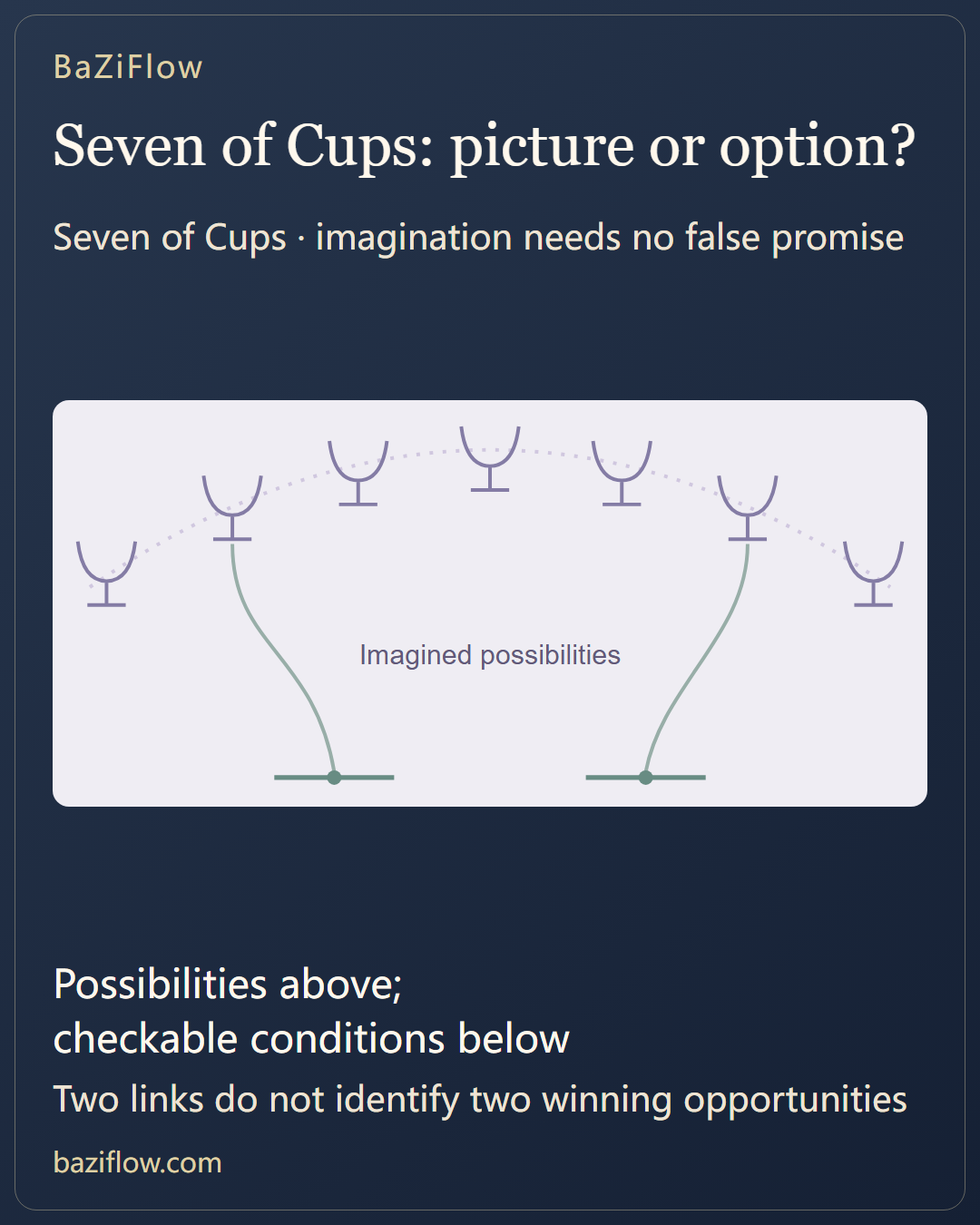
Read Waite’s visionary cups without turning imagination into guaranteed opportunity. Separate desired experience, verified conditions, and a specific next action.
The short version6 min read
Seven visionary cups open out attractive possibilities. Waite does not simply scold the dreamer: he allows attainment within imagination while withholding lasting assurance. Reversal turns toward will and a project, which still needs a clear object.
- The upright entry includes imagination, feeling and contemplation, not merely bad choices; inward attainment differs from durable results.
- Solo photography and shared creation can both produce pictures without satisfying the same wish, so compare more than the output.
- A two-page trial can turn four sketches into a visible layout without establishing all the conditions for producing an entire booklet.
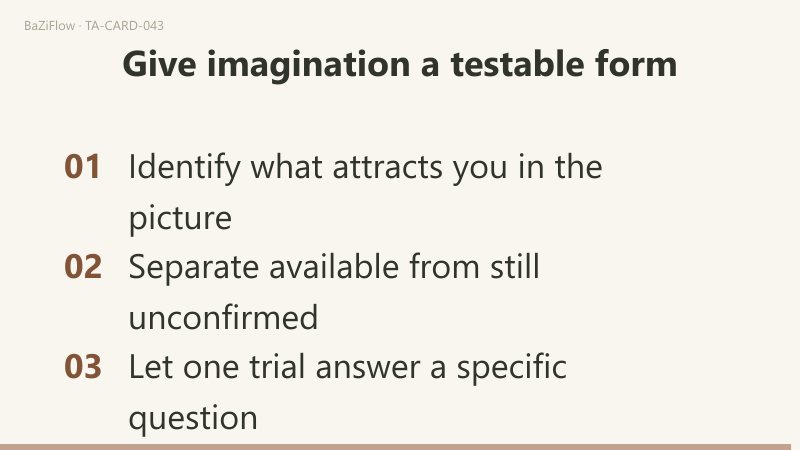
Read first
What the historical text actually puts together
On the RWS card, a figure seen almost only as a black silhouette, back to the viewer, reaches one arm out toward seven cups floating on clouds. Each cup holds something different: a human head, a covered and glowing form, a snake, a tower, a heap of jewels, a laurel wreath and a dragon.
Waite describes strange visionary cups and associates the scene with imagination, sentiment, and contemplation. He allows a degree of attainment within this territory while withholding permanence or substantial assurance. That combination is more nuanced than a rule that dreaming is always bad or that every vision conceals a real offer.
His main reversed entry names desire, will, determination, and a project. These words do not support a blanket rule that reversal means failure. Neither do they establish that determination supplies missing resources or makes a decision correct. They are historical interpretive terms, not evidence about the reader's circumstances.
The additional-meanings chapter also records ideas, design, resolve, and movement. Its success statement comes with a neighboring-card condition. Removing that condition would misrepresent the source; adopting the prediction as a guarantee would go beyond what this educational article can justify. Waite also acknowledges tensions among his supplementary meanings.
The wording above comes from the text consulted; the card description follows Pamela Colman Smith’s Rider–Waite–Smith drawing, and other editions may differ in detail, so a comparison would need to name the specific image examined.
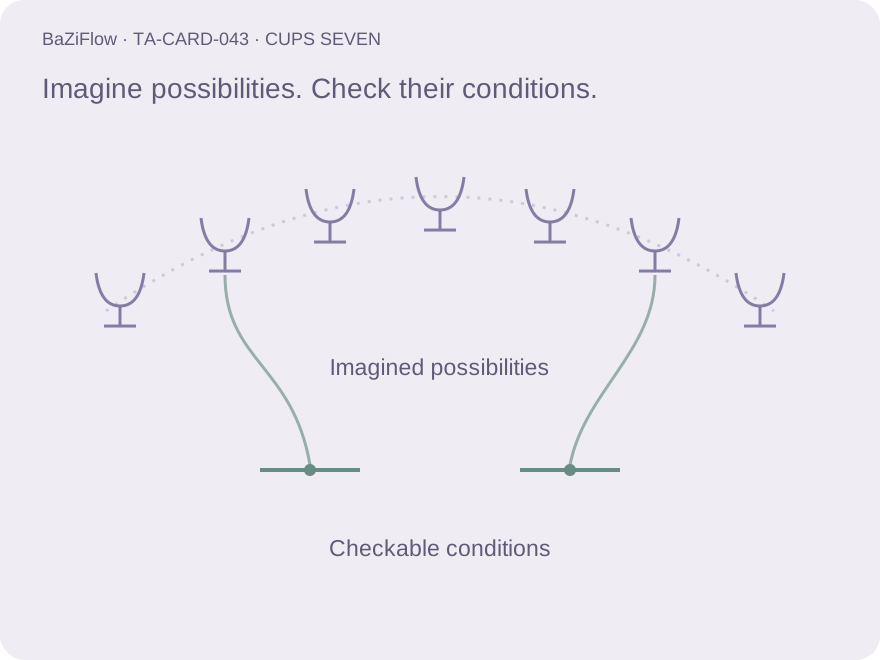
An original BaZiFlow option-clarification diagram. Seven cups identify the card; the links show inquiry, not seven real opportunities or probabilities.
Main upright
- Imagination, contemplation
- No permanence assured
Main reversed
- Will, determination
- A project still to realize
Start with the question that a list of dreams cannot answer
Which of these possibilities can I actually choose? That question is different from Which picture attracts me most? A quiet afternoon making art, a photographic walk with a friend, and a finished booklet may all appeal. Yet one is a desired atmosphere, another depends on someone else agreeing, and the third is an imagined result with several unfinished steps behind it.
Treating them as three ready-made options hides those differences. Before ranking them, identify what each proposal would require. This use of the RWS Seven of Cups makes room for imagination while refusing to count a pleasing picture as an opportunity already offered.
It also avoids the opposite mistake: dismissing every unformed idea as worthless. Exploration can be a legitimate activity in its own right. The question is whether the notebook is exploring possibilities or claiming that an arrangement is already available to act on.
| Attractive possibility | Information that would make it more concrete |
|---|---|
| A peaceful afternoon drawing | An available place and a realistic amount of time |
| Making photographs together | The other person's interest, availability, and agreement |
| Holding a finished booklet | Existing material, a manageable scope, and a production method |
The first inquiry might be as modest as checking opening hours. Another might be asking whether a friend wants to join, without presenting their participation as settled. If the booklet is too large for the available time, a two-page trial can test layout and paper without pretending to be the completed project.
Notice how these inquiries produce different kinds of answers. A venue can be open while the proposed group remains unconfirmed. A friend can like the idea while declining the date. Useful information does not have to validate the whole picture; it may clarify just one condition.
This distinction matters when communicating with others. Saying that you hope to make a booklet is accurate before production is arranged. Announcing that a collaborative booklet is underway may imply commitments that nobody else has made. Enthusiasm should not enlarge another person's answer during retelling.
Both called photography
Make images
- Solo walk
- Possible
- Shared walk
- Possible
Create together
- Solo walk
- Not fulfilled
- Shared walk
- Needs participation
Read the drawing as an unfinished inquiry
The upper arc holds seven cups, retaining the card's identity and a sense of multiple imagined possibilities. Only two connections reach the lower marks for checkable conditions. Those are not two winning choices. They illustrate how some inquiries acquire evidence while other parts remain open.
There is no conversion from seven cups to seven days, seven offers, or a probability. Nor does an unconnected cup mean that an idea must be abandoned. It may still express a valuable preference, such as wanting companionship rather than merely wanting to take photographs.
If companionship is central and the friend cannot attend, a solo walk remains possible but meets a different wish. Recording that difference is more useful than forcing the available activity to stand in for everything originally imagined. You can choose it knowingly, postpone the shared plan, or keep exploring.
An invented exercise: this line completes a layout trial, not the whole booklet.
Give determination an object and a limit
A note saying I must believe more strongly offers no way to tell whether the situation changed. A note saying I will ask about access, collect four existing sketches, or test one page does. Each action has an object and an observable result, without requiring a prediction about the finished work.
Permissions remain specific. Agreement to take photographs together does not automatically permit publishing a person's portrait. Interest in reading a sample does not make someone a co-producer. If a response has not arrived, the record should say unconfirmed rather than converting silence into a hidden promise.
For comparison, the Six of Cups brings remembered experience alongside present conditions; the Seven brings imagined possibilities alongside them. A shared suit does not make the two inquiries interchangeable. The upright and reversed methods guide can help keep the reading convention explicit.
At the next review, list newly established facts, conditions that ruled something out, and questions still open. Imagination has then helped reveal what matters, while inquiry has clarified what is available. Neither function has to impersonate the other.
Name the desired experience
For example, quiet, shared creation or seeing a work finished.
Choose an informative trial
Test two pages to learn about layout without promising a whole book.
Decide from what was learned
Continue if it fits, or change the form or retain it as inspiration.
Questions readers ask next
Does the Seven of Cups say that imagination has no value?
No. Waite includes imagination, contemplation and some attainment within them, while withholding permanence or substantial assurance. Exploring inspiration can be worthwhile; the distinction is between an imagined picture and an opportunity or agreement already available.
Does reversed determination mean the choice is already correct?
It does not. Will and a project describe a reading direction, not evidence that an actual decision is sound. A clearer intention still depends on space, time, material and the willingness of other participants before taking a particular form.
Do the two lower links identify the two best choices?
No. The original diagram uses links to show some conditions becoming clearer, while unconnected cups remain possible inspiration. Neither seven cups nor two lines express a success probability or a schedule of future offers.
Was this article helpful?
Sources & references
Continue reading
Six of Cups: a familiar memory can meet a different present ↗