

Three Stars: one star against ten
Content version · · Sources & references
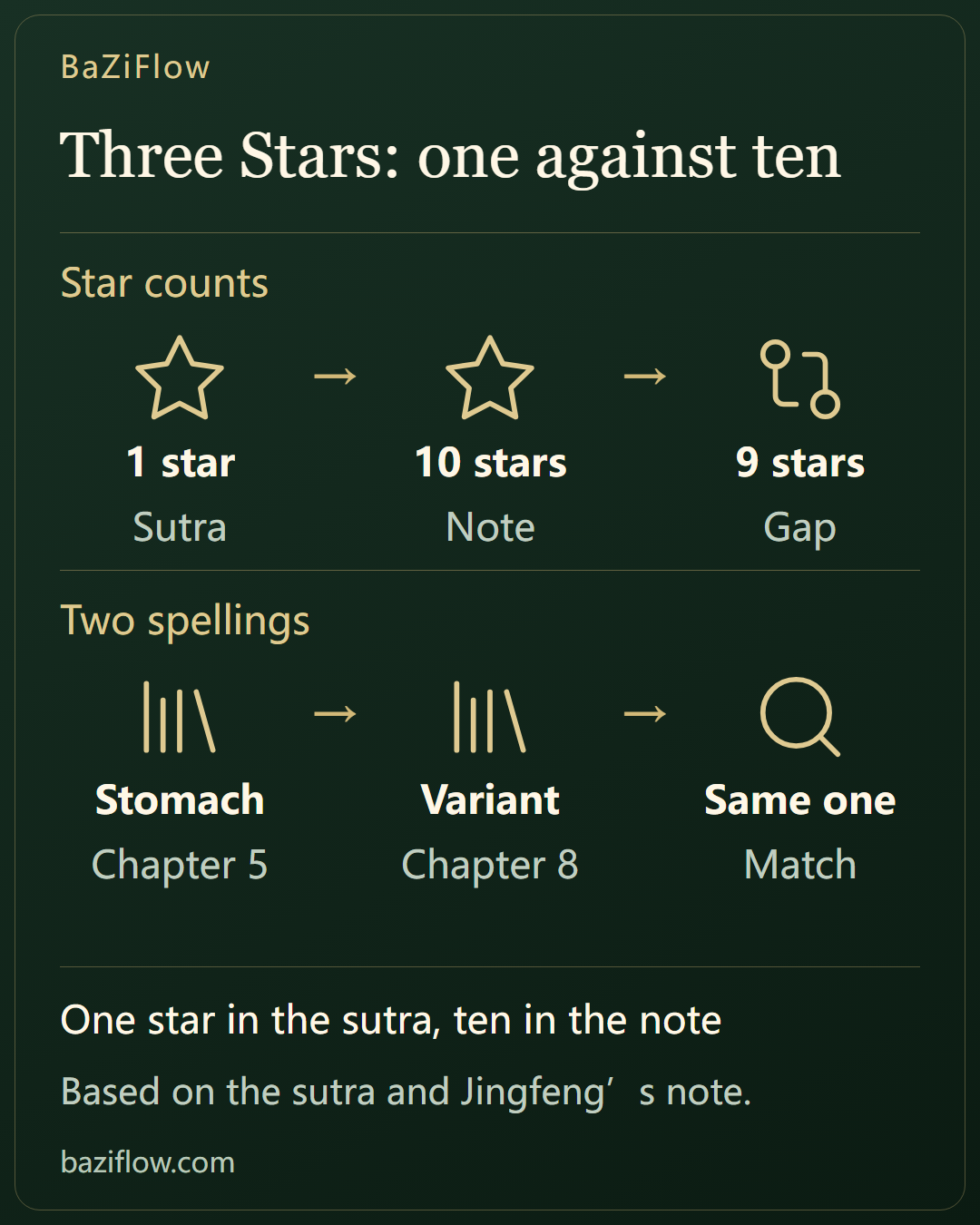
Three Stars (参) is position 4 on the ring: one star in the sutra against ten in the note, a Rakshasa-day list written twice with two variant characters, and a December date whose count crosses the ring’s seam.
The short version6 min read
Three Stars (参, Shin in Japanese) is position 4 on the site’s ring, between Turtle Beak and Well. The sutra’s picture draws a single star while the commentator’s note says ten in Chinese astronomy, the widest gap among the first seven mansions.
- Among the first seven mansions the two layers agree only for Turtle Beak, and Three Stars is the furthest apart: one star in the sutra, ten in the note, while the others differ by 1 to 6.
- The Rakshasa days are seven luminary-and-mansion pairs, with Mercury paired to Three Stars. The sutra writes the list twice, and only the Sun’s partner (胃 or 冒) and Jupiter’s (氐 or 底) are spelled differently.
- The day-1 mansion of month 12 in the Japanese old calendar (new moon fixed by Tokyo time) is Emptiness, and day 11 is ten steps on: the count crosses the seam of the ring and runs through Stomach, Hairy Head, Net and Turtle Beak to Three Stars.
Read first
What is Sukuyō astrology? How a birth mansion is found ↗
Sukuyō 27 mansions vs the 28 lunar mansions: what is the difference? ↗
One star, or ten
Count round the ring from Hairy Head and the fourth mansion is Three Stars (参, Shin in Japanese), tucked between Turtle Beak (觜) and Well (井); in the sutra’s picture it is the loneliest of them, with a single star.
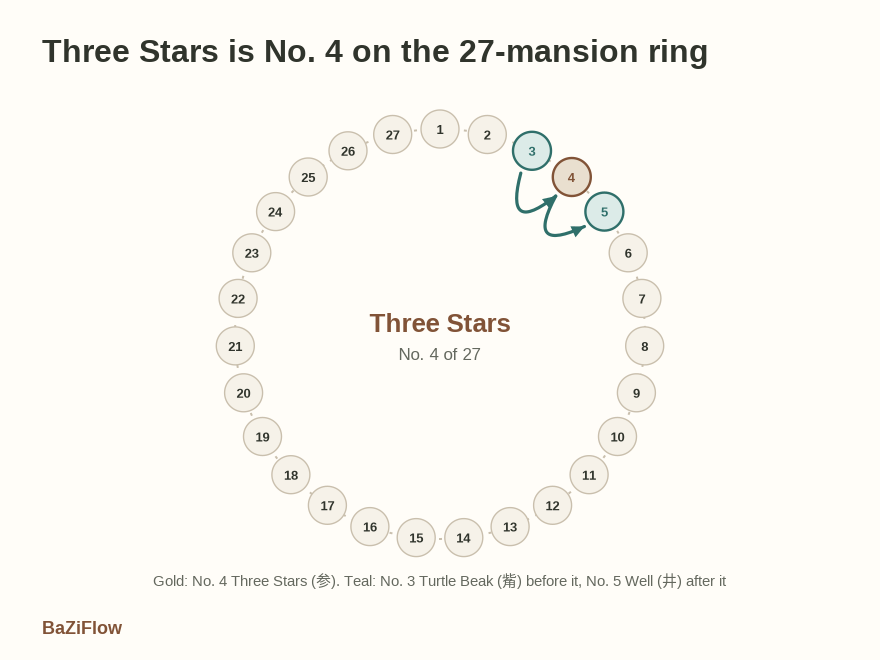
Three Stars at position 4 ends the four White Tiger mansions at the head of the ring; the next one, Well, is southern.
The sutra’s Three Stars picture opens:
Three Stars has one star, shaped like a dot on the forehead. Its deity is Rudra.
After the picture Yang Jingfeng added the Chinese-astronomy count:
In Chinese astronomy Three Stars has ten stars and governs generals. It is a western mansion.
Each of the first seven pictures carries such a note, so the two layers’ star counts can be set side by side, and Three Stars is the furthest apart:
Enlarge diagram · scroll sideways to read
Turtle Beak is the one mansion where the layers agree, and Three Stars is the one where they are furthest apart: one star against ten, a gap of nine. Each count has its own source, so a write-up can list both and leave them as they are.
Mercury pairs with Three Stars: the list written twice
The sutra also pairs the seven luminaries (the Sun, Moon, Mars, Mercury, Jupiter, Venus and Saturn) with seven of the 27 mansions. One set is called the "Sweet Dew days," another the "Vajra Peak days," and a third the "Rakshasa days" (罗刹日), and Mercury’s partner there is Three Stars. This list occurs twice in the book. First in chapter 5:
These seven days are called the Rakshasa days.
The other copy is in the luminary-day calendar of the second fascicle, worded "such a luminary directs the day, and the Moon joins such a mansion," and it also closes with "Rakshasa days." The seven pairs of the two copies, side by side:
Enlarge diagram · scroll sideways to read
Five of the pairs match character for character. In the other two, the Sun’s partner is written Stomach (胃) in one copy and with a different character (冒) in the other, and Jupiter’s partner is Root (氐) in one and a variant (底) in the other. Neither variant is a mansion name, and at the same positions in the other copy stand Stomach and Root, so the first is read as Stomach and the second as Root. This is cross-reading (collation) of two repeated lists in one book, an alignment by position rather than a guess from the shape of a character.
A count that crosses the seam
The counting rule is the one used on the earlier pages: the mansion of the month’s first day is the start, and each further day adds a place. Gregorian 10 January 2025 still belongs to the previous old-calendar year: it is month 12, day 11. The day-1 mansion of month 12 is Emptiness (虚), position 21 on the ring, and day 11 means ten places: Emptiness, Rooftop (危), Encampment (室), Wall (壁), Legs (奎), Bond (娄), Stomach (胃), then across the seam of the ring back to Hairy Head (昴), through Net (毕) and Turtle Beak to Three Stars.
Enlarge diagram · scroll sideways to read
In the same year Three Stars falls on 13 Gregorian dates: 10 January, 6 February, 6 March, 2 April, 30 April, 27 May, 23 June, 20 July, 19 August, 14 September, 11 October, 7 November and 5 December.
Where Three Stars stands in four of the sutra’s tables
Put Three Stars back into the sutra’s several tables and this is where it appears:
Enlarge diagram · scroll sideways to read
"Poisonous mansions" and "Rakshasa days" are the sutra’s names for what kind of day is at hand, and they are not remarks about anyone. The site gives only the mansion’s position.
Three checks
How many stars does Three Stars have in the sutra?
One in the sutra’s text, ten in Jingfeng’s note; state the layer when quoting.
Which mansion does Jupiter pair with in the Rakshasa days?
Root; the second fascicle spells it with a variant (底), and cross-reading reads it as Root.
Which mansion is old month 12, day 11?
Month 12 opens on Emptiness; ten places across the seam end on Three Stars.
The mansion before it is Turtle Beak and the one after is Well. What to do when a source offers two spellings is covered in how to check Sukuyō sources and editions, and why the ring has no Ox mansion is in the 27 and 28 lists compared.
Questions readers ask next
Does Three Stars have one star or ten?
It depends on the layer. The sutra’s picture says "Three Stars has one star, shaped like a dot on the forehead," and the commentator Yang Jingfeng’s note says ten in Chinese astronomy. One is the shape the sutra itself draws and the other is the Chinese count, so both numbers have a source and a citation should state which it uses.
Are the two spellings (冒 and 底) two new mansions?
No. The Rakshasa-day list occurs twice in the book. One version reads Stomach and Root at two positions, and the other has (冒) and (底) in exactly those places, with the other five pairs identical. Since neither character is a mansion name, they are read as Stomach and Root, an inference from comparing the two lists in the same book.
Three Stars is a "poisonous" mansion. Does that say something harmful about people born under it?
No. "Poisonous mansions" is the sutra’s label for the class of Three Stars, Willow, Heart and Tail, and it describes what kind of day they govern. It makes no statement about anyone born on that mansion, and the site only gives the mansion’s position and draws no conclusion from the class name.
Was this article helpful?
Sources & references
Continue reading
Turtle Beak (觜): Three Stars, Last of the Six "Ahead" Mansions, Split Across Two Houses ↗
Well (井): Where the Ring Turns from West to South, and How the Commentator Tags Directions ↗