

Gate pressure: palace, elements, arrow
Content version · · Sources & references
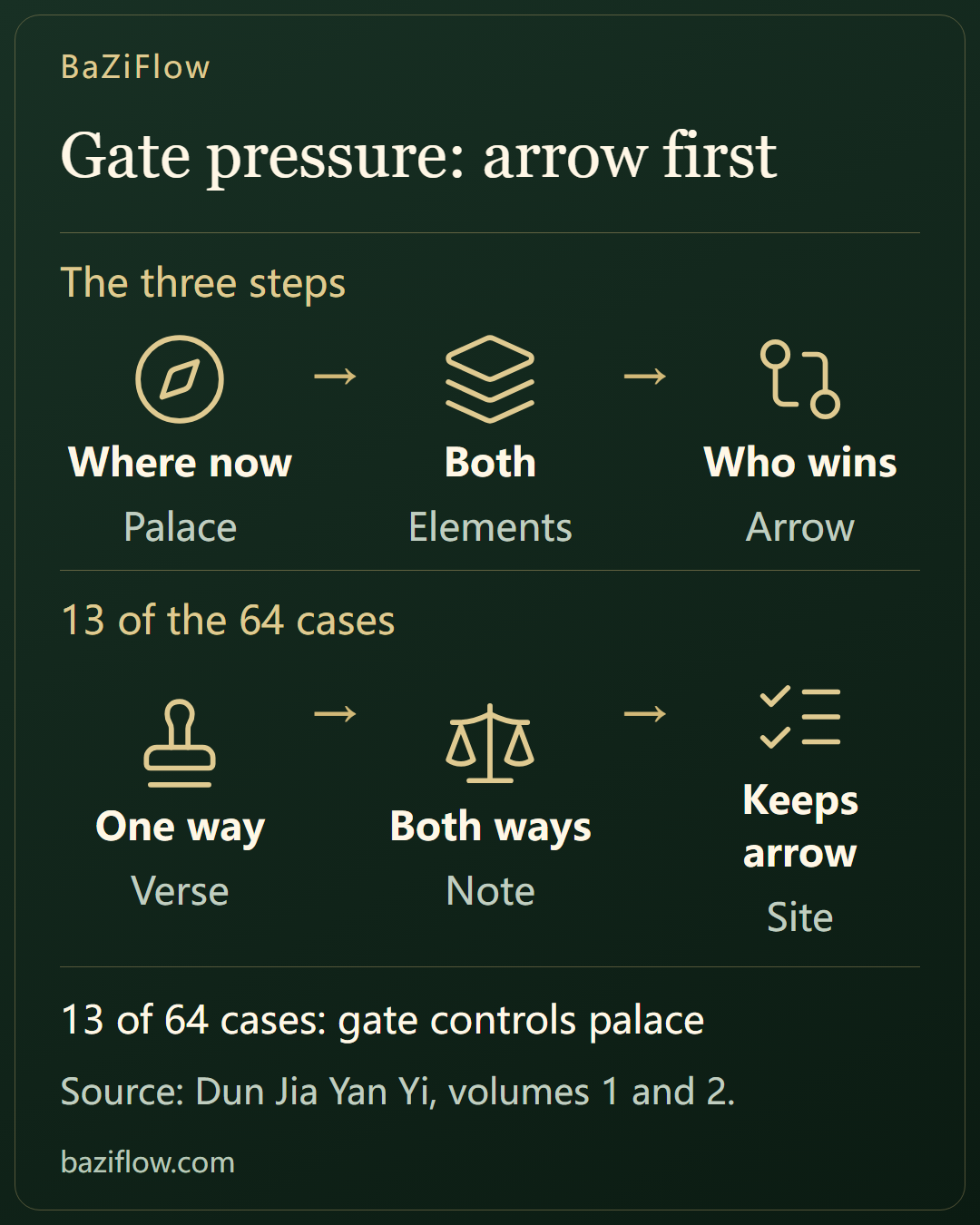
The look-up behind gate pressure: where the gate stands now, the elements of gate and palace, and who controls whom. The verse and note of Dun Jia Yan Yi disagree, and 13 of 64 cases are gate-controls-palace.
The short version8 min read
Gate pressure is one comparison between a gate and the palace it stands in: fix where the gate is now, take the two elements, and see who controls whom, while the very entry that defines it names the direction in two different ways.
- Three inputs decide it: the palace the gate stands in now, the element of gate and of palace, and the direction of control. Eight gates in eight outer palaces make 64 cases, 13 of them gate controls palace.
- In one entry the verse and the note call pressure by different names: the verse accepts only gate over palace, the note calls palace over gate harmful pressure and gate over palace auspicious pressure.
- When the arrow is the same, the book changes its wording by the gate's standing: a lucky gate under pressure is "lucky affairs do not succeed", an unlucky one "unlucky affairs are worse".
Read first
"Pressure" points two ways, and one entry names both
Gate pressure (门迫) looks like a state a gate is in, yet it is a comparison: set the element of the gate against the element of the palace under it and see which way the arrow points.
Volume 2 of Dun Jia Yan Yi (遁甲演义) has an entry headed "gate pressure, palace pressure". It opens with a line of verse (the Yanbo Diao Sou song in volume 1 has the same line), and a few lines of note follow. Laid out by relation, the two sources give the table below.
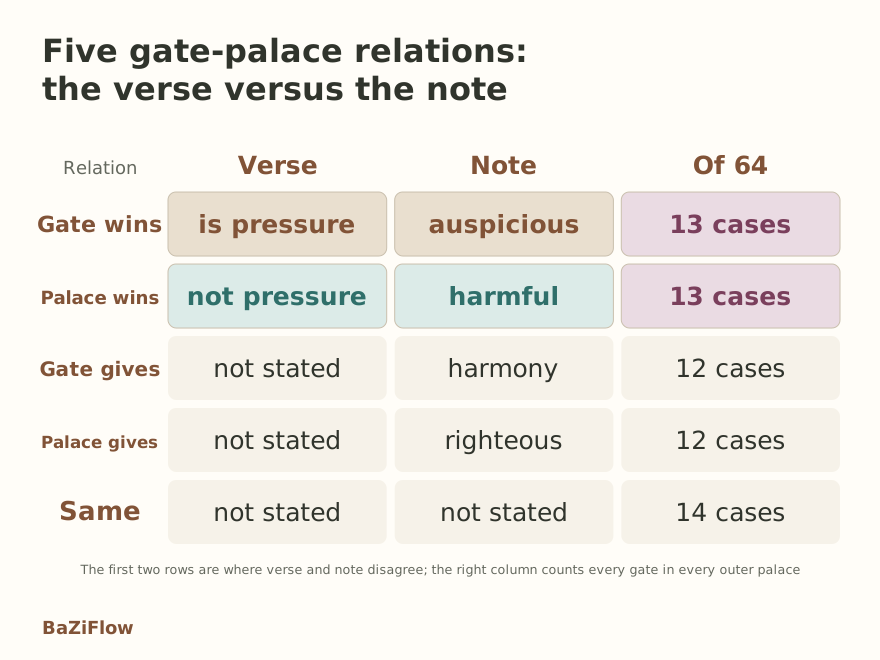
Relation table: the names come from the verse and the note of the gate-and-palace pressure entry in volume 2 of Dun Jia Yan Yi; the counts come from putting each of the eight gates into each of the eight outer palaces.
The left column lists the five relations a gate and its palace can stand in. The middle columns say what the verse and the note call each one. The right column counts how many of the 64 cases, eight gates in eight outer palaces, fall under each relation; the count is worked through later.
The verse takes one stand in two lines: a palace holding its gate in check is "not pressure", while a gate holding its palace in check is the "leading" kind. The note right after it uses another set of names:
Palace over gate: harmful pressure. Gate over palace: auspicious pressure. Gate feeding palace: harmony. Palace feeding gate: righteousness.
In the verse only gate over palace counts. The note names both directions, harmful pressure for palace over gate and auspicious pressure for gate over palace, and gives the two generating relations the names "harmony" and "righteousness". The book never explains what "auspicious pressure" would mean.
Three steps: palace, two elements, one arrow
Judging one case needs three things, and you stop at whichever one is missing.
Which palace is the gate in now
The eight gates move around the chart together as one ring, and the home palace is only the starting point. "The Rest Gate is at Kan One" names its home, not where it stands this hour, so the chart for that hour has to be set up first.
Take the two elements
A gate takes the element of its home palace: Rest Water, Life and Death Earth, Harm and Block Wood, View Fire, Shock and Open Metal. A palace takes the element of its trigram: Kan Water, Kun and Gen Earth, Zhen and Xun Wood, Qian and Dui Metal, Li Fire.
Read the arrow
There are five outcomes: gate controls palace, palace controls gate, gate generates palace, palace generates gate, and the same element. This step yields a direction only, with no "pressure" or "no pressure" yet.
How the ring turns and where the duty door is counted from is in the duty chief and the duty door. Here are two gates taken through the steps:
Enlarge diagram · scroll sideways to read
On a rotating chart the eight gates travel only through the eight outer palaces and never stand in the center; the center is Earth and lodges in Kun Two, also Earth, so it has no part in this step.
Eight gates times eight palaces: 13 of the 64 cases are gate over palace
Put each of the eight gates into each of the eight outer palaces and there are 64 cases. The eight gates carry only five elements (Shock and Open are Metal, Harm and Block Wood, Life and Death Earth), so there are really five kinds of row. Counted case by case: gate controls palace 13, palace controls gate 13, gate generates palace 12, palace generates gate 12, same element 14.
The book's eleven examples begin with the Open Gate in the third palace and the Rest Gate in the ninth, and every one is gate over palace. They are introduced by a word meaning "suppose", which marks a sample and nothing more. Gate by gate:
| Gate (element) | All gate-over-palace spots | Named in the book |
|---|---|---|
| Rest (Water) | Li Nine | Li Nine |
| Life (Earth) | Kan One | Kan One |
| Death (Earth) | Kan One | Kan One |
| Harm (Wood) | Kun Two, Gen Eight | Kun Two, Gen Eight |
| Block (Wood) | Kun Two, Gen Eight | Kun Two, Gen Eight |
| View (Fire) | Qian Six, Dui Seven | Dui Seven |
| Shock (Metal) | Zhen Three, Xun Four | Zhen Three, Xun Four |
| Open (Metal) | Zhen Three, Xun Four | Zhen Three |
The same rule fills in two more spots the book does not name: the View Gate in Qian Six (Fire over Metal) and the Open Gate in Xun Four (Metal over Wood). The book writes the Shock Gate in both the third and fourth palaces but the Open Gate only in the third. The two gates are both Metal, so their counts must match, which shows the list is a sample and not a full census.
Enlarge diagram · scroll sideways to read
Same arrow, different wording: lucky gate and unlucky gate under pressure
The arrow only answers "who presses whom". The book then words the same arrow in two ways, according to the gate's standing. The Sanyuan Jing (三元经) is quoted as saying:
When a lucky gate is pressed, its lucky business fails to come off; when an unlucky gate is pressed, its unlucky business turns heavier still.
The passage names Open, Rest, Life and View as lucky gates and Harm, Block, Death and Shock as unlucky ones, which splits the eight gates in half. Gates of the same element in the table above therefore pair up: Open and Shock are both Metal, Life and Death both Earth. In the same palace the arrow is identical, yet one case is worded as the good failing and the other as the bad worsening.
Enlarge diagram · scroll sideways to read
So gate pressure has two layers: the arrow, which the elements compute, and the wording, which the gate's name decides. The second layer is the book's statement and is only relayed here.
Write it as one line, then try three small cases
A judgment ends as one line: gate, palace, the two elements, direction, and whether the verse or the note was followed. For example "Block Gate / Gen Eight / Wood against Earth / gate over palace / verse and the volume 2 examples". Write "undecided" for anything missing and do not fill it from another field.
Three small cases
The Block Gate stands in Gen Eight. What is the relation?
The Block Gate is Wood and Gen Eight is Earth. Wood controls Earth, so the gate controls the palace, and it is one of the cases the book names.
The View Gate in Qian Six?
The View Gate is Fire and Qian Six is Metal. Fire controls Metal, so the gate controls the palace. The book does not name this spot, but the same rule yields it.
The Rest Gate in Dui Seven?
The Rest Gate is Water and Dui Seven is Metal. Metal generates Water, so the palace generates the gate. The verse is silent on this relation and the note calls it "righteousness".
This 64-case count can be read next to the three sample cards in gate pressure, striking punishment and tomb entry to see what input each label needs. Strike punishment swaps the arrow for "which instrument stands on which punishing spot"; it is the next piece, in what makes six-instrument strike punishment hold.
Questions readers ask next
Which counts as gate pressure, gate over palace or palace over gate?
The book gives no single answer. The verse calls only gate over palace pressure, while the note names palace over gate "harmful pressure". This site lists the rule as pending, so a citation has to say which line it follows and keep the direction of control.
If the same gate lands somewhere else, does the result change?
It can. The gate keeps its element and the palace brings its own, so the arrow may flip. The Life Gate is Earth: in Kan One (Water) Earth controls Water, in Zhen Three (Wood) Wood controls Earth. The gate name is unchanged and the relation has reversed.
The book lists eleven examples. Are those eleven the only gate-controls-palace cases?
No. Counting every case under the same element rule gives 13, and two of them, the View Gate in Qian Six and the Open Gate in Xun Four, are not named. The examples are introduced by a word meaning "suppose", which marks them as samples, not a full list.
Was this article helpful?
Sources & references
Continue reading
Strike Punishment (六仪击刑): Which Instrument, Which Branch, Which Palace ↗
Three Wonders in the Tomb (三奇入墓): Choose the Tomb Table, Then See Where the Wonder Lands ↗