

Where symbolic stars sit in a chart
Content version · · Sources & references
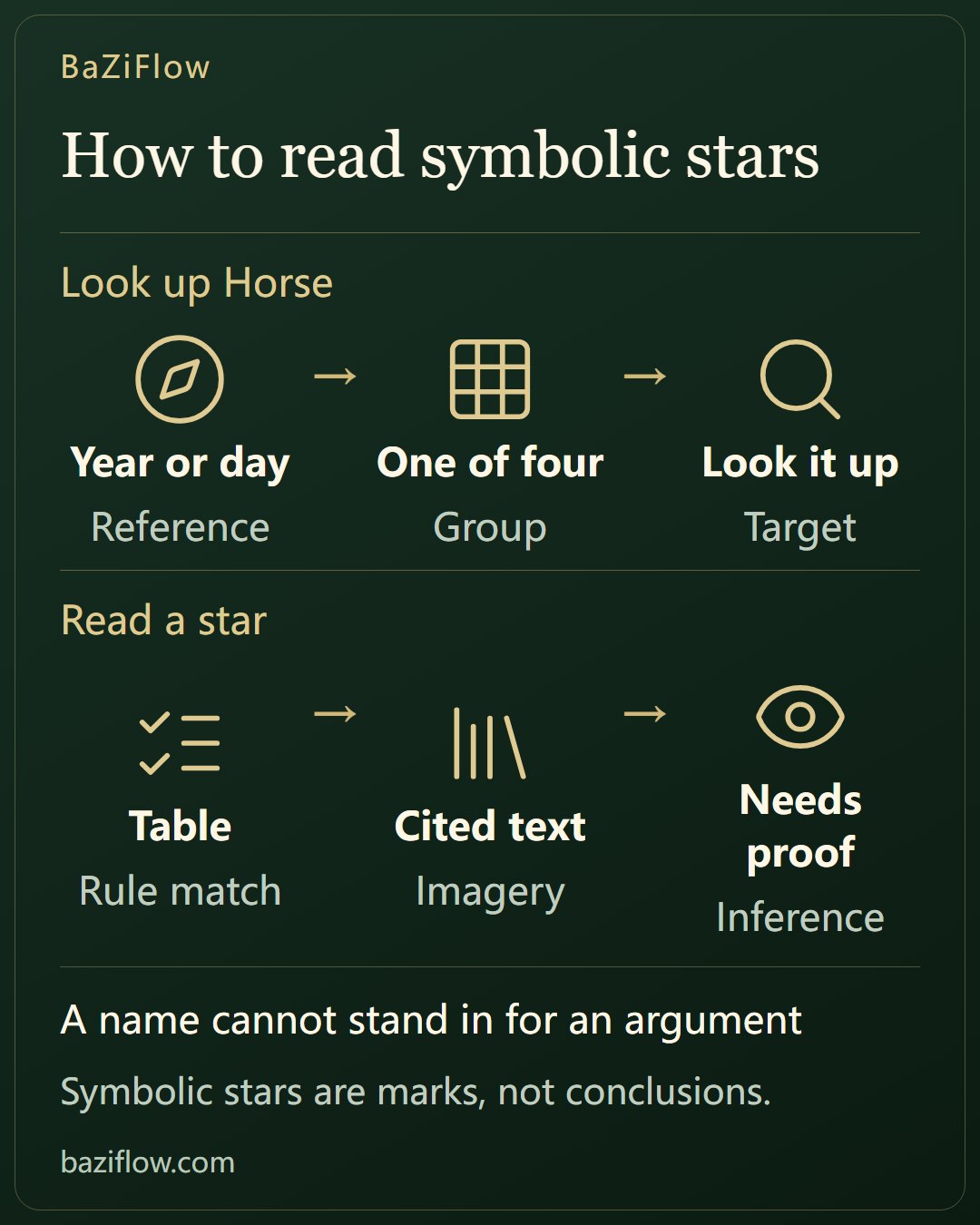
Symbolic stars are marks looked up by fixed rules, not stars in the sky. Four Traveling Horse pairings, three layers of checking and a six-item record separate reference, rule and real-life inference.
The short version5 min read
Symbolic stars are not stars in the sky but marks looked up from stem and branch relationships. Check the reference and the rule first, then the imagery; a name cannot stand in for an argument.
- Shen Sha (symbolic stars) are traditional marks found by fixed rules from stem and branch relationships: look up the rule first, then ask what it symbolises.
- Two tools can print different stars for one record, most often because their references differ (year branch or day branch) or their rule tables differ.
- More labels are not more evidence. San Ming Tong Hui collects the stars; Zi Ping Zhen Quan argues a pattern is not decided by stars. The two books have different priorities.
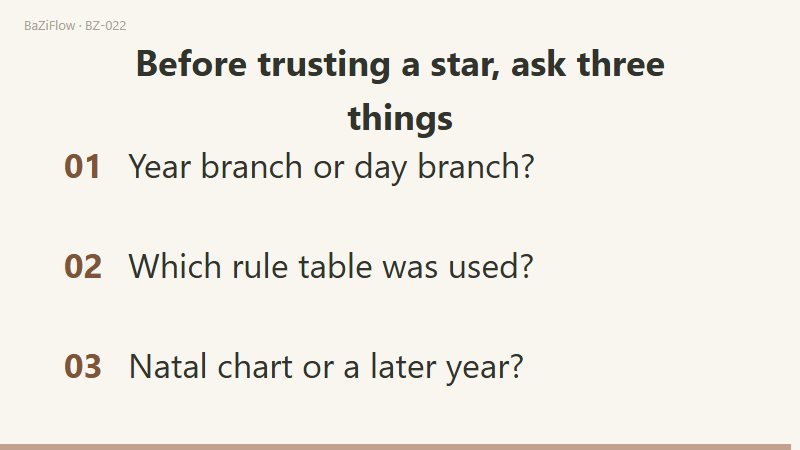
Read first
Reading a BaZi chart for the first time: the four pillars and the Day Master ↗
Symbolic stars are looked up, not seen in the sky
Imagine two chart tools reading the same teaching record: year branch Rat, month branch Tiger, day branch Rabbit. App A prints "Traveling Horse". App B does not. Which one is wrong? Most of the time neither is. They simply start from different references.
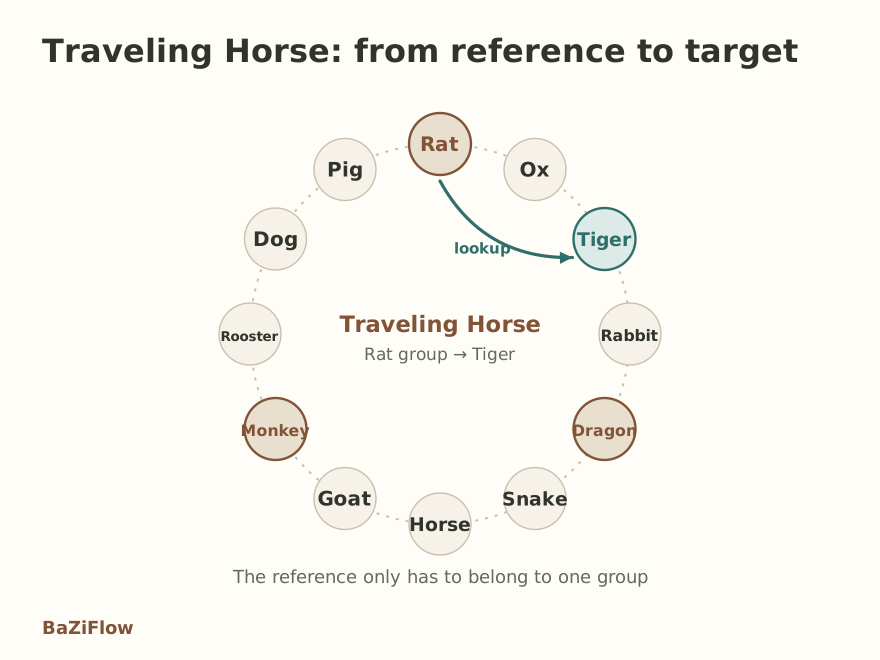
Lookup sketch: the reference Rat sits in the Monkey-Rat-Dragon group and the target is Tiger. It shows how the rule works, not anyone's travel.
Enlarge diagram · scroll sideways to read
Shen Sha, often translated as symbolic stars, are traditional marks found by fixed rules from relationships between stems and branches. The "star" in the name need not be a visible star, and words like "Nobleman" or "Loneliness" do not describe events that have already happened.
How Traveling Horse is looked up: pick a reference, then find the target
The Traveling Horse discussion in San Ming Tong Hui, volume three, gives four basic correspondences. The left column is the group the reference branch belongs to; the right column is the branch to look for in the chart. The reference only has to belong to one group. All three members need not appear in the chart.
Enlarge diagram · scroll sideways to read
Pick a reference
State whether the lookup starts from the year branch or the day branch.
Find its group
Rat sits in the Monkey-Rat-Dragon group; Rabbit sits in the Pig-Rabbit-Goat group.
Is the target there?
Rat points to Tiger, and the month pillar is Tiger: match. Rabbit points to Snake, and no pillar holds Snake: no match.
So App A most likely looks up from the year branch and App B from the day branch. The table is not wrong; the mistake is comparing outputs without asking about the reference. If Snake appears only in a year under discussion, that is an annual-layer encounter and cannot be written into the birth pillars.
More labels are not more evidence
One pair of stems and branches can trigger several names, and one name can be listed in several places. These are often different names for the same relationship, not independent confirmations. When you read a symbolic-star note, split it into three layers:
Enlarge diagram · scroll sideways to read
Three common misreadings
One point for each lucky name, minus one for each unlucky name
Several aliases of one relationship get counted as several pieces of evidence.
Nobleman means help, Horse means a move, Loneliness means staying single
These are traditional imagery, not events that have happened and not guarantees.
Judging from the word "Killing" or from a same-named mark elsewhere
A word like "Killing" says nothing about character, illness or reliability, and a same-named mark in another system cannot be moved into BaZi.
Two classical books, two priorities
San Ming Tong Hui, volume three, collects many symbolic stars with their conditions and sets different views side by side, so one modern short table cannot be treated as the single rule shared by all classics. Zi Ping Zhen Quan, in its chapter on stars having no bearing on pattern, argues that a pattern succeeds or fails by the four pillars and the Useful God, not by lucky or unlucky stars alone.
Enlarge diagram · scroll sideways to read
Six things to keep whenever you read a symbolic-star note
Recorded this way, "A has it and B does not" becomes a specific question you can trace, instead of an argument about which tool is more accurate.
Enlarge diagram · scroll sideways to read
To check the fields, start with the Four Pillars and Day Master. For where symbolic stars rank within a whole argument, see patterns formed and broken. For another family of table-based marks, read twelve life stages and void branches.
Questions readers ask next
Are symbolic stars visible stars in my chart?
No. They are traditional marks found by fixed rules from stem and branch relationships. The word "star" is a habit of naming and does not point to a visible star in the sky.
Why do two apps show different symbolic stars for the same person?
Usually the references differ: one looks up from the year branch and the other from the day branch, or they use different editions of the table. Compare reference and rule version before asking which one is wrong.
Does a chart with many symbolic stars read better?
No. Several labels are often aliases for one relationship, so a count is not an amount of evidence. Lucky and unlucky names cannot simply be added and subtracted; the conclusion belongs in the argument for the whole chart.
Was this article helpful?
Sources & references
Continue reading
Bazi pattern formation: follow the conditions and assistance ↗
Nayin and ordinary elements: why Jia-Zi Metal does not replace Jia Wood ↗
Twelve Life Stages and Void Branches: Two Tables, Two References ↗