

Leave room for a child to grow
Content version · · Sources & references
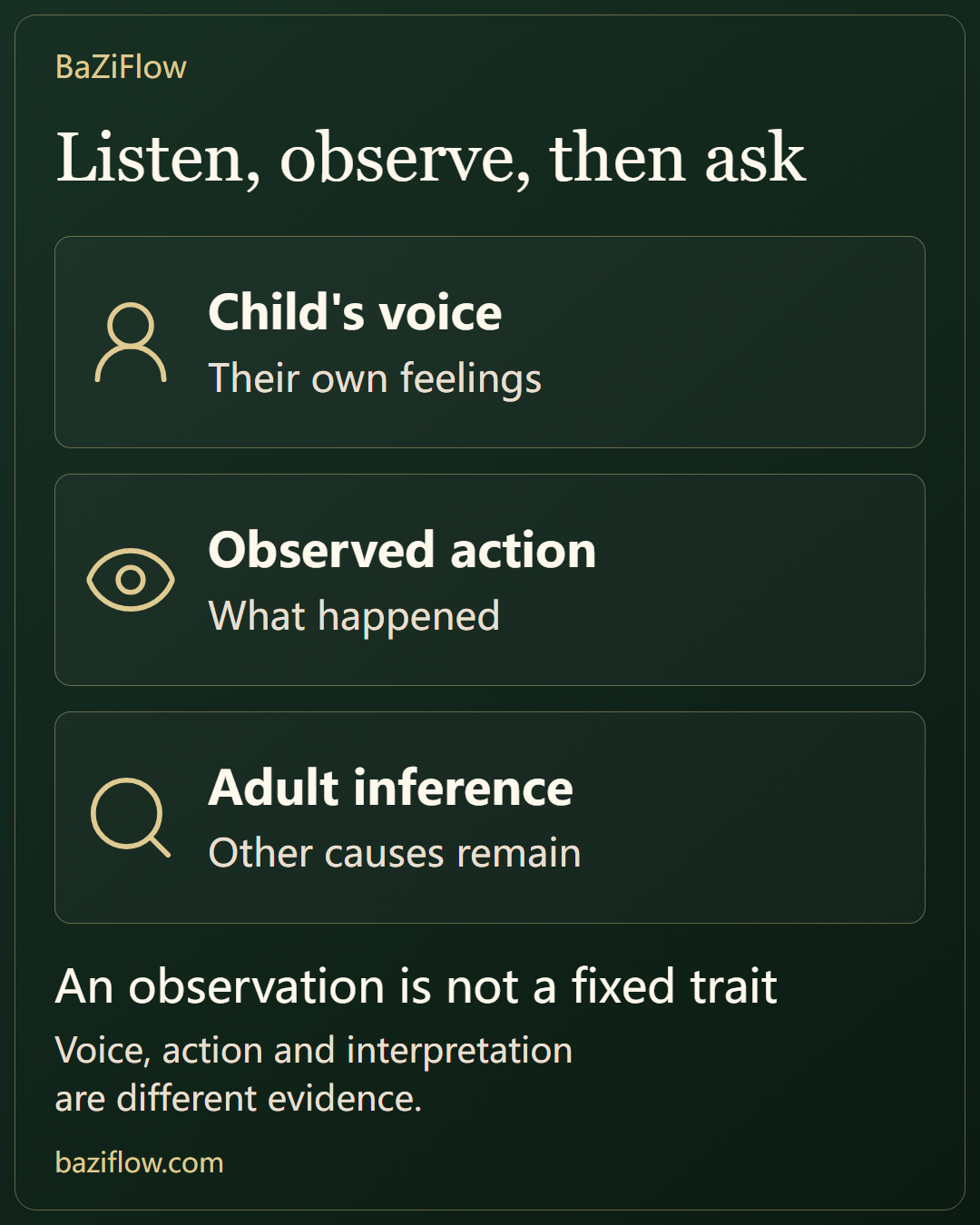
Separate the child’s words, observed behavior and an adult’s interpretation. Preserve privacy and opportunities to try things; a more detailed chart does not authorize a verdict on ability or identity.
The short version6 min read
Not joining one activity does not establish what kind of person a child is. Listen to their account, describe the visible action and identify your own interpretation separately. Later experience can then change the adult’s understanding.
- A child’s account, an observation and an adult inference have different sources.
- One attempt does not establish a lifetime identity or an ability ceiling.
- Chart study is not child assessment, and private records need care when shared.
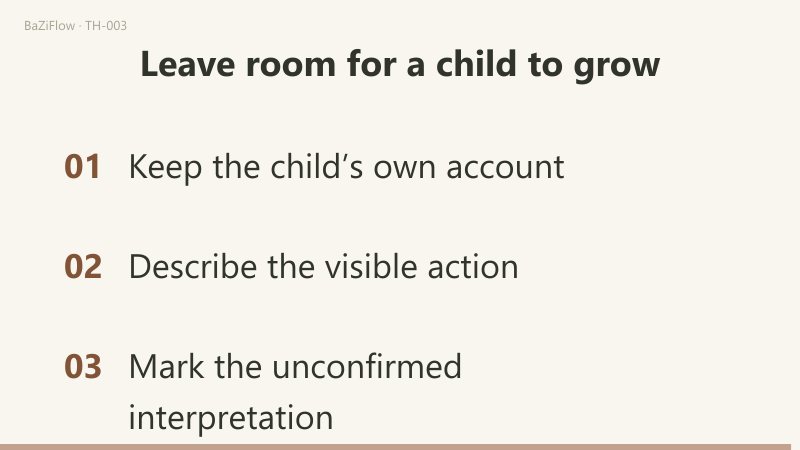
Preserve the opportunities that a label might remove
Before using a reading about a child, consider what it could change in the adult's behavior. Would a description lead you to stop offering a subject, decide a future occupation, or interpret every disagreement through the same trait? A chart should not be used to set an ability ceiling or close an opportunity before the child has had a chance to explore it.
One unsuccessful art activity does not establish a lack of creativity. One impressive performance need not become a destiny to be exceptional. Describe what the child did and how they approached it. Let future attempts remain attempts, rather than tests of whether an adult's label was correct.
One activity
- An event to describe
A fixed ability limit
- A claim beyond that event
Keep the child’s voice apart from adult interpretation
- Observation
- An action in a stated situation, without adding an unspoken motive.
- Interpretation
- An adult’s proposed meaning, kept open to missing information and revision.
Keep three records instead of one conclusion
The child says an activity is too noisy. You observe them moving to a quieter place. You interpret that as being unsociable. Those are three different entries, and the first two do not require the third. Keeping the layers visible makes room for another explanation.
UNICEF's communication guidance for young children encourages listening, using language suited to the child's age and directing comments toward behavior rather than the whole person. That is a reference for communication, not evidence that a chart can identify a child's needs. Ask and observe without requiring the child to endorse a symbolic description.
| Record | What belongs there |
|---|---|
| The child's voice | What they actually express about the experience |
| Observation | The situation and action you could describe |
| Adult interpretation | Your proposed meaning, reasons and missing information |
If the child does not want to speak, or cannot yet explain the experience clearly, leave the gap visible. Silence is not agreement with the reading. Repeated questions designed to obtain the expected answer do not create independent evidence either.
Child
- What was recorded?
- Says the activity is noisy
- Kind of information
- Direct expression
Observer
- What was recorded?
- Sees a change of location
- Kind of information
- Visible behavior
Interpreter
- What was recorded?
- Infers a dislike of groups
- Kind of information
- A provisional explanation
Context comes before a permanent trait
Not joining an activity may involve unfamiliar instructions, an unfamiliar setting or simply a lack of interest at that moment. Check the situation before promoting an isolated action into an account of the child's nature. A different task, time or group may reveal a different pattern.
An observation record can include what happened before the activity, what the child tried and what was different on another occasion. Do not save only the examples that fit the interpretation. A contrary example may be the most useful information for changing an adult's understanding.
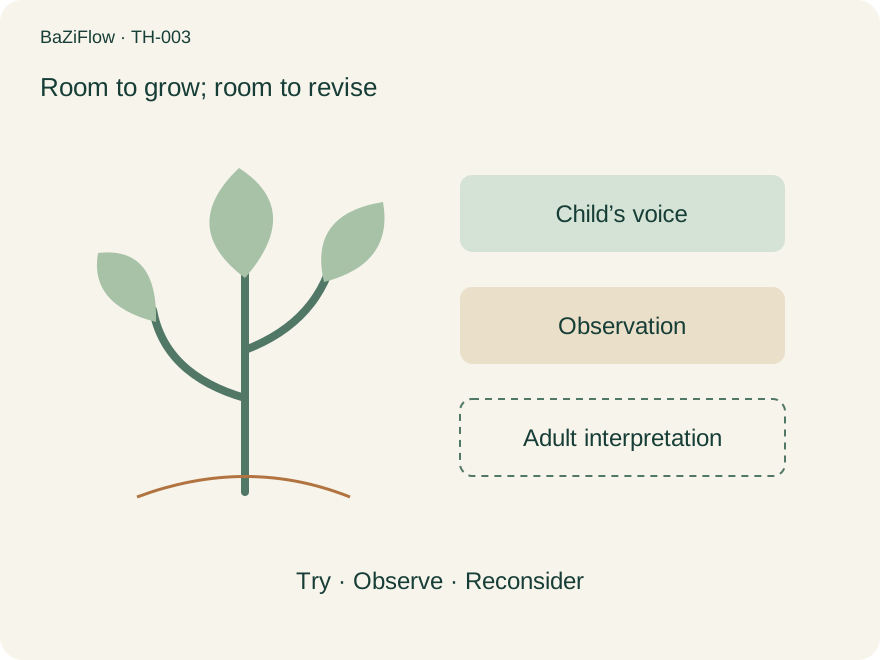
Original BaZiFlow parenting-reading diagram. The plant suggests open possibilities, not chart-derived developmental stages.
The plant in the diagram has more than one direction of growth. The records beside it remain separate, and the adult interpretation is marked as revisable. This is an educational image, not a developmental scale or a claim that chart factors determine stages of childhood.
Unfamiliar setting
- Check what was different
A different occasion
- Keep contrasting observations
Whole-chart reading is still not a child assessment
If your aim is to learn astrological structure, begin with a whole-chart reading order instead of selecting one planet and treating it as a complete explanation. Carole Taylor's introduction organizes planets, signs, houses and their relationships together. That describes the internal structure of a teaching approach; it does not demonstrate an ability to assess child development or forecast a child's future.
A more comprehensive interpretation contains more conditions, but it does not grant more authority to define the child. Interests, practice, circumstances and the child's own choices remain relevant. Do not use symbolic material to bypass those sources of information.
If a paragraph works equally well after substituting another child's name, inspect its basis. The guide to evidence-based personal readings helps separate input-specific explanation from broadly applicable language. An elaborate paragraph is not necessarily evidence of knowing this particular child.
Whole-chart structure
- Learning aim
- Relations among components
- What it does not establish
- A developmental assessment
Practical support
- Learning aim
- Respond to actual difficulties
- What it does not establish
- Proof of a symbolic account
Treat privacy as part of the record
A private note and a public discussion need different levels of detail. Keep only information required for the question. Do not automatically attach full birth details, a school name, family history or the child's private words when sharing a reading. The parent-child relationship does not make every personal detail suitable for public circulation.
As the child's understanding changes, explain the purpose of the record in language they can understand. The exercise is for adults to improve their questions and recognize the limits of their interpretations. The child is not responsible for making the reading look accurate or the notebook look complete.
When information is corrected, retain the earlier record and the reason for revision. Do not rewrite what originally happened to match a later explanation. Saving evidence and uncertainty provides a way to preserve that distinction without filling every unknown with a guess.
For practical difficulties that continue to affect learning or daily life, seek appropriate educational or professional support based on the actual difficulty. Symbolic interpretation is not a replacement for assessment. A constructive parenting reading leaves the adult more attentive to the child's experience and more willing to revise an assumption, while keeping the child's future open.
Private notes
- Only details needed for the question
Public discussion
- Remove identifying and private material
Record two confirmable details
The child says it is noisy and moves somewhere quiet. Do not replace those entries with unsociable.
Keep an alternative explanation
Avoiding noise is not the same as avoiding other people. The latter would need the child’s account and other situations.
Respect the next choice
Ask whether a quieter activity would suit them, while leaving room not to participate. The child need not demonstrate that a reading was correct.
Questions readers ask next
Can a whole-chart reading assess development?
A fuller symbolic account is still not a developmental assessment. Continued practical difficulties call for appropriate educational or professional support based on actual needs.
Should I supply a reason if the child does not answer?
Leave the reason unknown. Offer clear, age-appropriate ways to respond without treating silence as agreement or repeatedly seeking the expected answer.
How can a successful attempt be acknowledged?
Describe the action and method, such as adjusting a material patiently or completing a step. This recognizes the work without attaching every future performance to a title.
Was this article helpful?
Start reading
Personalization Needs a Reason That Changes with the Input ↗ · Cross-system studies
Keep an Evidence Trail That Can Survive a Correction ↗ · Shared methods
A whole-chart reading needs an evidence trail ↗ · Western astrology
Sources & references
Continue reading
Personalization Needs a Reason That Changes with the Input ↗