

Opposition: the one-sided orb at 180°
Content version · · Sources & references
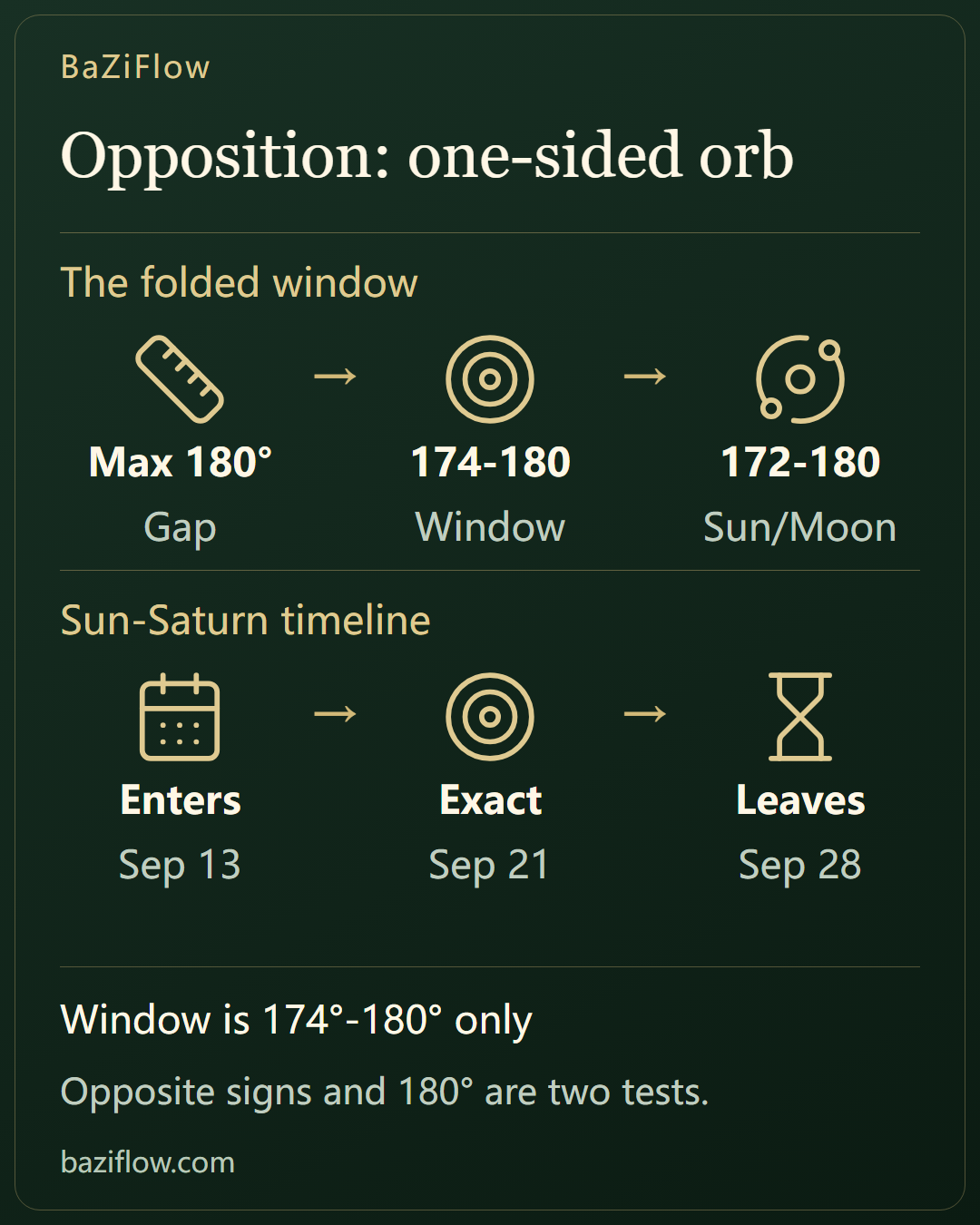
An opposition is a 180° ecliptic difference. Three dials, Ptolemy's four distances, a full-moon window and the September 2025 Sun-Saturn opposition show how the 174°-180° window works.
The short version8 min read
An opposition puts two points at opposite ends of the ecliptic, 180° apart. Separation is measured along the shorter arc and cannot exceed 180°, so the orb folds into the single side next to 180°.
- The site's orb for an opposition is 8° when the Sun or Moon takes part and 6° otherwise, taking the wider end. Folded, the window runs 172°-180° or 174°-180°.
- Ptolemy writes 180° as two right angles and six signs, calls the distance self-explanatory and files it as discordant. His "different sex" reason does not check out against his own alternating table: signs six apart share a sex.
- In the Sun-Saturn opposition of September 2025 the degree window lasted 15.2 days. By sign, the first 9.1 days were opposite signs and the last 6.0 days were five signs apart.
Read first
Aspects and orbs in astrology: how to calculate the angle between two planets ↗
180° is the ceiling of separation
In plain words first: an opposition is two points standing at opposite ends of the ecliptic circle, joined by one straight line.
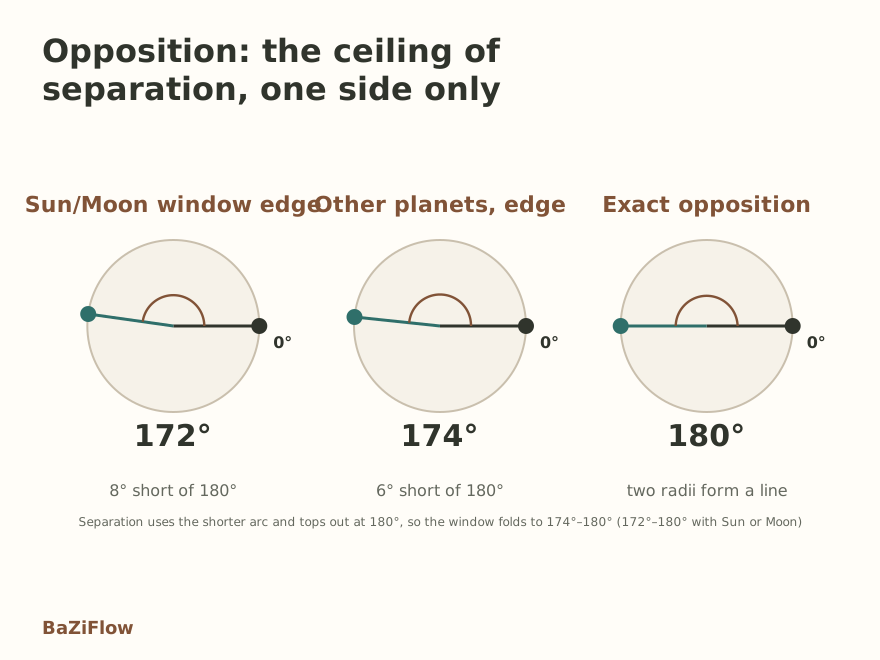
Three dials: the 0° radius stays on the right and the second radius turns to 172°, 174° and 180°; the orb numbers are the site's convention.
The separation of two points is measured along the shorter arc, so it can only fall between 0° and 180°. At 180° both arcs are equal; one step further and the shorter arc starts to shrink. The windows of the conjunction, sextile, square and trine sit on both sides of their target angles, but for the opposition the target angle is the ceiling itself.
In ecliptic longitude there is 6° of room on either side of the point opposite a planet. Folded into separation, that is 174° to 180°. With the Sun or Moon involved the room is 8°, and the window reads 172° to 180°.
The book's "opposite": one use needs no explanation, another reads it as distance
The chapter on configurations in Book I of the Tetrabiblos (chapter XVI in the Ashmand translation) puts the opposition first among the four distances:
The opposite distance is two right angles, that is six signs, a hundred and eighty degrees. This distance is clear in itself and needs no further explanation; the others have to be derived by dividing the half circle into halves and thirds.
The book files it as discordant, on the ground that it joins signs of a different kind (the same chapter defines "same kind" as entirely masculine or entirely feminine, so "different kind" means different sex). That reason can be checked against the book's own table of the sexes, and the middle column is the result of the check:
Enlarge diagram · scroll sideways to read
The table of the sexes is in chapter 12 of Book I (XV in the Ashmand numbering): the twelve signs alternate masculine and feminine, with Aries and Libra masculine. Because the alternation has period two, signs six apart always share a sex, so the "different sex" reason does not fit the opposition. The same rule does hold for the signs two and four apart; the derivation is in the sextile article.
The opposition has a second use in the book, in the chapter on the houses of the planets. Saturn takes the outermost place and is set across from the homes of the luminaries:
Saturn is cold and moves in the orbit farthest from the luminaries, so he takes the signs opposite Cancer and Leo, Aquarius and Capricorn; the configuration of opposition does not work toward the production of good.
Here the opposition is distance in position: Saturn's homes stand directly across from the home of the Sun and the home of the Moon.
Seven 180° pairs a chart carries before any planet moves
A few oppositions are fixed by structure and wait for no planet. In the house table, cusp 7 is always cusp 1 plus 180°, and cusp 4 is always cusp 10 plus 180°; the six pairs 1-7, 2-8, 3-9, 4-10, 5-11 and 6-12 hold in both whole-sign and Placidus houses. The engine computes only half of the cusps independently and adds 180° for the rest.
Enlarge diagram · scroll sideways to read
Lilly's method for setting up a chart rests on the same fact: once the tenth cusp is known at some degree of some sign, the fourth cusp goes at the same degree of the opposite sign. The lunar nodes are the seventh pair, the South Node being the North Node plus 180°, and the site uses the mean node.
These seven pairs are exact at every birth moment, so they never appear in the aspect table. That table lists two bodies that each move on their own, and their 180° has to wait for a particular day.
The full moon: one 180°, three windows
A Sun-Moon opposition is a full moon. On 26 October 2026 at 04:12 UTC the engine puts the Sun-Moon separation at its peak, 179.997°. That is 12:12 in Beijing and 00:12 in New York daylight time on the same calendar day.
Few bodies can stand opposite the Sun: the Moon, and Mars through Pluto. Mercury and Venus never can. A daily scan over 1900-2100 (UTC noon) puts their largest separation from the Sun at 27.79° and 47.27°, so the only aspects the Sun can make with them are the conjunction and a semisextile near 30°. For the dates of Mars oppositions, see Mars by sign and house.
With the same full moon, a different way of writing the orb gives a different window length:
Enlarge diagram · scroll sideways to read
The top bar follows William Lilly in Christian Astrology (1647). He gives every planet its own orb and, when two bodies meet, takes half of each and adds them. His Sun-Moon example takes half of 15° for the Sun, 7°30′, and half of 12° for the Moon, 6°, which sum to 13°30′. The site's 8° is a different convention, and its window is almost half as long.
September 2025: a Sun-Saturn opposition across the equinox
On 1 September 2025 at 07:15 UTC Saturn slipped back from Aries into Pisces and stayed near 28° Pisces. The Sun moved across to the far side, and a Sun-Saturn opposition followed. Split into three stretches:
Enlarge diagram · scroll sideways to read
The exact moment came on 21 September at 05:42 UTC, with the Sun at 28°30′ Virgo and Saturn at 28°30′ Pisces. The two bodies have identical degrees inside their signs: for two points six signs apart, an exact opposition always falls on the same degree.
Two days later the Sun entered Libra (22 September, 18:20). Counted by signs, Libra and Pisces are five signs apart, and the chapter of the Tetrabiblos on signs without familiarity files five signs apart as unconnected. Counted by degrees, the separation was still 178.4°, and the window lasted another 6.0 days. For the same two bodies in the same window, the two methods give different names after that moment. The site counts by degrees.
Two exercises
On 23 September at UTC noon the Sun is at 0°43′ Libra and Saturn at 28°19′ Pisces. Is that an opposition?
The separation is 177.61°, 2.39° off 180° and inside the 8° allowed with the Sun, so yes. By sign the two are five signs apart.
On 3 September at UTC noon the Sun is at 11°14′ Virgo and Saturn at 29°50′ Pisces. And now?
The signs are opposite, but the separation is 161.40°, 18.60° off 180° and far outside the window.
Writing an opposition into a record
A complete record has four layers:
Enlarge diagram · scroll sideways to read
With the four layers written down, the opposition can be put back into the whole chart; for how to read it there, see conjunction, opposition and square. Thirty degrees short of 180° in the aspect table sits the quincunx.
Questions readers ask next
Is a full moon the same thing as a Sun-Moon opposition?
It is the same geometry: the ecliptic longitudes of Sun and Moon differ by 180°. The calendar full moon marks the exact instant, while the aspect window stretches over many hours on both sides, so the two use different time conventions.
Do two planets in opposite signs always form an opposition?
Only the degrees decide. Opposite signs just put the planets in opposite halves of the circle, and they can still be 160° apart. The reverse also happens: one planet at 29° Leo and another at 3° Pisces are five signs apart yet only 4° off 180°.
Can Mercury or Venus ever oppose the Sun?
No. Both orbit close to the Sun. A daily scan over 1900-2100 gives a largest Sun separation of 27.79° for Mercury and 47.27° for Venus, nowhere near 180°.
Was this article helpful?
Sources & references
- Ptolemy, Tetrabiblos Book I (F. E. Robbins text on Perseus/LacusCurtius): the four aspects, signs without familiarity, the houses of Saturn ↗
- TimePassages Support: Why Don’t I See Certain Aspects in My Chart? ↗
- NASA Science, About the Planets ↗
- William Lilly, Christian Astrology (1647), Of the Twelve Houses (cited for the passages named in the text; chapter and page cross-check pending) ↗
- Ptolemy, Tetrabiblos (J. M. Ashmand translation, 1822), chapter numbering as cited in the text ↗
Continue reading
The Trine (120°): Four Triangles of Signs and Windows That Last a Day or a Year ↗
Quincunx (150°): The Five-Sign Distance, Read From Two Sun-Saturn Passes in 2026 ↗
Conjunction, opposition and square aspects: measure the angle before judging good or bad ↗