

Recognizing Guanyin Hundred Lots
Content version · · Sources & references
Understand what a hundred-lot title establishes, compare historical and institutional evidence, and test catalog completeness without mixing editions.
The short version6 min read
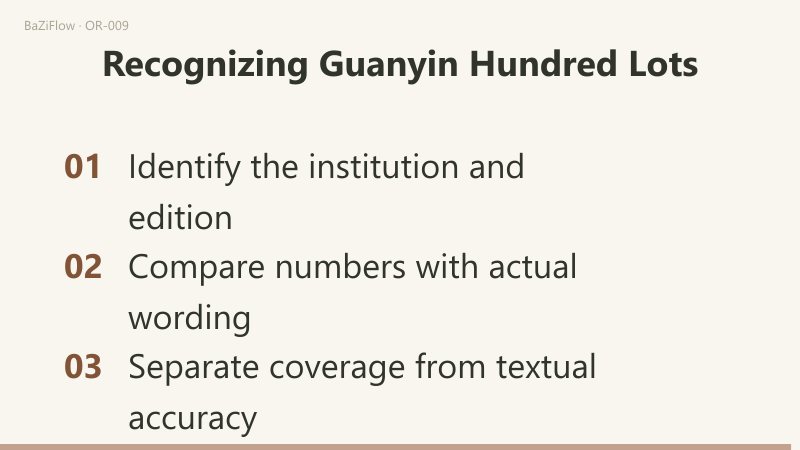
A hundred-lot label gives a catalog a boundary, not an automatic identity for every item. Connect institutional descriptions to the material in hand before transferring another version’s interpretation.
- Recorded collections of one hundred and one hundred thirty do not establish a single unchanged lineage.
- Matching names and numbers still require edition and wording comparison.
- Rows, distinct identifiers and textual accuracy are separate checks.
Read first
What are oracle lots? Numbers, poems, and narrative references ↗
Why the same oracle-lot number can have different versions ↗
What does “one hundred” actually tell you?
The name Guanyin Hundred Lots identifies a religious association and a claimed collection size. It does not, by itself, tell you the wording of lot one, the story assigned to lot fifty, or the grade printed beside lot one hundred. Those belong to particular materials and editions.
This is an overview of how to recognize and read a hundred-lot collection, not a sequence of one hundred individual readings. It does not elevate one modern website into the standard original for every setting. The first task is to establish which collection a paper belongs to and whether the number, poem, and later explanation still refer to the same material.
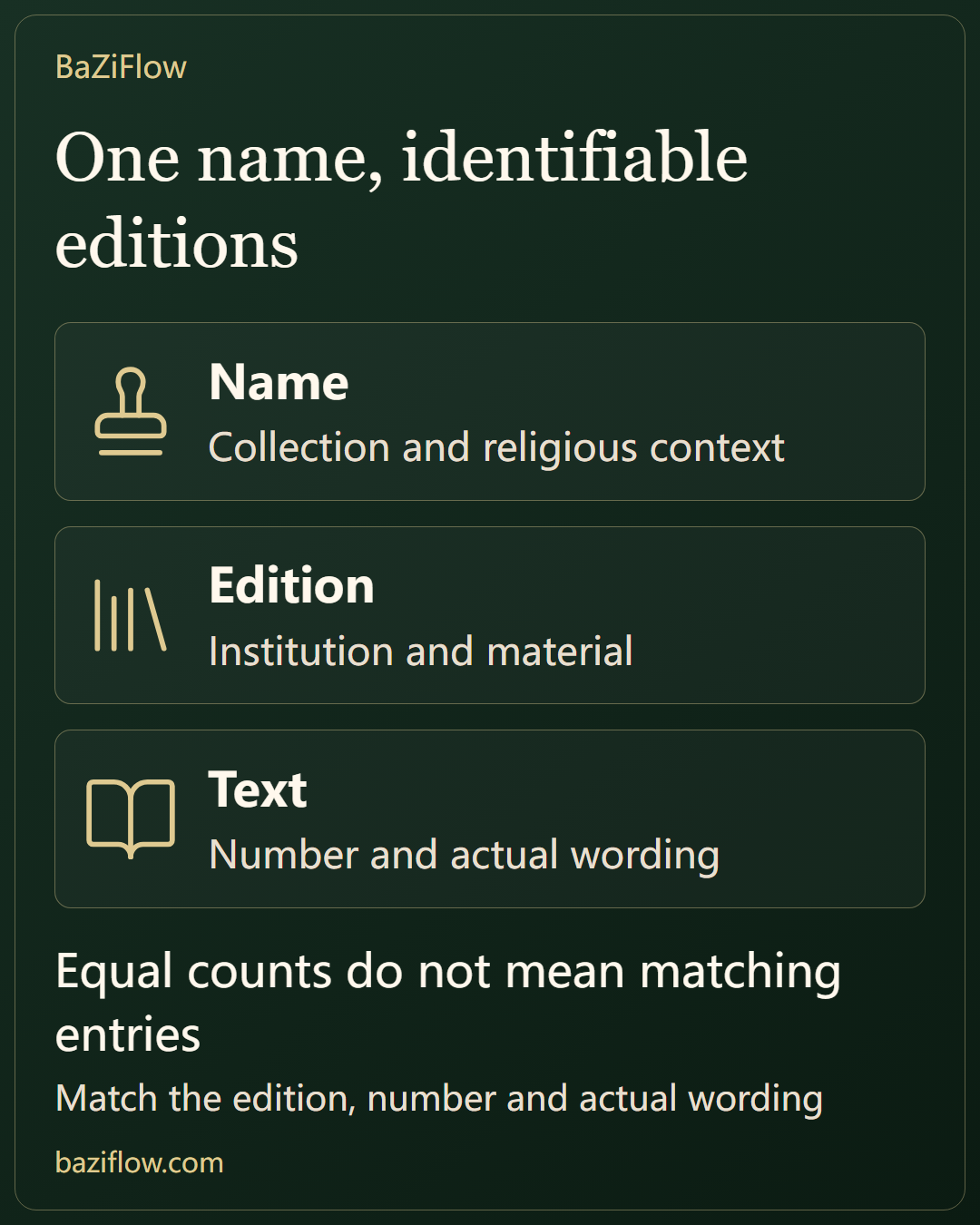
Name
- Collection context
Edition
- Material identity
Wording
- The actual entry
A collection name does not identify every text
- Distinct identifiers
- The number of different identifiers, with repetitions counted once.
- Coverage
- Expected identifiers present divided by the expected total, not an accuracy rate.
A historical count is evidence of a count, not a complete lineage
In the temple section of Zongjian's Shimen Zhengtong (释门正统), the examined passage mentions a hundred Bodhisattva lots and a hundred and thirty at Yuantong in Yue, following discussion associated with Tianzhu Guanyin. This is textual evidence that the work records collections of different sizes. It does not support reducing every Guanyin-related lot practice to exactly one hundred entries.
Nor does a historical mention of one hundred prove that a modern set preserves every item unchanged. Establishing a particular poem's transmission requires comparable wording and identifiable editions. A repeated number cannot fill the intervening documentary gaps.
The passage has a religious perspective on efficacy, which is not treated here as a measured prediction rate. This overview also does not derive a unique inventor or a precise founding year from the count. Evidence that a collection size was recorded and evidence about the formation of a modern edition answer different questions.
Hundred
- Recorded count
Hundred thirty
- Another recorded count
Modern poem
- Needs textual comparison
Current institutions identify their own materials
An article in Lungshan Temple's issue-43 magazine introduces two groupings through different story headings for their first lots. That is a useful lead within the author's account, not proof that only two versions can exist everywhere. Actual text still needs checking beyond the heading.
The Chinese Temples Committee's Guanyin search accepts numbers from one through one hundred. Its accompanying editorial explanation describes comparative work and a reference presentation that retains local variation. Senso-ji's FAQ also calls its own omikuji Kannon Hyakusen, or Guanyin Hundred Lots. These statements locate names and institutional contexts; they do not establish identical poems at corresponding numbers.
Shared characters can make cross-language transfer especially tempting. A familiar title is not enough to import an online Chinese explanation into a different paper obtained elsewhere. Check the edition and wording first. The same caution applies to actions at the site: procedure and local custom treats that separate question.
A hundred rows can still be an incomplete catalog
Imagine a catalog intended to contain numbers one through one hundred exactly once. It has one hundred rows, but number 42 appears twice and number 43 is missing; every other expected number appears once. This is an invented data exercise, not a claim about defects in any actual temple collection.
| Check | Result in the exercise | Meaning |
|---|---|---|
| Total rows | 100 | A row count alone cannot establish completeness |
| Distinct numbers | 99 | One duplicate has occupied another entry's place |
| Repeated number | 42 | Both rows need comparison with the source |
| Missing number | 43 | A same-number item from another edition is not an automatic replacement |
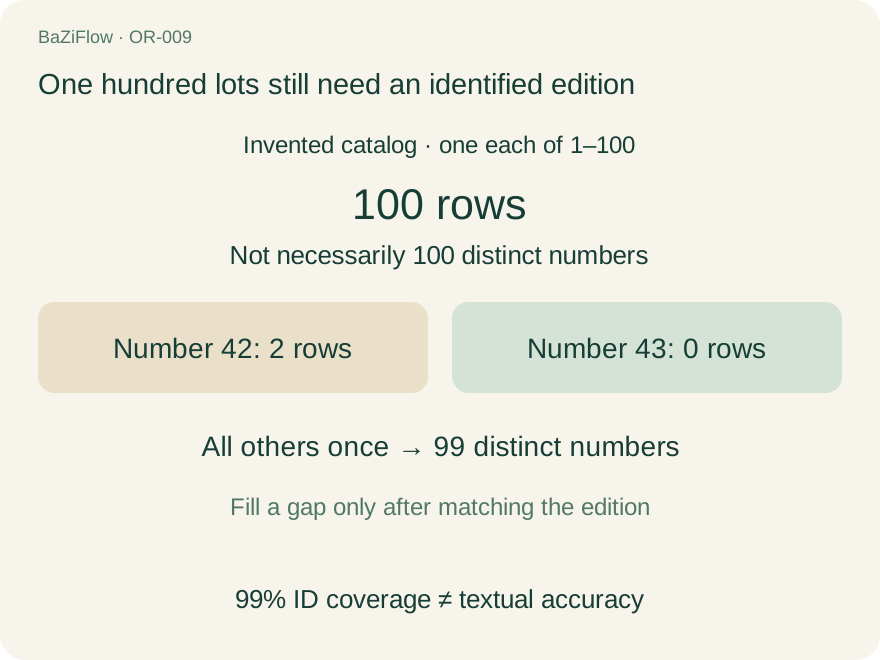
Original BaZiFlow catalog exercise. The duplicate and omission are invented, not findings about a real collection.
Ninety-nine divided by one hundred gives 99% coverage of the expected identifiers in this exercise. It says nothing about textual accuracy or predictive validity. Even after all identifiers are present, a poem can contain a copied error or a commentary can have been taken from the wrong edition.
This separates three useful checks: row count, identifier coverage, and textual comparison. None can substitute for the others. The purpose is not to make a collection seem complete through a convenient total, but to make every entry traceable.
Original exercise
- Rows
- 100
- Distinct IDs
- 99
- Text correct?
- Separate check
Add missing 43
- Rows
- 101
- Distinct IDs
- 100
- Text correct?
- Separate check
Resolve duplicate 42
- Rows
- 100
- Distinct IDs
- 100
- Text correct?
- Separate check
Replace missing evidence only with matching evidence
If number 43 is missing, a search result for another number 43 is a candidate, not yet a match. Check the institution or publisher, edition description, opening words, and surrounding catalog context. If the connection remains uncertain, preserve the gap rather than quietly assembling a hybrid collection.
An entry record can retain the setting or editor, edition, number, poem opening, and visible story heading. Keep grade and explanatory remarks in their own fields. When an original lacks a field, mark that absence; do not fill it from a more elaborate version without recording the addition and its source.
Same-number edition differences develops the comparison in more detail, and recording version and source preserves the route back to the material. These practices remain useful whether the collection is on paper, in a book, or on an institutional website.
Identification comes before interpretation
Once an entry is securely identified, read its actual components. A story heading in one item does not establish that every item follows the same format. A favorable grade is not an observed outcome, and a modern commentary is not automatically part of the poem. Reading the textual layers helps keep those distinctions visible.
The collection size gives a catalog a checkable boundary. It is the edition and wording that make each entry recognizable. Holding both together allows an overview to be useful without claiming a single universal hundred-lot text or reproducing a complete sequence of readings.
Add the genuinely missing entry
Starting at 100 rows and 99 distinct identifiers, adding verified 43 produces 101 rows and 100 identifiers.
Resolve the duplicate independently
Compare both records for 42 with the source before deciding which is redundant; do not delete arbitrarily.
Check the text as a separate task
A hundred rows and identifiers satisfy the numerical checks, while copied errors or foreign commentary can still remain.
Questions readers ask next
Does the common name identify one universal text?
No. It provides context, while institution, edition, number and actual wording identify the material.
Does an old count prove unchanged modern transmission?
Comparable texts and identifiable editions are still needed; the number alone cannot bridge documentary gaps.
Why can filling a gap create 101 rows?
The missing entry and duplicate are separate defects. Adding one without resolving the other restores coverage but increases the row count.
Was this article helpful?
Part of a learning path
Sources & references
Continue reading
Recording an oracle-lot source: identifiers, dates, and gaps ↗
Oracle-lot procedures and local customs: keep the setting ↗
Read the poem, allusion, and commentary as distinct layers ↗
Guandi and Guanyin lots: compare texts before assigning roles ↗