

Procedure and local custom
Content version · · Sources & references
Compare named temple guidance without filling missing details from another site; distinguish stages, consecutive checks, sticks, and paper slips.
The short version6 min read
A block result can answer permission to begin or confirmation of a selected number. Keep the place, stage and object beside each count, rather than carrying a remembered custom into a different setting.
- A missing count in a passage is missing information, not an instruction to use one.
- S S X and a new S S S are separate segments; the first run does not become valid later.
- Returning a stick and tying a particular paper concern different objects.
Read first
What are oracle lots? Numbers, poems, and narrative references ↗
An omitted detail is not a rule with a value of one
When comparing temple instructions, a blank field can be tempting to complete from memory. If one guide specifies three consecutive confirmations and another merely says to confirm the number, the second text has not thereby prescribed one confirmation. It has left that detail unstated in the passage being read.
This distinction matters when moving between sites. A visitor can remember a procedure accurately and still apply it in the wrong setting. This article compares limited points in the official guidance of Lungshan Temple, Hsing Tian Kong, and Senso-ji. It does not combine them into a universal ritual or rank their effectiveness.
Keep the source, setting, and stage beside every instruction. On-site clarification may be needed where an online summary is incomplete. If guidance changes, record which version you followed rather than silently rewriting your earlier visit.
Named guide
- Place and stage
Memory
- May concern another site
Permission, number and text are different objects
- Consecutive
- Uninterrupted within the same checking segment; a redraw starts another segment.
- Unstated
- Absent from the passage read, not proven absent from all local guidance.
A stage label explains why two numbers can both be correct
Lungshan's guide distinguishes permission to draw from confirmation of the selected lot number. Its initial permission stage specifies one shengjiao, an affirmative divination-block result; its later number check specifies three in succession. Removing the stage labels would make those numbers look inconsistent when they address different requests.
Hsing Tian Kong's page also separates permission, checking the drawn number, and obtaining the corresponding poem. The passage read here does not state a consecutive count for that number check. We can compare the functions of the stages while leaving that count unresolved. Importing Lungshan's number would add evidence that the second passage does not supply.
The object of a confirmation is equally important. Permission to participate is not a prediction that a job application will succeed. Confirmation of a number is not proof that an interpretation found later online belongs to the correct edition. The guide to framing a question concerns the real-world matter brought to the reading.
Lungshan passage
- Permission
- One affirmative result
- Number check
- Three consecutive
Hsing Tian Kong
- Permission
- Separate permission stage
- Number check
- Consecutive count unstated
Consecutive results cannot be assembled across a restart
Consider an invented sequence limited to Lungshan's stated number-confirmation condition. Let S stand for an affirmative shengjiao and X for a laughing result. After the interruption, the described procedure returns to drawing a number; the next check is a new segment.
| Segment | Invented sequence | Longest run of S | Three consecutive results? |
|---|---|---|---|
| Check of the first selected number | S, S, X | 2 | No |
| Check after drawing again | S, S, S | 3 | Yes, for that selected number |
The record contains six throws and five affirmative results. Five divided by six is a count ratio for this invented record, not a success probability for the visitor's concern. Nor can two results from the first segment be saved and combined with one from the second to meet a consecutive condition.
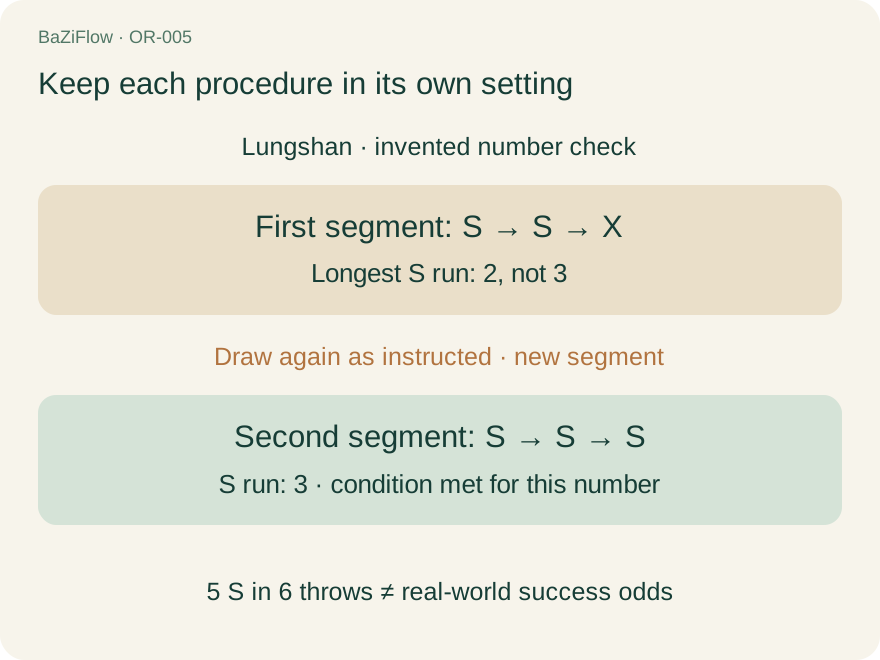
Original BaZiFlow procedure-reading exercise. It illustrates a named guide's consecutive condition, not predictive odds.
This example is specifically about checking a number after selection. It should not be transferred to the earlier permission stage as an instruction to persist through every refusal. The location of a restart within a procedure is part of its meaning. A procedural redraw also differs from discarding an accepted text simply because its message is unwelcome.
Nothing in this arithmetic models the physical probability of block outcomes. We have not measured a distribution, established independence, or evaluated predictions. The only calculation needed is the length of an uninterrupted run in a supplied sequence.
First number
New number
The object being returned is not always the paper being received
Senso-ji's FAQ tells visitors to return the stick to its container and directs those receiving a kyo, or unfavorable, paper to a designated tying location in the grounds. The distinction between stick and paper, and the condition attached to the paper, are essential to that instruction.
An abbreviated note saying “tie every lot anywhere” would change both its scope and location. A photograph of papers tied somewhere does not establish permission to use any tree or fixture. This article does not extrapolate the temple's guidance to all Japanese temples and shrines, or use it to decide what to do with paper at a Taiwanese temple.
A useful comparison therefore identifies the material object before describing the action. A reusable numbered stick, a received poem slip, and a later commentary downloaded from a website are three different things. Completing a ritual does not make all three interchangeable. Same-number edition differences explains the separate task of matching the text.
Stick
- Return to container
Unfavorable paper
- Designated tying place
Make a comparison table that can honestly contain unknowns
For each site, record what the source explicitly covers: the request being made, the applicable stage, any stated count or sequence condition, and the destination of the object. Where a passage omits a detail, mark it as unstated in that passage. This is a statement about the available evidence, not a judgment that the institution has no practice on the subject.
Do not compare a full guide with a short summary and conclude that the longer one represents a stricter or more powerful tradition. The documents may simply serve different purposes. Nor does a shared practice of drawing lots establish identical poems or procedures across settings.
Keep a visit record separate from the normative guide. If you remember receiving a paper but did not record the confirmation sequence, label that part incomplete. Knowing what the guide asks for does not restore a forgotten event. Recording version and source helps preserve the material actually obtained.
The practical result is a smaller, more reliable claim: this action belongs to this stage in this named setting. That is enough to prevent many errors of transfer. It does not require turning local differences into a competition or treating successful completion of the steps as a guarantee about an outside event.
Remember only the paper
- Record
- Incomplete check record
- Do not invent
- Three confirmations occurred
Count omitted in passage
- Record
- Not stated here
- Do not invent
- Local rule must be one
Keep the segment boundary
Record S S X under the first number and S S S under the newly drawn number.
Calculate two runs
The longest runs are two and three. A later completed check does not retrospectively complete the earlier one.
Name what five over six measures
Five affirmative outcomes among six invented throws describe this record. They do not measure the chance of a wish occurring.
Questions readers ask next
May an unstated count be filled with one?
No. Mark it unstated in that passage and seek the named place’s clarification rather than importing a number.
Are consecutive and cumulative counts equivalent?
No. A consecutive run cannot skip an interruption or combine checks of different drawn numbers.
Does finishing the procedure establish the correct online interpretation?
No. Matching the received text and edition is a separate task from completing the actions.
Was this article helpful?
Sources & references
Continue reading
Why the same oracle-lot number can have different versions ↗
Recording an oracle-lot source: identifiers, dates, and gaps ↗