

Emolument Star: the day stem's own post
Content version · · Sources & references
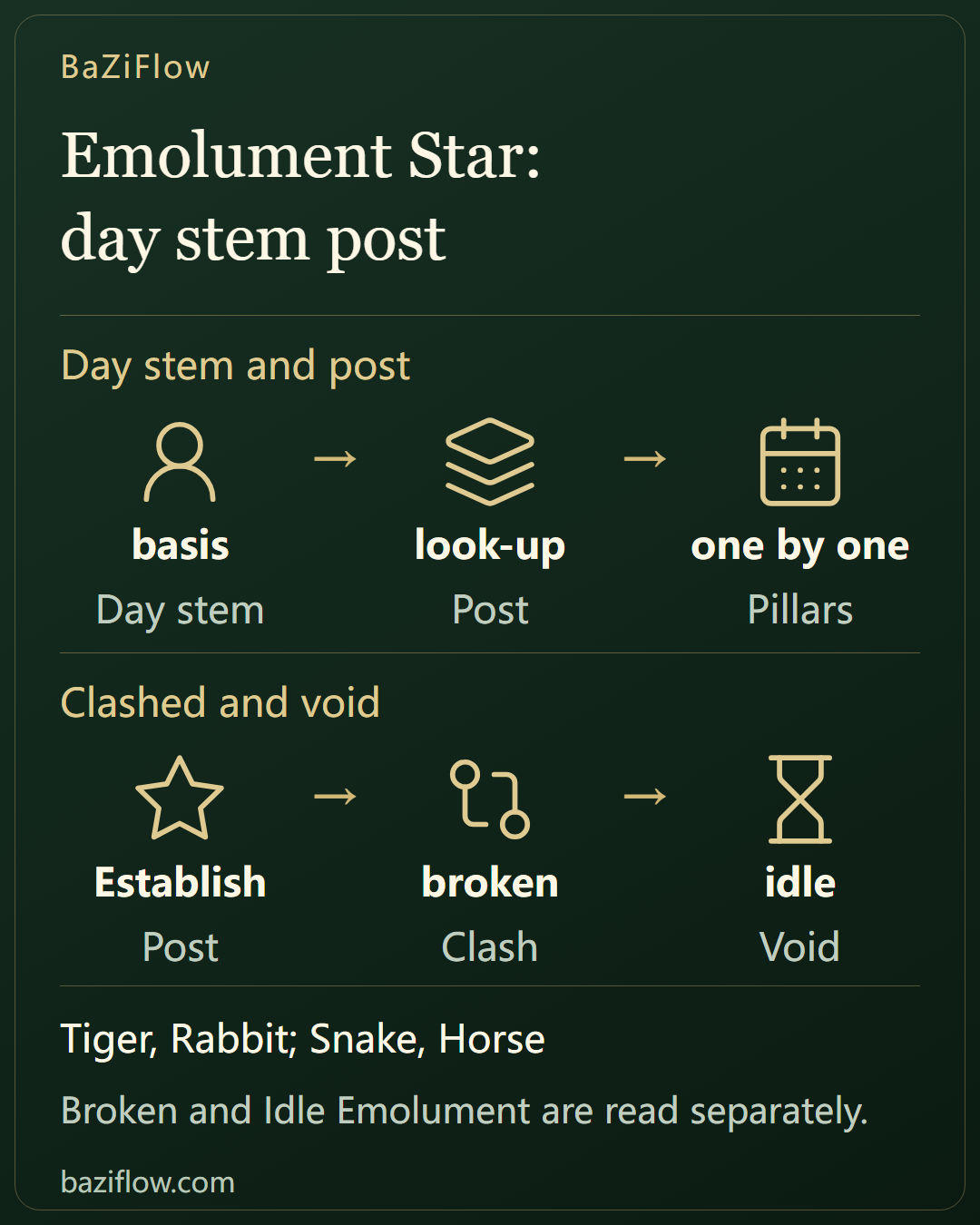
The Emolument Star starts from the day stem and lands on eight branches, the Establishment cell of the twelve stages. A look-up table, the Sanming Tonghui reasoning, two charts, and names for clashed or void Emolument.
The short version7 min read
The basis of the Emolument Star is the day stem: look up the branch of each of the ten day stems, which is the Establishment cell of the twelve life stages, and then look for it in the branches of the year, month, day and hour pillars.
- The ten day stems land on eight branches, Tiger, Rabbit, Snake, Horse, Monkey, Rooster, Pig and Rat, and none of them is Dragon, Dog, Ox or Goat.
- The Sanming Tonghui says Emolument "follows the flourishing" and pairs the stems with the four directions, with Earth riding on Fire; Dragon and Dog are the Kui Gang and Ox and Goat the gates of the Heavenly Nobleman, so the four storehouses carry none.
- Clashed Emolument is called Broken and void Emolument is called Idle; the book also warns it cannot be counted as auspicious outright, and the site's steady-income line is a modern summary.
Read first
Symbolic Stars in BaZi: Check the Reference and Rule Before the Meaning ↗
Each stem takes one post, and the posts follow the directions
The Emolument Star is found in a single step: look at the day stem. Each day stem has one post; look up that branch, then see whether any of the four pillars (year, month, day, hour) carries it.
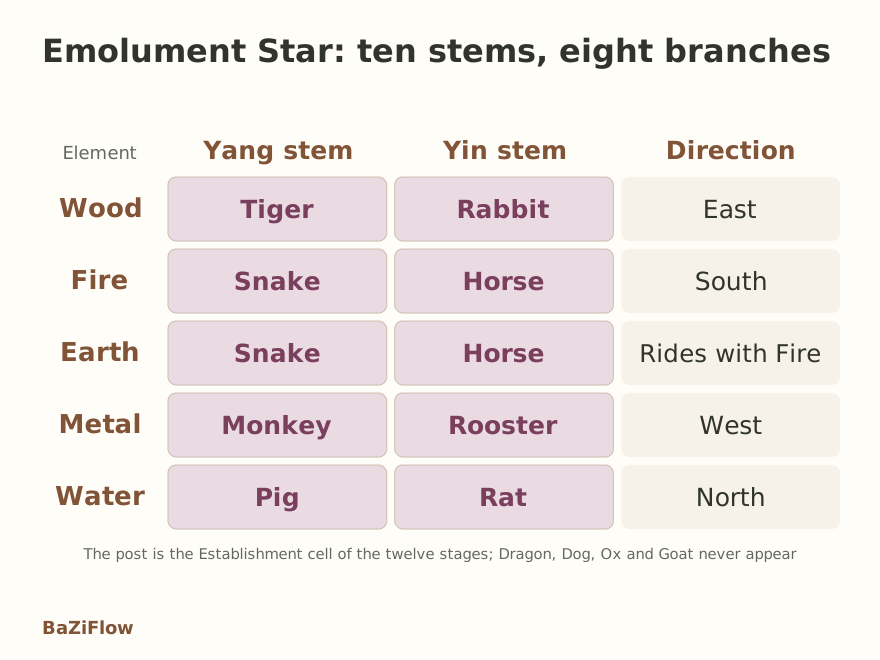
Sketch: data from the site engine, checked cell by cell against the Establishment cell of the twelve life stages; Earth rides with Fire, so ten stems fall on eight branches and none on Dragon, Dog, Ox or Goat.
Each row is one element's pair of stems. Yang and Yin Wood belong to the east and take Tiger and Rabbit; Yang and Yin Fire belong to the south and take Snake and Horse; Yang and Yin Metal belong to the west and take Monkey and Rooster; Yang and Yin Water belong to the north and take Pig and Rat. Earth has no direction of its own and rides with Fire on Snake and Horse. These positions are exactly the Establishment cell of the twelve life stages: a stem that reaches Establishment is said to build its Emolument. How that cell comes out of the stage table is explained in the article on Establishment.
Why Emolument never lands on Dragon, Dog, Ox or Goat
The Emolument of the ten stems lies on Tiger, Rabbit, Snake, Horse, Monkey, Rooster, Pig and Rat, the four cardinal branches together with the four first-of-season ones, and none of Dragon, Dog, Ox or Goat appears. The same section of the Sanming Tonghui (三命通会) gives the reasons:
Dragon and Dog are the Kui Gang, a remote and wicked place, and Emolument does not lodge there. Ox and Goat are the gates where the Heavenly Nobleman comes and goes, and Emolument keeps out of the way. So the four palaces have no Emolument.
Enlarge diagram · scroll sideways to read
The book explains it first with the Kui Gang and the Nobleman's gates, and adds a last line that the season-end branches carry "mixed qi, so Emolument is not pure there and is not taken". The site table simply gives the eight landing spots, and it agrees with each of these lines without repeating the reasons on the page.
Two charts: one sitting on its own post, one doubled
Enlarge diagram · scroll sideways to read
Chart one has a Yang Metal day master whose day branch is itself Monkey, so the day pillar already hits the Emolument, and the Monkey of the hour pillar hits it once more. In chart two the day master is Yin Fire, whose post is Horse, and the year and month pillars hold one Horse each; the Snake of the day pillar and the Rat of the hour pillar do not match.
Of the sixty day pillars, only four have the day branch on their own post: Jia Yin (甲寅), Yi Mao (乙卯), Geng Shen (庚申) and Xin You (辛酉). Combinations such as Yang Fire with the Snake or Yin Fire with the Horse would set yang against yin between stem and branch, which the sixty-cycle never allows.
Emolument clashed, Emolument void: two names in the book
The same section goes on to two things that can happen to Emolument:
A chart with Emolument fears most a clash, which is called Broken Emolument: Yang Wood has its Emolument at Tiger and meets Monkey, Yin Wood has it at Rabbit and meets Rooster, and the qi scatters and does not gather. ... It fears next falling into the void, which is called Idle Emolument: in the Jia Chen decade the void is Tiger and Rabbit, yet Tiger is Yang Wood's Emolument.
A clash is the branch six places away; each stem's post has exactly one clasher:
Enlarge diagram · scroll sideways to read
Falling into the void refers to the void branches of a ten-pillar decade. The Jia Chen decade runs from Jia Chen to Gui Chou and lacks Tiger and Rabbit among its ten branches, so the void of that decade is Tiger and Rabbit, which happen to be the posts of Yang Wood and Yin Wood. In the book's words, Emolument that drops into the void is called Idle.
"Not to be relied on alone": the book's caution and the site's summary
Enlarge diagram · scroll sideways to read
The site describes the Emolument Star as "capital for earning one's living, standing firm on one's own post and profession, income of the steady kind rather than the bursting kind", and files it as favorable. At the end of the same section the book has a more careful sentence:
Whether a chart carries Emolument, it may be fortunate or unfortunate, noble or humble; it cannot be relied on and counted as auspicious outright.
Both readings can stand together: the site line is an easy summary, while the book places Emolument inside conditions such as a clash, a void and the other stars on the pillar. The look-up shows only whether the star is present and which pillar holds it. Its weight depends on the Day Master's strength, the pattern and the years, in the way described under shensha within a whole chart.
Just before this star in the series stands the Solitude Star. Counting two places on from the Emolument gives the Golden Carriage, and one place on from a yang stem's Emolument is where the Yang Blade sits.
Questions readers ask next
Is the Emolument Star the same position as Establishment in the twelve life stages?
Yes, the position is the same: the site looks up the Emolument Star from the day stem, and the landing branch is that stem's Establishment cell. The two names come from different places, one a shensha name and one a stage name; a shensha adds the question of which pillar it lands on.
Why do Yang Fire and Yang Earth land on the same branch?
The book lodges Earth on Snake and Horse because those are the lands where Fire flourishes, and calls this "the child follows the mother and takes Emolument": Yang Earth goes with Yang Fire to Snake and Yin Earth with Yin Fire to Horse. The site table agrees, so ten stems use only eight branches.
Does the branch of the day pillar itself count?
It does. The site checks all four pillars: a Yang Metal day master with a Monkey day branch hits the Emolument on the day pillar. Of the sixty day pillars, only four have the day branch on their own Emolument: Jia Yin, Yi Mao, Geng Shen and Xin You.
Was this article helpful?
Sources & references
Continue reading
Solitude Star (寡宿): One Before the Year Branch's Group, on the Four Storage Branches ↗