

Audit four-valued inputs before reviewing claims
Content version · · Sources & references
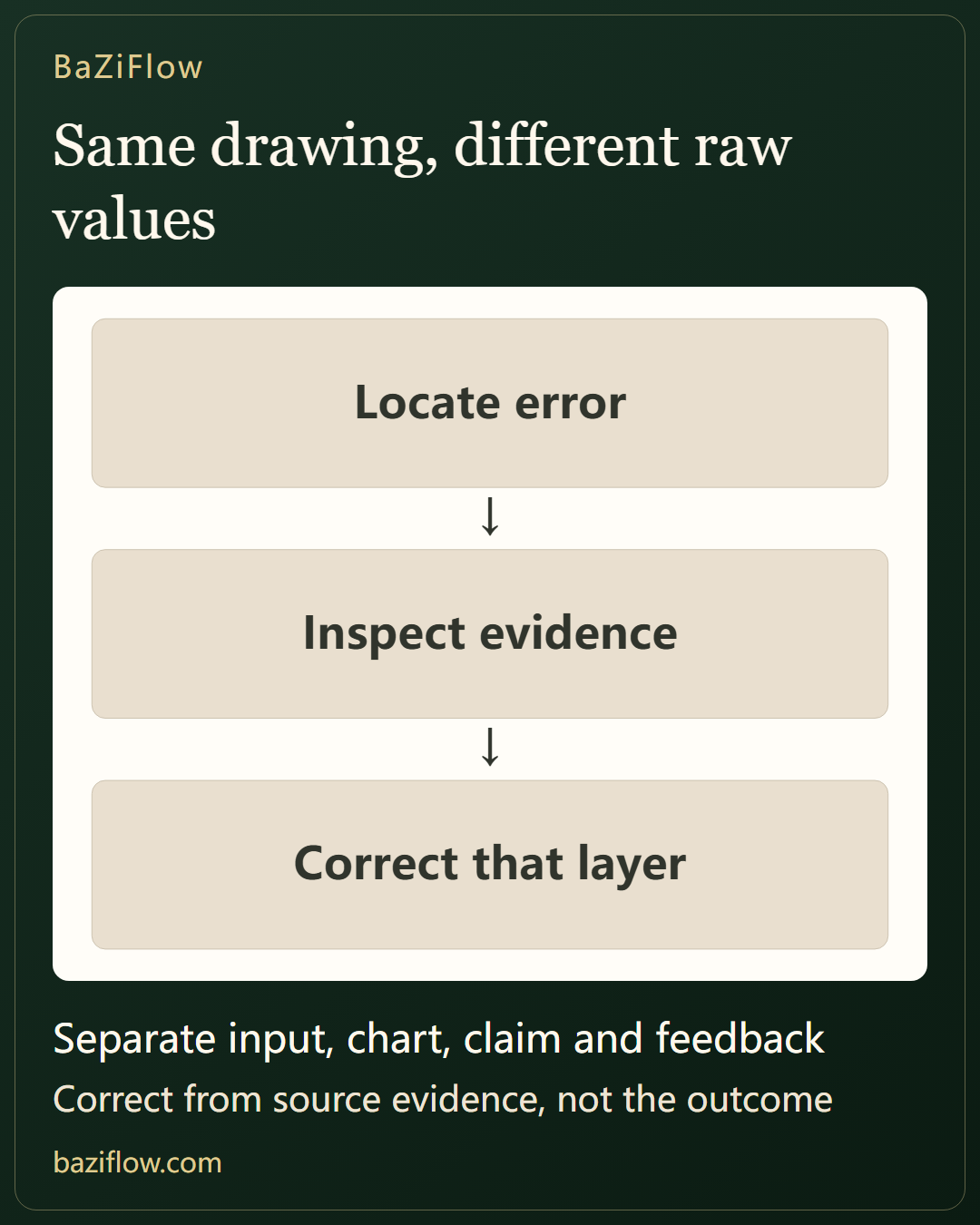
Rebuild Jie changing to Kan from a six-value record, detect a hidden transcription error, and keep repeat castings, revisions, and missing follow-up distinct.
The short version6 min read
The bottom-up record 9, 7, 8, 8, 7, 8 gives Jie changing to Kan. Miscopying the first nine as seven keeps primary Jie but removes its only movement. Preserve raw values, derivation, original interpretation and later feedback so corrections remain traceable.
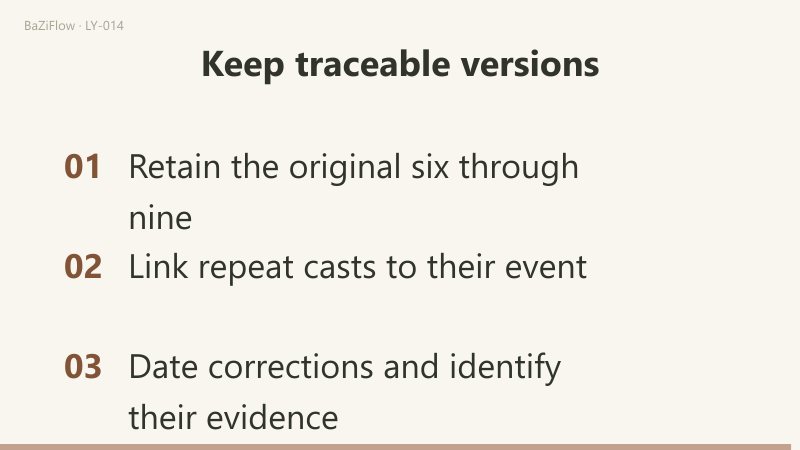
- Matching primary drawings establish polarity agreement, not agreement in movement or the complete casting record.
- Correct transcription, chart derivation, interpretation and observation at the layer supported by the evidence.
- Link repeat casts to their event and distinguish evaluable-subset proportions from confirmed matches across the full ledger.
Read first
Moving lines and changed counterparts: auditing Xu to Song ↗
What does seven out of twelve describe?
Imagine a teaching ledger containing twenty initial events. Twelve have enough follow-up to evaluate: seven meet the criterion stated beforehand and five do not. Five further events lack follow-up, and three were cancelled. Seven divided by twelve is about 58.3 percent, but that describes the evaluable subset, not the performance of all twenty events.
Seven divided by twenty is 35 percent: the share of the entire hypothetical ledger with a confirmed match. It does not classify all thirteen remaining events as failures. These invented counts demonstrate denominator discipline; they are not measured evidence for Liuyao's predictive validity.
A useful case record keeps missing follow-up, cancellation, and a documented mismatch distinct. It also retains unsuccessful cases. A collection selected only for satisfying stories cannot establish the performance of all attempts.
7 / 12
- 58.3%: evaluable subset
7 / 20
- 35%: full-ledger confirmed
Preserve the observation before the interpretation
Keep the original question, the relevant roles, the casting method, and six ordered results. If coins are used, record the convention for assigning values to their faces. A final sum alone does not authorize inventing which individual coin showed which face. Record calendar information and its time-zone and day-boundary convention when available; identify omissions instead of supplying guesses.
Store the calculated chart separately from the interpretation. The chart should be reproducible from the raw record. The interpretation should identify the target, the rule or passage used, its conditions, and the claim actually made at that time. Later feedback belongs in an outcome record. Corrections need a dated version and a stated reason.
This separation is a modern proposal for reviewing cases. It is not attributed to an ancient standardized ledger, and it does not turn interpretive choices into mechanically proven facts.
Raw inputs
Calculated chart
Original claim
Later feedback
Dated correction
A transcription error that leaves the primary hexagram unchanged
For this exercise, use 6 for old yin, 7 for young yang, 8 for young yin, and 9 for old yang. Read the sequence from bottom to top: 9, 7, 8, 8, 7, 8. The lower trigram is yang-yang-yin, Dui; the upper is yin-yang-yin, Kan. The primary hexagram is Water over Lake, Jie.
Only the first line moves. Applying the moving-yang-to-yin rule described in Zengshan Buyi changes the lower trigram to Kan while leaving the upper Kan intact. The result is doubled Kan. The book's Eight Palace diagrams provide a separate check on these two structures. This is a newly constructed exercise, not a reconstructed historical coin throw.
| Position, bottom upward | Saved value | Primary state | Resulting polarity |
|---|---|---|---|
| 1 | 9 | Moving yang | Yin |
| 2 | 7 | Still yang | Yang |
| 3 | 8 | Still yin | Yin |
| 4 | 8 | Still yin | Yin |
| 5 | 7 | Still yang | Yang |
| 6 | 8 | Still yin | Yin |
If the first 9 is transcribed as 7, the primary drawing is still Jie. However, its only moving line disappears, so the record no longer yields the Jie-to-Kan transformation. Checking only the hexagram name or six polarities would miss the error. Keep the four-valued input, not just a reduced yin/yang picture. See moving and changed lines.
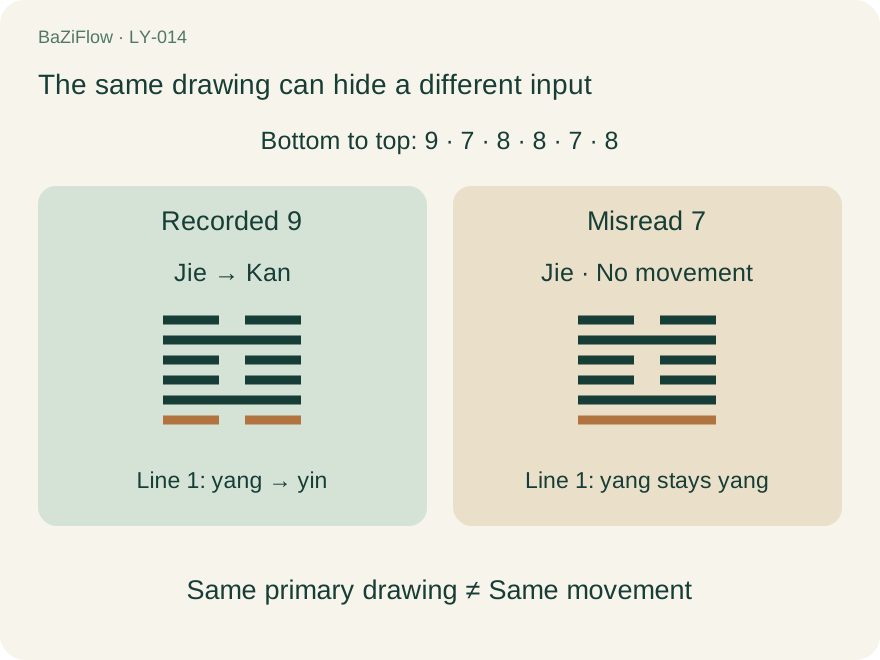
Original BaZiFlow record check. Matching primary drawings do not prove that two raw records are equivalent.
Jie
Kan
A second casting is part of an event history
The void chapter of Zengshan Buyi describes a wealth inquiry on a Yin Wood Rabbit (乙卯) day in a Dragon (辰) month: Jiaren changing to Bi is followed by Kui changing to Sun, and the author combines the two before reporting the outcome. A faithful case summary retains the initial uncertainty and the second casting, rather than extracting only the final confident statement.
These are two castings associated with one event, not two independent successful events. When a modern record includes another casting, link it to the original event and state why it occurred. Keeping a historical author's method visible does not endorse unlimited recasting until a preferred answer appears.
The source is a historical narrative. It does not supply the continuous registration, complete timestamps, and independent observation needed to convert its examples into a modern performance dataset. Missing research design cannot be filled in by a persuasive retelling.
Correct the layer that actually failed
If evidence shows that a 9 became a 7 during transcription, correct that entry and recompute what depends on it. If the values were preserved but the wrong hexagram was calculated, correct the derivation. If the chart is sound but a rule was applied to the wrong target, review the interpretation. These are different failures with different remedies.
Changing the event or extending the deadline after seeing the outcome changes the evaluation criterion. Having no follow-up is an observation gap. Neither problem is solved by adding more symbolic detail. The articles on question scope and timing uncertainty help keep those boundaries explicit.
Never change the raw casting merely because a different chart would fit the eventual result more neatly. Preserve the old version, identify the evidence for a correction, and show the recalculated result. An interpretation revised after the outcome must remain distinguishable from a claim made beforehand.
Make a case reviewable without exposing the person
For sharing, a case identifier and the necessary structural inputs can often replace names, contact details, and unrelated personal history. State the kind of outcome evidence available without publishing private material merely to make the story feel authentic. Keep the original protected record separate from the public teaching version.
A useful review ends with a specific finding: which input, derivation, interpretive choice, or observation was deficient, what was changed, and what remains unknown. It need not rescue every previous claim. Its value lies in making the next record more reliable and allowing another reader to reproduce the parts that genuinely can be checked.
Shared review
Calculation
- Keep
- Raw values and rule version
- Withhold
- Names and contact details
Outcome
- Keep
- Evidence type and observation date
- Withhold
- Identifying private narrative
Correction
- Keep
- Old version and reason
- Withhold
- Unnecessary personal identifiers
Questions readers ask next
Why is a yin–yang drawing insufficient for review?
Reducing four values to two polarities removes the difference between six and eight or seven and nine. Those distinctions determine reversal, so one primary drawing can accompany different movement sets and changed figures. The original numbers preserve that information.
Can an input be adjusted to fit a disappointing outcome?
The later outcome is not evidence of a transcription error. A reliable original record must support a correction before its dependent chart is recomputed. An interpretive mistake can be revised separately without manufacturing different casting inputs.
Why do two casts not automatically become two independent events?
If both track one target and one eventual result, they share the event being observed. Their changing interpretations can be studied, but the unit must be stated as events or casts. Selecting favorable entries and counting them twice changes the question being measured.
Was this article helpful?
Part of a learning path
Liu Yao: from casting to the Useful God and movement · Step 6 of 6 available
Sources & references
Continue reading
Timing judgments need uncertainty: candidates are not guarantees ↗