

Records and reflection
Content version · · Sources & references
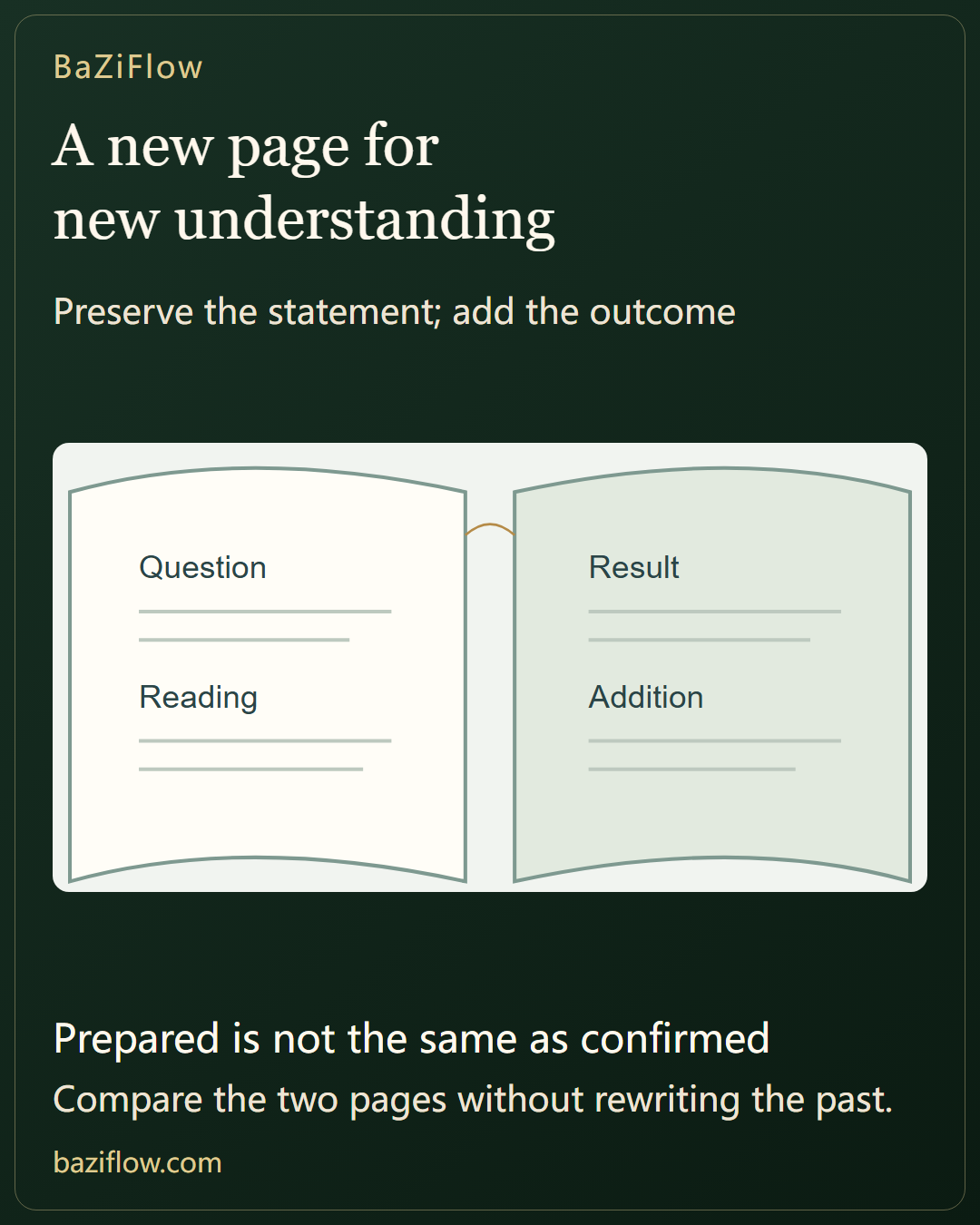
Review Tarot and Meihua records with the original wording, later evidence and corrections kept separate. Include misses and unresolved cases rather than rebuilding a successful story.
The short version6 min read
A review should make a change in understanding visible. Preserve what was actually written, then add the outcome and later evidence without turning a new interpretation into an earlier prediction.
- Keep the original conditions and dates separate from later evidence.
- Materials being ready does not establish that an arrangement was confirmed.
- Correcting input, revising an interpretation and testing a whole method are different tasks.
A correction should create a trace, not erase one
Suppose you discover that the time in a saved reading was entered incorrectly. Correcting it is useful, but the corrected chart is a new basis for interpretation. If the earlier record disappears, a later reader cannot tell why the explanation changed or which version was being assessed.
Keep the old input, the correction and its date together. This is not about assigning blame. It makes the dependency visible. A factual input error, a copying mistake and a difference of interpretation are separate issues and should not be reported as if they were the same kind of correction.
Input correction
- Old value and evidence
Interpretive revision
- The reasoning that changed
Preserve the statement; add the outcome
- Original record
- The question, input and interpretation recorded before the outcome, rather than a retrospective summary.
- Dated addition
- Information obtained later, linked to the original while preserving when it became known.
Compare the actual statement with the actual event
Retrieve the original question and interpretation rather than relying on a memory such as “it mentioned change.” What kind of change? Within which period? Which conditions were already known? Without the wording, it is easy for later experience to supply details the reading never contained.
Write the outcome separately before giving it a verdict. An arrangement being prepared, formally started and completed are different events. If the original statement referred to one, do not count another simply because it provides a convenient match.
| Part of the record | What belongs there |
|---|---|
| Initial version | Question, method, input and original interpretation |
| Later result | Dated observations and their evidence |
| Comparison | Matches, differences and unresolved points |
| Addition | New information and reasons for correction |
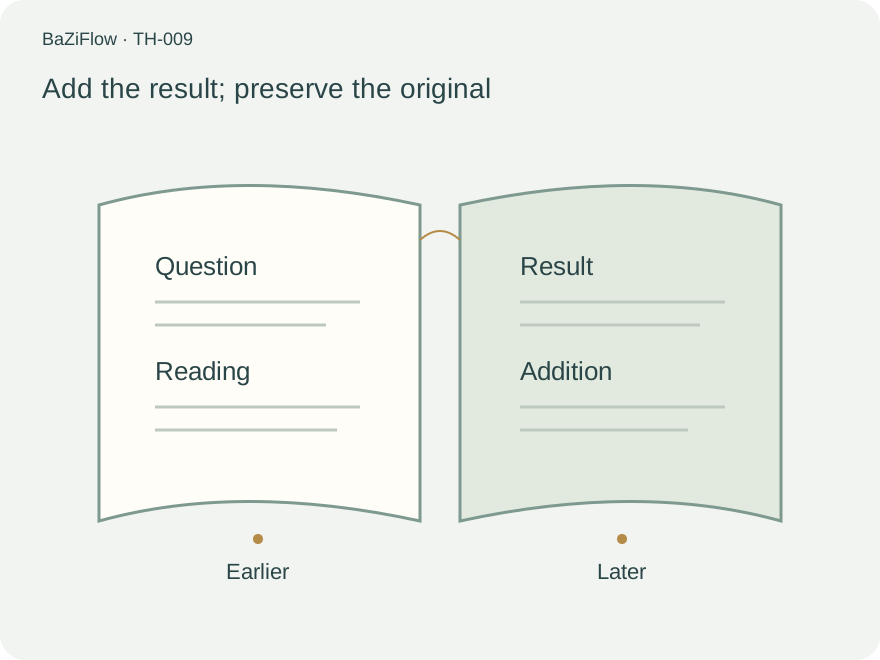
Original BaZiFlow two-page review. New information belongs on the later page while the initial version stays intact.
The drawing keeps the initial page and the later page distinct. Their connecting curve invites comparison; it does not authorize replacing the left page with a better-fitting account. Dates help prevent knowledge acquired later from being credited to the original reading.
Confirmed by Friday
- Original condition
- An explicit reply
- Available record
- Materials ready Thursday
Comparison
- Original condition
- A confirmation is still needed
- Available record
- Preparation is a different state
Preserve the process each method actually used
For Tarot, reviewing Tarot records is the relevant route. The question, card order, positions, orientations and initial interpretation all provide context. Saving only a final sentence may leave enough flexibility to choose an entirely different meaning after the event.
Waite himself flags inconsistencies in the supplementary card meanings he presents in Part III.4, alongside their dependence on a card’s place. A reviewer therefore needs the particular reading made on that occasion. The existence of alternatives in a source cannot rescue a claim by retroactively substituting a different meaning.
For Meihua, reviewing cases without retrospective fitting directs attention to the original casting basis, question and interpretive path. A detail learned later should not be inserted into that starting path as though it had been there all along.
If you need a smaller routine, start with building a learning log. The goal is recoverability, not volume. A few complete records are easier to examine than a large collection of screenshots containing only favorable conclusions or brief verdicts.
Tarot
- Cards and positions
Meihua
- Casting and body/use
Records
- The method’s actual steps
An unresolved case is a result, too
Some statements are too broad to compare with confidence. If almost any event counts as change, the record may not support a meaningful judgment of the claim. Mark it unresolved rather than awarding a match by default.
Include what did not occur and what occurred only partly. A review made solely from matching fragments will give a distorted impression. You can learn to define a clearer scope next time without rewriting the old statement to make it seem more specific than it was.
Privacy does not require discarding the original. Keep a private record and make an anonymized excerpt if you share the learning point. Label an excerpt as an excerpt; omitting personal details should not imply that readers are seeing every part of the initial account.
Same subject and deadline
- Available evidence
- A documented outcome
- Review status
- A limited comparison
Missing outcome record
- Available evidence
- Only recollection or hearsay
- Review status
- Still unresolved
Ask what another source can establish
The National Archives' written-document worksheet asks about authorship, timing, context and other evidence. Here it provides a discipline for examining the provenance of a record. Its history-education purpose does not certify the effectiveness of a divination method.
An additional record may confirm a date, clarify a condition or show that an important detail was missing. It should not be used merely to invent a new route by which the original statement can be defended. Keep the claim and its supporting evidence identifiable.
A striking individual match does not establish general predictive ability. Several cases selected through the same process can share selection bias. Improving your record-keeping is worthwhile without turning that limited experience into a guarantee or presenting only successful fragments to others.
Choose one concrete improvement for the next record
The result of a review might be to fix the time range before interpreting, save the full card layout, or place observations and inferences in separate fields. These changes make the next record easier to assess. They do not need a grand conclusion about the whole tradition.
End by stating what can be judged, what changed and what remains unknown. A preserved difference between expectation and event is useful information. Smoothing it away may produce a satisfying story, but it removes the very material a review needs.
Original statement
- Preserve
- Its wording and scope
- Add separately
- Later questions
Original reasoning
- Preserve
- Its stated conditions
- Add separately
- Dated corrections
Identify the original test
Suppose the statement requires a confirmation by Friday. Mark both the required action and its deadline.
Record only what is known
Materials ready on Thursday establish preparation. Without an explicit reply, they do not establish confirmation.
Retain the missing information
Keep receipt of confirmation as a separate item to check. In the next record, distinguish prepared, confirmed and carried out.
Questions readers ask next
Can one review establish that a method works?
It supports only a limited comparison of that record. It does not replace systematic research or make different methods interchangeable.
What if an input was copied incorrectly?
Keep the old value, the discovery date and the evidence for the correction. A revised result is not what was produced at the original time.
Should unresolved outcomes remain in the record?
Yes. Insufficient evidence is a meaningful information state; it should not be forced into a success or failure label.
Was this article helpful?
Start reading
Review the whole tarot journal, not just the memorable matches ↗ · Tarot
Reviewing Meihua cases: preserve inputs and outcomes ↗ · Meihua Yishu
A Learning Log Should Change Your Next Attempt ↗ · Shared methods
Sources & references
Continue reading
Review the whole tarot journal, not just the memorable matches ↗