

Why Jia-Zi can be Wood and Water yet have a Metal Nayin
Content version · · Sources & references
Nayin classifies a complete stem-branch pair. Ordinary phase assignments describe its components. Compare four examples and keep year labels distinct from the Day Master.
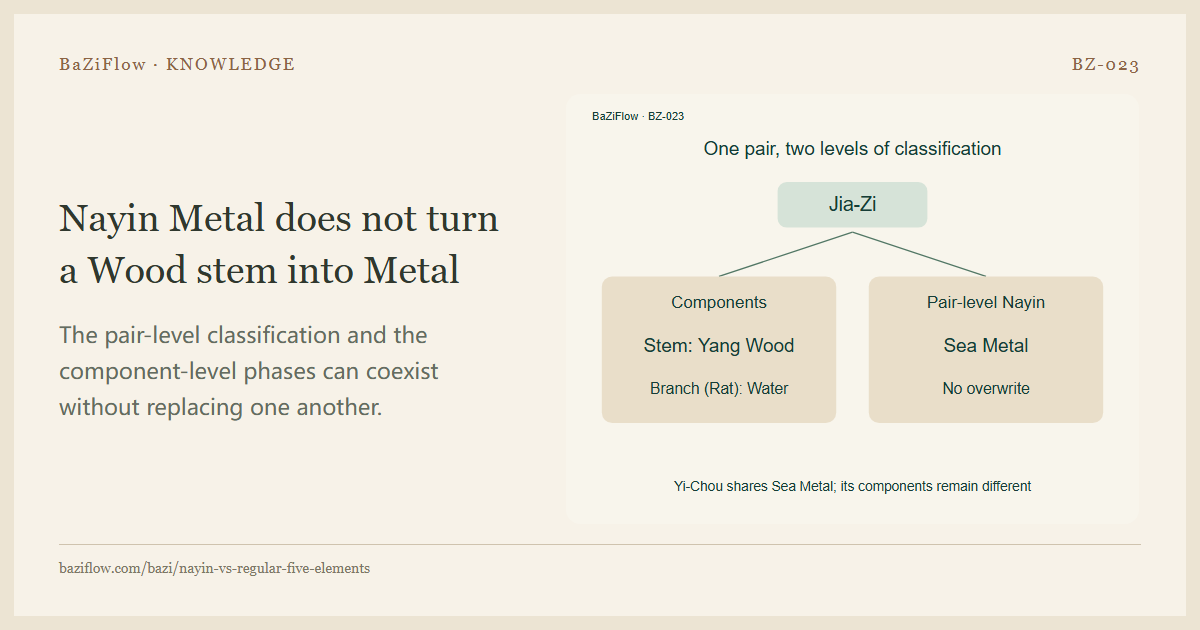
The pair-level classification and the component-level phases can coexist without replacing one another.
Read first
What disappears when a worksheet keeps only Metal?
A study worksheet replaces Sea Metal and Sword-edge Metal with a single field: Metal. For a question about the broad Nayin phase, that may retain the information requested. For a question about the named imagery, it has discarded a distinction. Before deciding that a shorter label is sufficient, identify the question the field is meant to answer.
Now imagine the worksheet removes the pillar name as well. We can no longer tell whether that Nayin came from a year, month, day or hour pair. The label has become less reproducible even though it still looks familiar. This is why a Nayin note should preserve both the complete pair and its place in the chart.
A shared category is not a shared input
Jia-Zi and Yi-Chou are neighboring entries at the start of the sixty-pair cycle. They share Sea Metal in the conventional Nayin classification. Their components remain different: the Yang Wood stem sits with the Rat branch, associated with Water; the Yin Wood stem sits with the Ox branch, associated with Earth.
One operation reads the stem and branch separately. The other assigns a category to their complete valid pair. The outputs do not need to agree, since the questions differ. Neither operation deletes the data used by the other.
Compare the input before comparing the output
The Hong Kong Observatory's sexagenary table establishes the sequence used in this exercise. San Ming Tong Hui, volume one, supplies the traditional Nayin names. The sources have different jobs: the calendar table is not evidence that a public observatory endorses divinatory claims about those names.
| Complete pair | Ordinary component assignments | Nayin category |
|---|---|---|
| Jia-Zi | Yang Wood stem; Rat branch (Water) | Sea Metal |
| Yi-Chou | Yin Wood stem; Ox branch (Earth) | Sea Metal |
| Bing-Yin | Yang Fire stem; Tiger branch (Wood) | Furnace Fire |
| Ding-Mao | Yin Fire stem; Rabbit branch (Wood) | Furnace Fire |
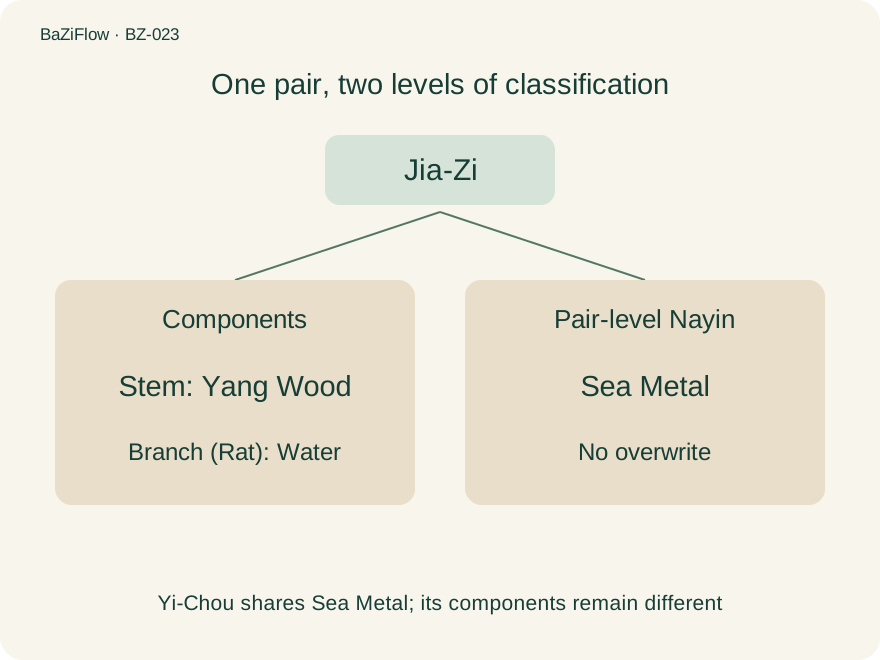
Original BaZiFlow classification diagram. Pair-level Nayin does not overwrite component properties.
The branch column gives an introductory phase association, not a replacement for the branch's hidden-stem contents. The Ox branch, for example, has an internal structure that this short comparison is not attempting to enumerate. See hidden stems before treating a branch label as a complete inventory of its contents.
Nor is Sea Metal the result of physically combining Wood and Water. Nayin is a separate traditional classification scheme. If you add its Metal to a count of visible Metal stems, you have silently changed the meaning of the count. The same mistake would occur if you used a year's Nayin phase to reassign the chart's Ten Gods instead of retaining the actual Day Master.
Read the traditional imagery at its own level
San Ming Tong Hui's general discussion connects Nayin with traditional musical and stem-branch theories; its imagery section discusses names such as Sea Metal and Furnace Fire. These passages are sources for a historical classification and its imagery, not modern chemical, acoustic or materials-science formulas. Origin legends within them should not be restated as established events.
The conventional table has thirty named entries, each covering two neighboring pairs. The lookup requires the complete valid pair. An arbitrary stem from one record and a branch from another do not become suitable input simply because a familiar name can be found.
Keeping the full imagery name does not establish a person's behavior either. Sea Metal is not evidence that someone conceals feelings; Furnace Fire does not demonstrate a volatile temperament. Those descriptions would extend an association into a personal claim without checking the person's data or experience.
A year label cannot supply a missing day stem
Suppose the only field supplied is Jia-Zi as the year pillar. Its Nayin can be looked up, but the day stem remains unknown. A popular Metal-life expression may refer to that year category. A Metal Day Master is a different statement: the actual day stem is Yang Metal or Yin Metal.
If another record describes a Wood Day Master, do not change either field merely to make the words agree. Ask which component each sentence identifies. Pair-level Nayin cannot take over the Day Master's role in calculating the Ten Gods.
Month, day and hour pillars can each receive their own Nayin classification, too. A method may emphasize a particular pillar, but it should declare that choice. Combining all four into one personal identity would conceal the inputs rather than summarize them faithfully.
Return to the worksheet before interpreting its owner
For a controlled reading exercise, compare two records whose year pillars are Jia-Zi and Yi-Chou. Their year Nayin agrees while their year components differ. If the other pillars are supplied later, those may differ as well. A complete reading copied from the shared year label would not demonstrate any use of the additional information.
Missing Metal in a count, favoring Metal under a declared interpretation, and receiving a Metal Nayin label are also independent propositions. None establishes the others. Nor does a correct lookup establish the effect of a purchase or name change.
Keep pillar, complete pair, full Nayin name and broad phase as separate information. Then state what the chosen method does with that information. The Four Pillars and Day Master provides the underlying chart fields. The point is not to make the shortest possible identity label, but to keep enough detail that another reader can reproduce the classification and see its limits.
Sources & references
Continue reading
Reading a BaZi chart for the first time: the four pillars and the Day Master ↗