

Death: the eighth cell and its ten pictures
Content version · · Sources & references
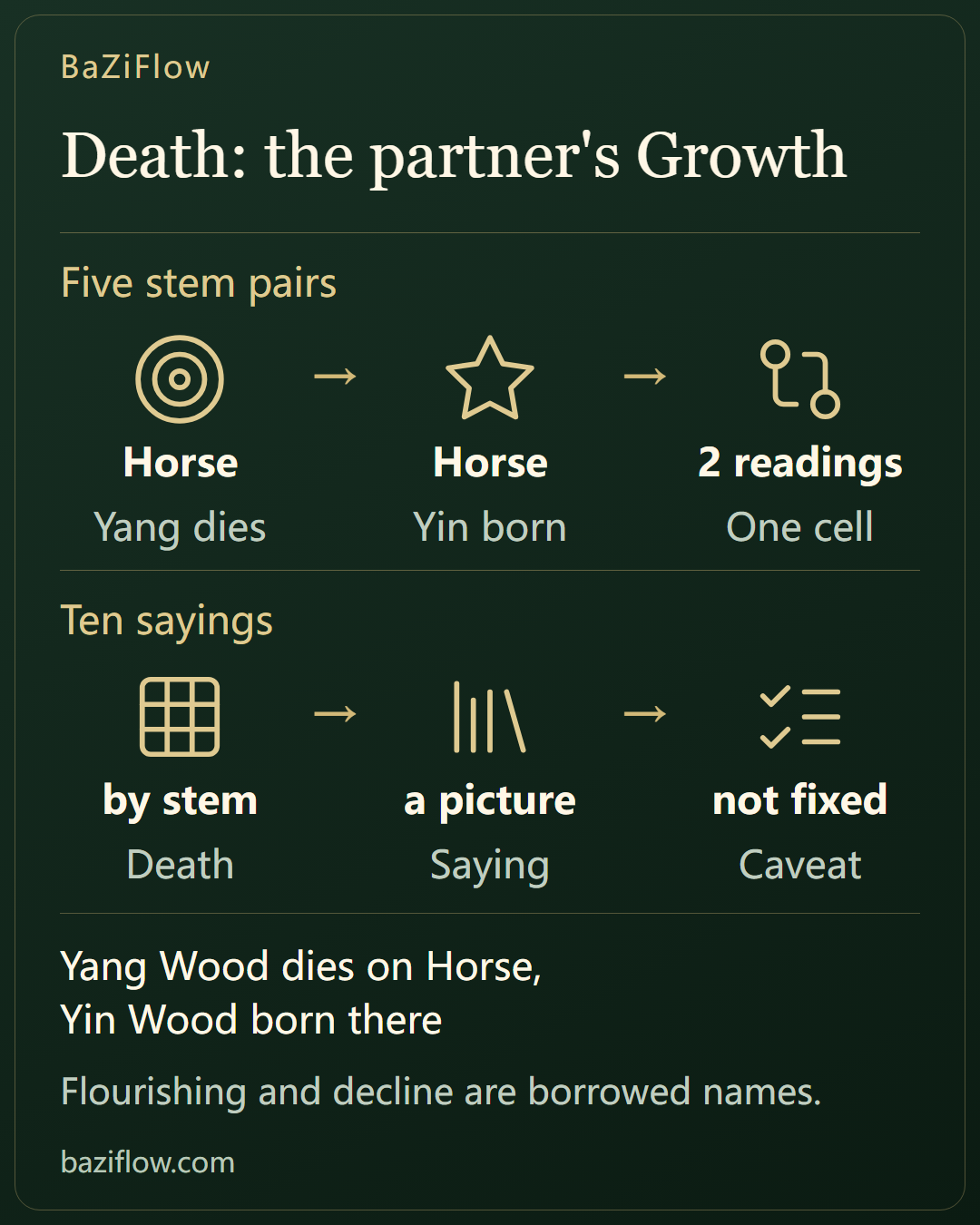
Death is the eighth cell of the twelve life stages, and each stem dies exactly where its partner is born. Five pairs, ten sayings from the Sanming Tonghui, the luck bands and the book's own caveat explain the cell.
The short version9 min read
Death is the eighth cell of the twelve life stages: the Death position of a Yang stem is the Growth position of the Yin stem of the same element and the other way round, and the Sanming Tonghui attaches a saying to each of the ten stems, turning every position into a picture from nature.
- The branch where one stem dies is the branch where the other stem of its element is born: Yang Wood dies on Horse while Yin Wood is born there, Yin Wood dies on Pig while Yang Wood is born there.
- Juan 2 of the Sanming Tonghui gives each stem a saying: Wood does not run south, water floods and wood floats, Fire does not face west, Metal sinks to the bottom, and so on, each turning a position into a scene.
- In the same juan the book says the five elements have "no real life or death" and that flourishing and decline are borrowed names, and adds that meeting decline, death or severance need not be read as ill.
Read first
Twelve Life Stages and Void Branches: Two Tables, Two References ↗
Strong and weak Day Masters: references, relationship directions and evidence ↗
"Death" is a borrowed name
The twelve life stages borrow a human life and lay it out in twelve cells: receiving qi, conception, taking shape, then birth, bathing, coming of age, taking office, prime, decline, illness, and after that Death (死) and Storage (墓); counted from Growth, Death is the eighth cell and Storage the ninth. The Sanming Tiyao (三命提要) gives this cell a single line: "All things die, as a person dies."
Before reading further, look at what juan 2 of the Sanming Tonghui (三命通会) says itself:
In general, the five elements as they are used contain no real life or death; flourishing and decline are likewise only borrowed names.
The line comes after the book has gone through the ten stems and the twelve branches, and it is blunt: names such as Growth, Death, Decline and Peak are borrowed labels for how the strength of an element changes. The rest of the sentence says to go straight to the source and understand where the name comes from. Everything below is read under that premise.
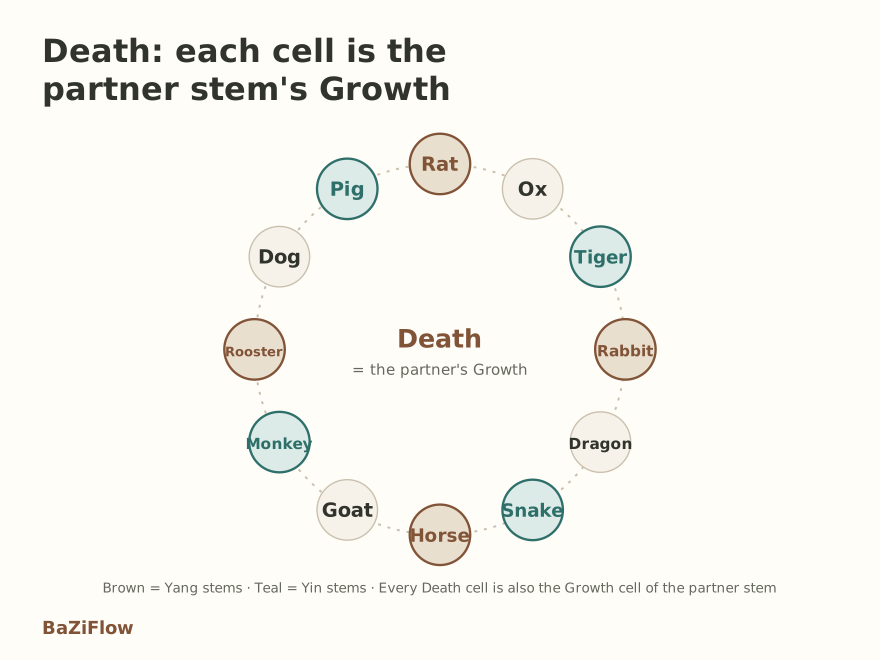
Position sketch: the positions come from the site engine's twelve-stage table; Yang Fire and Yang Earth share Rooster, Yin Fire and Yin Earth share Tiger; the pairing in the center is checked pair by pair against the same table.
Five pairs: where one dies, the other is born
The ten stems form five pairs, one Yang and one Yin for each element. Put the Growth and Death of the two side by side and the pairing is plain:
Enlarge diagram · scroll sideways to read
This is the old saying "Yang is born where Yin dies, and Yang dies where Yin is born" (see Growth). The same branch is Death for one stem and Growth for the other stem of its element: Rooster is Death for Yang Fire and Yang Earth and Growth for Yin Fire and Yin Earth. The reason is that, within one element, seven steps forward from the Yang stem's Growth position is the Yin stem's Growth position (Pig for Yang Wood, Horse for Yin Wood); the Yang stem walks seven steps forward and the Yin stem seven steps back, and each lands on the other's starting cell.
The pairing left an odd trace in Na Yin. The Na Yin of the pillar Ding You (丁酉) is Fire at the Mountain Foot, and Fire on Rooster is Death, which is why the book calls it "self-dying fire". The Na Yin of Yi Mao (乙卯) is Water of the Great Stream, and Water on Rabbit is Death, so that is "self-dying water". Yet the stem Yin Fire stands on Rooster at Growth, and the stem Yin Wood stands on Rabbit at Establishment:
Enlarge diagram · scroll sideways to read
The same branch gives different answers depending on whether the stem on the pillar or the Na Yin element is looked up, which is one more appearance of the pairing above.
Ten stems, ten sayings
Juan 2 of the Sanming Tonghui goes through the ten stems one by one, saying where each is born, where it dies and why, and every entry ends with a saying introduced by "the classics say". Take Yang Wood first:
Horse belongs to Li, the Fire trigram; Fire depends on Wood to be born, Wood is Fire's mother and Fire is Wood's child, and when the child flourishes the mother wanes: how could it not come to an end? So Yang Wood dies on Horse, which is what the classics mean by "Wood does not run south".
Horse is Fire. Fire is born from Wood, so Fire is Wood's child and Wood is Fire's mother, and when the child is flourishing the mother is drained. By Horse, Wood has run its course, and that is the picture behind "Wood does not run south". Each of the ten stems has one saying:
Enlarge diagram · scroll sideways to read
The ten pictures differ from one another: Yang Wood is drained by the Fire it feeds, Yang Metal is drowned by Water, the light of Yang Fire is covered by strong Metal, and Yin Water is penned in by the Earth and Metal inside Monkey so that it cannot flow. In the entries for Yang Wood and Yang Metal alike, the reasoning includes "when the child flourishes the mother wanes", and the entry for Yang Earth has the same phrase in reverse order. Read the table as imagery attached to a position; the position itself is still fixed by the counting rule above.
Luck at the Death cell: the bands in the book
Juan 2 also has an entry on luck cycles that sorts the twelve cells into bands and attaches one line to each:
Enlarge diagram · scroll sideways to read
The Death and Severance band is written most harshly. That is the rule of thumb from the section on luck pillars in juan 2. Earlier in the same juan, in the section on the twelve cells, the author follows the list of their names directly with a note that can be set against rules of this kind.
The other half of the juan: the book's own note
That note is the most pointed passage on Death in this juan:
In reading a chart, meeting flourishing or Peak need not be judged as good, and meeting decline or Death or Severance need not be called ill; where flourishing is too strong it should be restrained, where Death and Severance fall short they should be supported; the skill lies in knowing how to adapt. The old way took Conception, Growth, Peak and Storage as the four prized, Death, Severance, Weakening and Bath as the four to avoid, and the rest as the four plain, which is only a rough account.
The passage has three layers. First, flourishing is not always good and decline, death and severance are not always bad. Second, the remedies are "restraint" and "support": where flourishing is too strong it needs restraining, where Death falls short it needs supporting, so in this book the Death cell means above all "strength that falls short", and what it calls for is help. Third, the book sorts the twelve cells roughly into three classes and adds, in its own voice, that this is "only a rough account".
Enlarge diagram · scroll sideways to read
The grouping holds a surprise too: Establishment sits among the "plain" cells, while Conception and Storage are among the "prized". When quoting it, say that it is the Sanming Tonghui's grouping.
Two look-ups through the pairing
The Day Master is Yin Metal. On which branch does it die?
Yin Metal is born on Rat and counts backward; the eighth cell is Snake. The other way round works too: Snake is the Growth cell of Yang Metal, so Yin Metal dies on Snake.
On the Pig branch, which stem is dying and which is being born?
Yin Wood is dying and Yang Wood is being born. Pig is the Growth cell of Yang Wood and also the Death cell of Yin Wood.
The cell before is Weakening and the next is Storage; for the whole table see the twelve life stages and void branches.
Questions readers ask next
Why does the Death cell of each stem fall on the Growth cell of another stem?
Within one element, seven steps forward from the Yang stem's Growth cell is the Yin stem's Growth cell (Pig and Horse for Wood), and Death is also seven steps from Growth, so a Yang stem moving forward and a Yin stem moving backward each finish their seventh step on the cell where the other began. That is why the two positions coincide.
A classic says "Fire does not face west". Does Yang Fire on Rooster always go badly?
That saying is a picture the book attaches to Yang Fire standing on Rooster: Rooster is Metal, Metal is strong there, and it covers the fire's light. It explains how the name was chosen and is not a verdict on any chart. The same juan adds that where strength falls short, support is what is needed.
What does "self-dying" mean in Na Yin?
It says the Na Yin element of a pillar stands on its own Death cell. Ding You has Fire as its Na Yin and Fire on Rooster is Death, so it is "self-dying fire", yet the stem Yin Fire on Rooster is at Growth. Looking up by stem and by Na Yin element give opposite answers.
Was this article helpful?
Sources & references
Continue reading
Weakening (病): The Seventh Cell, and Two Other Uses of the Word in the Books ↗
Storage (墓): Which Day Masters Each Storehouse Holds, and How Three Harmony Fixes It ↗
What is Na Yin in BaZi? Why Jia-Zi Gold in the Sea does not replace Yang Wood ↗