

Ace of Wands: the leafing staff
Content version · · Sources & references
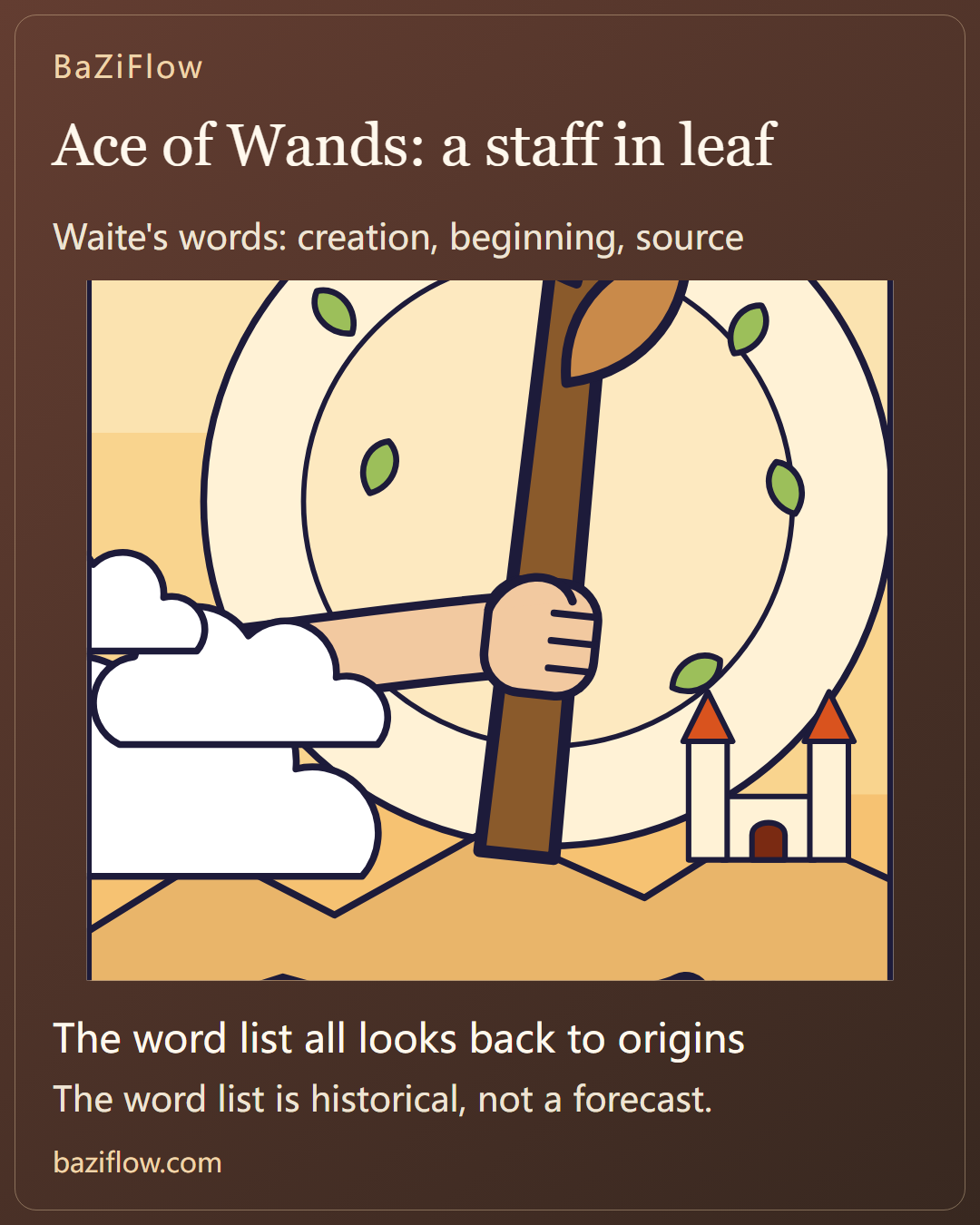
The Ace of Wands shows a hand from a cloud gripping a stout staff. Separate Waite's main list, his "another account" and the extra meanings, then split a running-group launch into hold, leaf and ground.
The short version7 min read
The Ace of Wands holds one hand and one staff. Waite's word list looks back to where things come from: creation, beginning, source. Ask first which one thing is actually in hand.
- Waite gives the picture a single sentence: a hand out of a cloud grasps a stout wand or club. The list that follows: creation, invention, enterprise; principle, beginning, source; birth, family, origin.
- The same entry adds "another account": money, fortune, inheritance. Reversed it reads fall, decadence, ruin, perdition, with "a certain clouded joy" at the end.
- The additional meanings turn the pair around: "calamities of all kinds" upright and "a sign of birth" reversed. As a practice, rest it on one concrete thing you can hold.
Read first
A staff in leaf: what the hand from the cloud holds
In The Pictorial Key this card gets one sentence: a hand issuing from a cloud grasps a stout wand or club. There is no figure, and no word about anything growing on the staff.
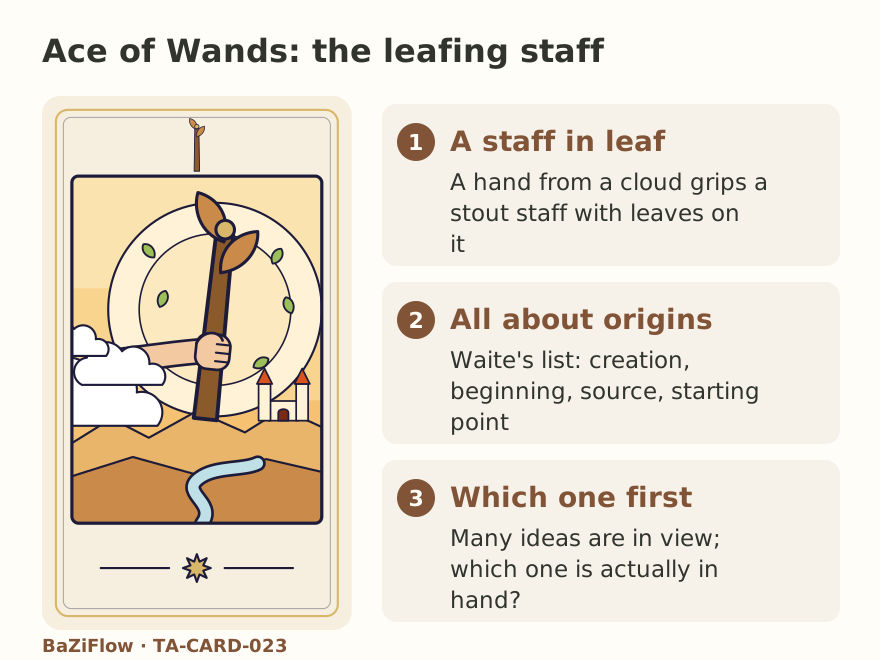
BaZiFlow's own Ace of Wands, with three ways in.
The Rider-Waite-Smith picture holds a good deal that the sentence leaves out. The hand comes out of a cloud bank on the right, with a ring of short rays around it. The staff is red-brown with a rounded knob at the top; green leaves sprout along the shaft and at the tip, and a few more drift through the air. Below lies gentle green country: a castle on a small hill at the left, a river winding through, trees and blue-violet mountains beyond. All of this comes from the picture; Waite does not mention it in this entry.
Read down the picture and there are three layers: cloud and hand, staff and leaves, land and water. The hand appears once, and there is only one staff.
Enlarge diagram · scroll sideways to read
What Waite lists: beginnings and sources, then money as "another account"
Waite's divinatory meanings run backward along one line: creation, invention, enterprise and the powers which result in these; then principle, beginning, source; then birth, family, origin, "and in a sense the virility which is behind them" (1910 wording); and finally "the starting point of enterprises". Not one word in the string is about an outcome. All of them say where something comes from.
Then he adds that, according to another account, the card means money, fortune, inheritance.
Creation, invention, enterprise... principle, beginning, source; birth, family, origin... the starting point of enterprises; according to another account, money, fortune, inheritance.
Enlarge diagram · scroll sideways to read
The first set is about how something gets started; the second is about what you hold once it has. Waite puts both in one entry and does not rank them.
Staff, leaf, land: which layer says what
Of this card's symbols, Waite writes only the staff itself in this entry. He does not mention leaves or a background. The leaves, river, castle and sun disc all come from the picture.
Staff, leaf and land, and the layer each comes from
- Staff
- Waite writes "a stout wand or club". The suit is named after it; in the picture it is red-brown with a rounded knob at the top.
- Leaves
- Waite does not write them. In the Rider-Waite-Smith picture leaves grow along the shaft and at the tip, with a few hanging in the air; that is information you can see on the card.
- Land and water
- Waite does not write them. The picture has green country, a river, a castle on a small hill and distant mountains: the staff is not in a void, it faces a particular place.
Enlarge diagram · scroll sideways to read
Reading the leaves as "signs that already exist" and the land as "the place where it starts" is an exercise modern teaching builds on the picture, and the next section uses both. Neither is in Waite's words, so say so when you use them.
How to read it: find a staff you can actually hold
The Ace of Wands carries its own practice shape: a hand, a staff, leaves on the staff, land underneath. Carry it to an everyday matter, say someone who wants to start a Saturday-morning running group in the neighborhood. The usual snag is a three-page plan and not one thing actually in hand. Three questions follow the three layers of the picture:
Which one staff is in hand?
Waite's sentence has one staff, not a bundle. Shrink the whole plan to the one thing you can finish this Saturday: fix 7 a.m., pick a 3 km loop, post those two facts in the group chat. Everything else waits.
Where is a leaf already?
The leaves grow out of the staff; nobody hung them on. For the group, that means small signs that already exist: someone replied, someone asked what time. If you cannot name one, write "none yet". That is useful information too.
What ground is under it?
The staff faces a particular place. For the group that means the meeting point, the start time and what happens when it rains. Until those are settled, the start still lives in the chat.
Here is that exercise as a table for the Saturday run group:
Enlarge diagram · scroll sideways to read
Starting a running group: where the card helps
Helps you see
- The start is one thing
- Where signs already are
Cannot supply
- How many will come
- How long it will last
Fill this week
- One cell of bare ground
- One line for the chat
Reversed and neighboring cards: fall, decadence, and a joy under cloud
Waite's main entry writes the reversed card heavily: fall, decadence, ruin, perdition, to perish. Then he tacks on half a sentence, "also a certain clouded joy", and does not explain it.
Fall, decadence, ruin, perdition, to perish; also a certain clouded joy.
The additional meanings are other readers' words, and they nearly mirror the main entry: upright is "calamities of all kinds", and reversed, instead, "a sign of birth".
Enlarge diagram · scroll sideways to read
Each set has its own source. If you read reversals, say which one you follow.
Three cards, and where each puts the topic
The next card: one staff becomes two
A man on a battlement holds a globe. Waite writes two readings that cannot be married, one toward riches and magnificence, one toward distress and sadness: from "the start" to "weighing it up".
The same hand from a cloud, holding a cup
Four streams pour from the cup while a dove lowers a Host into it. The list: house of the true heart, joy, content, abode, nourishment, abundance, fertility. The Ace of Wands looks at where to begin; this one looks at what is held.
The same hand, holding up a pentacle
The list: perfect contentment, felicity, ecstasy, also speedy intelligence and gold. Money is only "another account" under the Ace of Wands; here the list reaches gold directly.
Enlarge diagram · scroll sideways to read
Questions readers ask next
Is the Ace of Wands simply "a new beginning"?
Waite's words are principle, beginning and source, which speak of where things come from and sit close to the popular phrase. He says nothing about what follows the start, and the same entry's "another account" talks about money and inheritance.
What does the Ace of Wands mean reversed?
The main entry says fall, decadence, ruin, perdition, to perish, and ends with "a certain clouded joy". The additional meanings run the other way: reversed is a sign of birth. Say which source you follow before you read.
Why does the staff on the Ace of Wands have leaves?
Waite's text mentions only "a stout wand or club" and no leaves. The leaves are a detail in the Rider-Waite-Smith picture: a piece of wood putting out new growth. Reading that as growth is a reading of the picture, not Waite's statement.
Was this article helpful?
Sources & references
Continue reading
The Magician: one hand to heaven, one to earth, and a table to take stock of ↗
Two of Wands: a globe in hand, and two readings Waite says cannot be married ↗