

Zhun: three times, riding and circling
Content version · · Sources & references
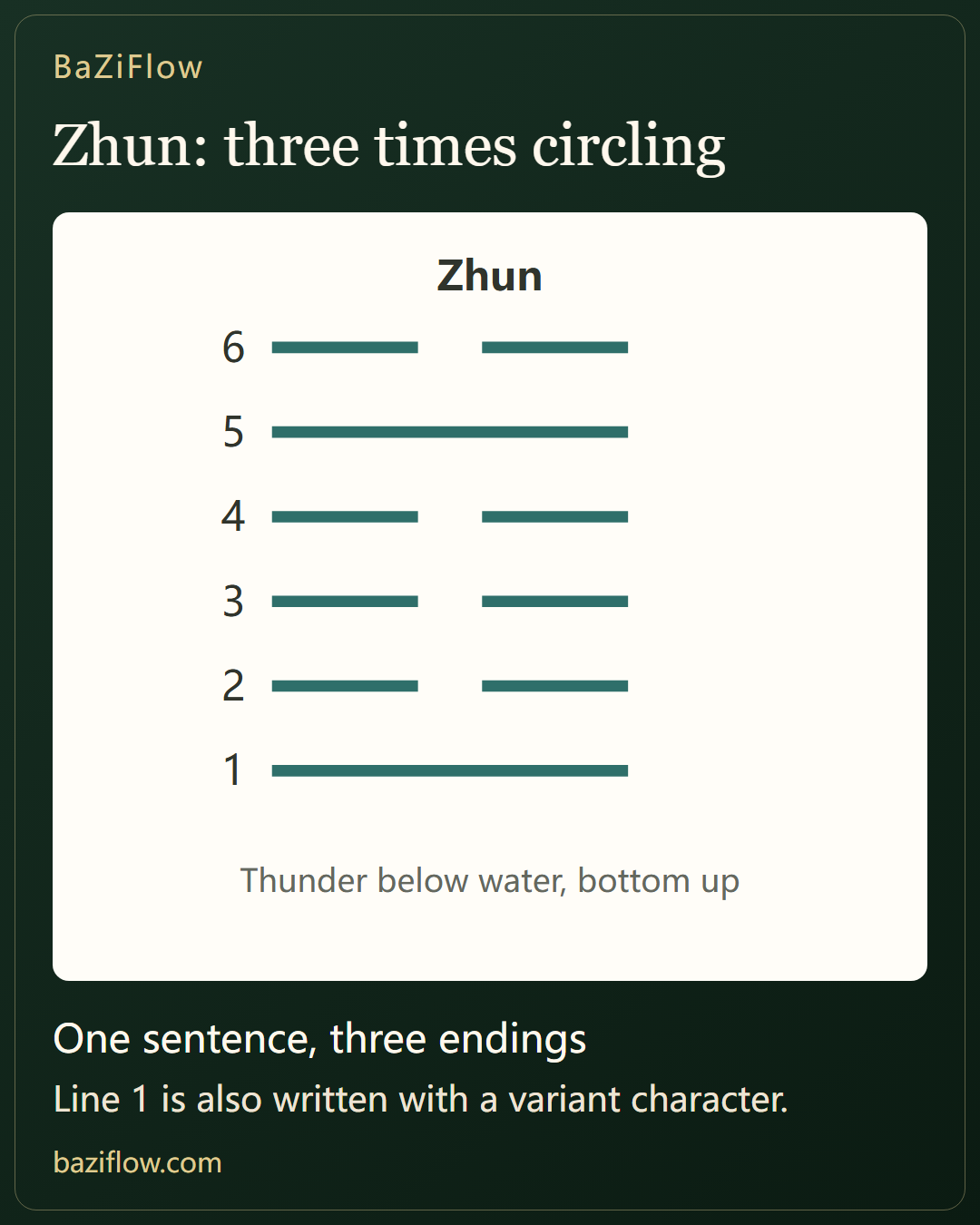
Zhun is the third of the 64 hexagrams, thunder below and water above. Read its judgment, the Great Image of clouds and thunder, and one sentence that opens three lines and ends three different ways.
The short version7 min read
One sentence occurs three times in Zhun: "riding a horse, circling and not advancing". After it come, in turn, "in ten years, betrothed", "good fortune, nothing unfavorable" and "weeping blood".
- Zhun puts thunder below water, and only the first and fifth lines are yang. The Shuo Gua says "thunder is movement" and "water is a pit"; the Commentary on the Judgments joins them as "moving within danger".
- The judgment has twelve characters. The first four match Qian, then it turns to "do not set out; fitting to set up lords". In the Great Image, the upper trigram is clouds: "clouds and thunder; the noble person sorts the threads".
- "Riding a horse, circling" opens lines 2, 4 and 6, followed in turn by "in ten years, betrothed", "to go is good fortune, nothing unfavorable" and "weeping blood".
Read first
The Sixty-Four Hexagrams: How Upper and Lower Trigrams Form One Figure ↗
Judgment and Line Statements: Whole Hexagram or Single Line? ↗
Thunder below, water above: two senses of the word
Zhun (屯) is the third hexagram: thunder below, water above. From the bottom the six lines are yang, yin, yin, yin, yang, yin, so only two lines are yang, the first and the fifth. The Shuo Gua gives each trigram a word: "thunder is movement" and "water is a pit". The Commentary on the Judgments (彖传) joins them in one phrase: "moving within danger".
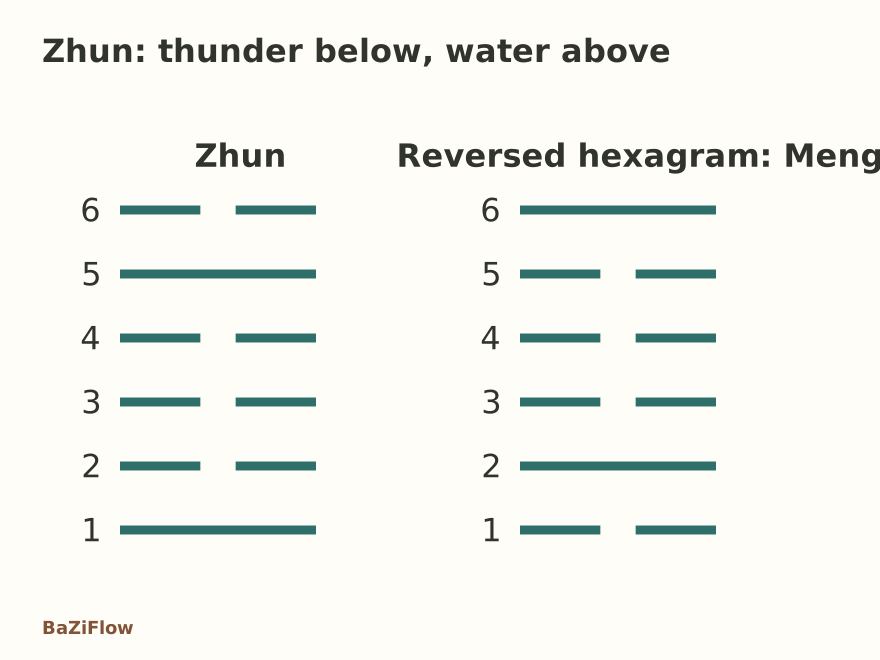
Zhun and its reversed hexagram Meng: the reversed hexagram is the whole figure turned upside down.
Enlarge diagram · scroll sideways to read
Each trigram holds one yang line: in thunder it is at the bottom, and in water it is caught in the middle between two yin lines. Stacked, they leave Zhun with a yang first line and a yang fifth line.
The word zhun carries two senses, and the Xu Gua states both: "zhun means fullness; zhun is the first birth of things". Fullness is being filled; first birth is just coming into being. Things newly born crowd together, full and in difficulty at once, which is why the Commentary on the Judgments goes on: "the firm and the soft first meet, and difficulty is born."
The judgment: free-flowing and steadfast, yet "do not set out"
Zhun's judgment is twelve characters: "Primal, free-flowing, fitting and steadfast. Do not set out anywhere; it is fitting to set up lords." The first four words match the judgment of Qian (乾), then it turns at once: do not set out, yet it is fitting to set up lords.
Enlarge diagram · scroll sideways to read
The Commentary on the Judgments comments on these sentences.
Zhun: the firm and the soft first meet and difficulty is born. Moving within danger, it is greatly free-flowing and steadfast. The stirring of thunder and rain fills everything; heaven's making is raw and dim. It is fitting to set up lords, and not to be at rest.
In the first half the firm and the soft have only just begun to meet, and difficulty comes out of that; moving inside danger, it is "greatly free-flowing and steadfast". In the second half the stirring of thunder and rain fills everything, the making of the world is still rough and dim, and so it is fitting to set up lords, and not to be at rest.
"Do not set out" and "fitting to set up lords" point in opposite directions at first sight: one says stay home, the other says put people in place. The Commentary on the Judgments explains only the second sentence and writes nothing separate for the first.
Clouds, thunder and sorting threads: the Great Image (大象)
The Great Image for Zhun reads: "clouds and thunder: Zhun. The noble person sets the warp and sorts the thread." In this Great Image the upper trigram is written as clouds and the lower as thunder, a different picture from the "danger" and "pit" of the Commentary on the Judgments and the Shuo Gua. What the noble person takes from it is to set the warp and sort the thread. The expression originally means putting threads in order: the warp is the lengthwise thread in weaving, and the thread is sorted and twisted; by extension it means finding the loose ends of a matter and planning it. (The Ten Wings overview, the Commentary on the Judgments, Great Image and the rest, says what each part does.)
Enlarge diagram · scroll sideways to read
Put the Great Image next to the judgment and the two can be read together: the judgment says "set up lords", the Great Image says "sort the thread". One puts people in place and the other finds the ends of the threads, and both are the same sort of act, building structure first.
Riding a horse, circling: one sentence, three endings
Among the six line statements of Zhun, one sentence occurs three times: "riding a horse, circling and not advancing". It appears once each in lines 2, 4 and 6, and each time something different follows. "Circling" is usually read as turning about without moving forward: on horseback, yet going round in place.
Enlarge diagram · scroll sideways to read
Set the three side by side and the difference is plain.
Enlarge diagram · scroll sideways to read
Line 2 reads: "Not a robber, but a suitor. The young woman is steadfast and does not accept a betrothal; after ten years she is betrothed." Those who come are not bandits but people seeking a marriage; she stays steadfast and does not consent, and consents only after ten years. The Small Image puts the difficulty in "it rides on the firm": line 2 is a yin line sitting on the yang first line (for the positions, see line positions). It adds "in ten years, betrothed: it returns to the usual course".
Line 4: "Seeking a marriage: to go is good fortune, nothing unfavorable." The topic is again a marriage, but this time one goes to seek it, and going is good. The Small Image says "to seek, then go: clear-sighted", meaning one sees clearly before seeking and going.
Line 6: "Weeping blood, tears streaming." The Small Image asks, "how can this last?"
The other three lines lack the sentence. Line 1, "lingering and hesitating; fitting to stay steadfast where one is, fitting to set up lords", is one of only two yang lines, at the very bottom, yet the Small Image says it is "putting the honored below the humble, and wins the people greatly". Line 3, "chasing deer without a keeper", means chasing deer with no forest keeper; "the noble person sees it is better to give it up; to go on brings regret". In line 5, "hoarding its rich fat", the first word is a verb, to gather and stockpile, and the fat is grease. The Small Image says "what it gives out is not yet bright", and the line closes: "a small steadfastness is good fortune, a large one is ominous."
Zhun and Meng: the Xu Gua, the reversed and the nuclear hexagram
Having named heaven and earth, the Xu Gua turns to what lies between them, nothing but the ten thousand things, and so arrives at Zhun; it then explains the name: "zhun means fullness; zhun is the first birth of things". After that, whatever has just been born is bound to be dim and small, so the next hexagram is Meng.
Zhun and Meng (蒙) are each other's reversed hexagram: turn Zhun upside down and you get Meng. After the turn, Zhun's first line becomes Meng's top line, and Zhun's fifth line becomes Meng's second. Zhun's inverse hexagram is Ding (鼎), made by swapping every line's polarity, and its nuclear hexagram is Bo (剝). A nuclear hexagram takes the two middle runs of three lines in the original and stacks them into a new figure; the method is in how a hexagram is built from two trigrams.
Enlarge diagram · scroll sideways to read
Questions readers ask next
Why does "riding a horse, circling" occur three times in Zhun?
The text gives no reason for the repetition. The sentence is the same each time and what follows differs: line 2 continues with a suitor and "in ten years, betrothed", line 4 with "seeking a marriage: to go is good fortune", line 6 with "weeping blood". Reading the three side by side is clearer than reading any one alone.
Do "do not set out" and "fitting to set up lords" contradict each other?
On the surface one says do not go and the other says it is fitting to set up lords. The Commentary on the Judgments explains only the second, against the background of "heaven's making is raw and dim", and adds nothing on the first. So the practical reading is to hold the two sentences side by side without forcing them into a single meaning.
How is the name Zhun pronounced?
As a hexagram name it is usually read zhun, with the same character read tun in words such as stationing troops or stockpiling grain. The Xu Gua says "zhun means fullness", putting both "filled up" and "just born" in one character, and in line 5 the character is a verb, to hoard.
Was this article helpful?
Sources & references
Continue reading
Kun (坤): six yin lines, read from stepping on frost to dragons fighting in the wilds ↗
Meng: from "it is not I who seek the young" to opening, embracing and striking ↗
The Sixty-Four Hexagrams: How Upper and Lower Trigrams Form One Figure ↗
Judgment and Line Statements: Whole Hexagram or Single Line? ↗