

Lü (履): treading on the tiger's tail, three ways
Content version · · Sources & references
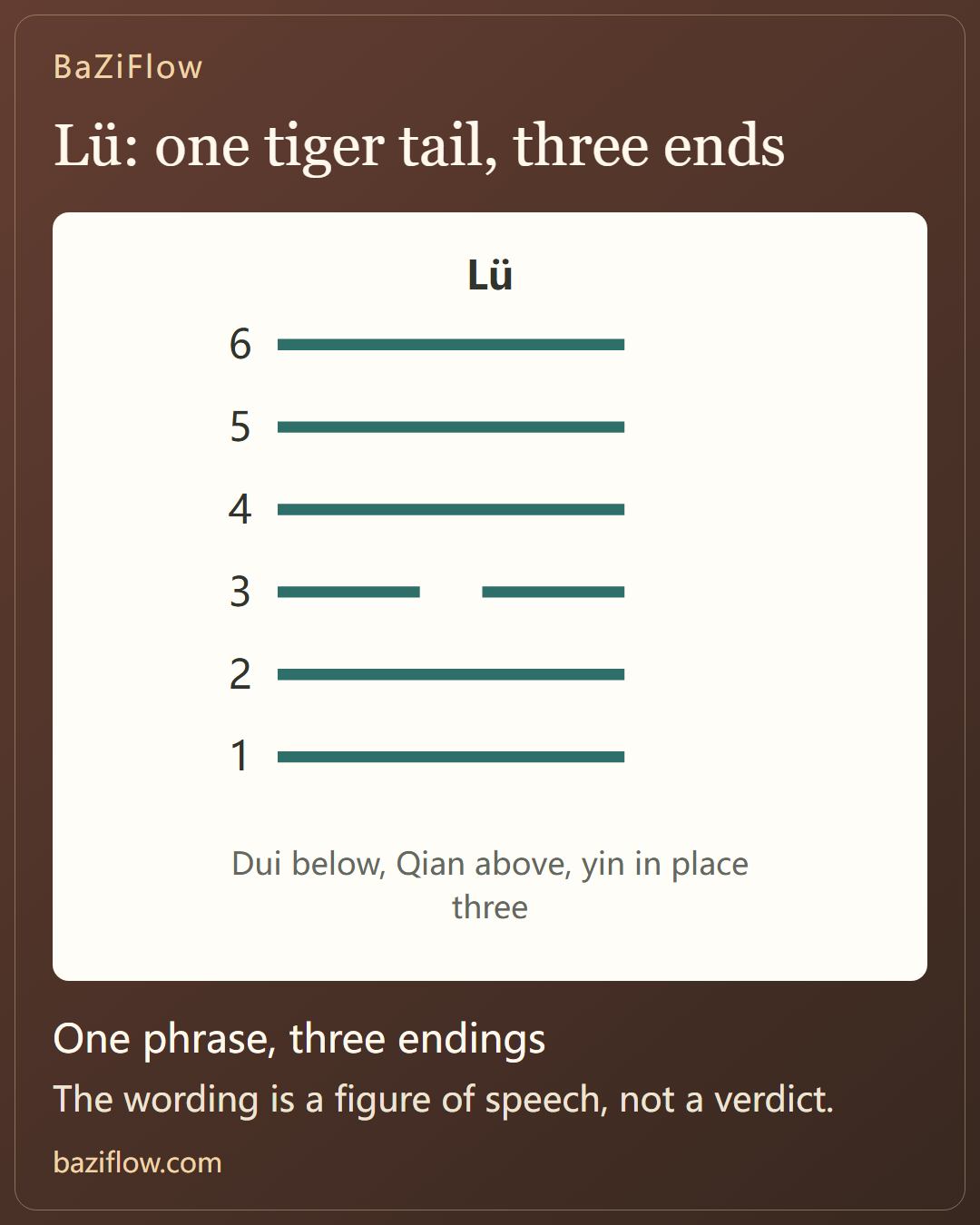
Lü has Dui (marsh) below and Qian (heaven) above, with one yin line among five yang. Read the Judgment "tread on the tiger's tail", the Great Image "distinguish above and below", and the six ways of walking in its lines.
The short version6 min read
Lü turns on one phrase, treading on the tiger's tail. It appears in the Judgment, in line 3 and in line 4, each time followed by a different ending; the six lines then describe six ways of walking, from plain sandals to looking back over one's steps.
- Lü stacks Qian (heaven) on Dui (marsh) and has a single yin line, in the third place. The Commentary on the Judgments explains the name as "the yielding treads on the firm" and adds "delighted, and answering Qian".
- The three tails come with three endings: not bitten, success; bitten, misfortune; wary and alarmed, good fortune in the end. For line 3 the Small Image gives the reason "the place is not fitting".
- The Great Image ends on "distinguish above and below, settle the people's aims"; the lines run through plain sandals, a smooth road, the one-eyed, wariness, resolute treading and looking back.
Read first
The Sixty-Four Hexagrams: How Upper and Lower Trigrams Form One Figure ↗
Judgment and Line Statements: Whole Hexagram or Single Line? ↗
A marsh under heaven: the shape of Lü
The upper trigram of Lü (履) is Qian (乾, heaven) and the lower is Dui (兌, marsh), so it is read as Dui below, Qian above. Line three is the single yin line, drawn broken, and the other five lines are all yang. The Shuo Gua glosses Qian as strength and Dui as delight.
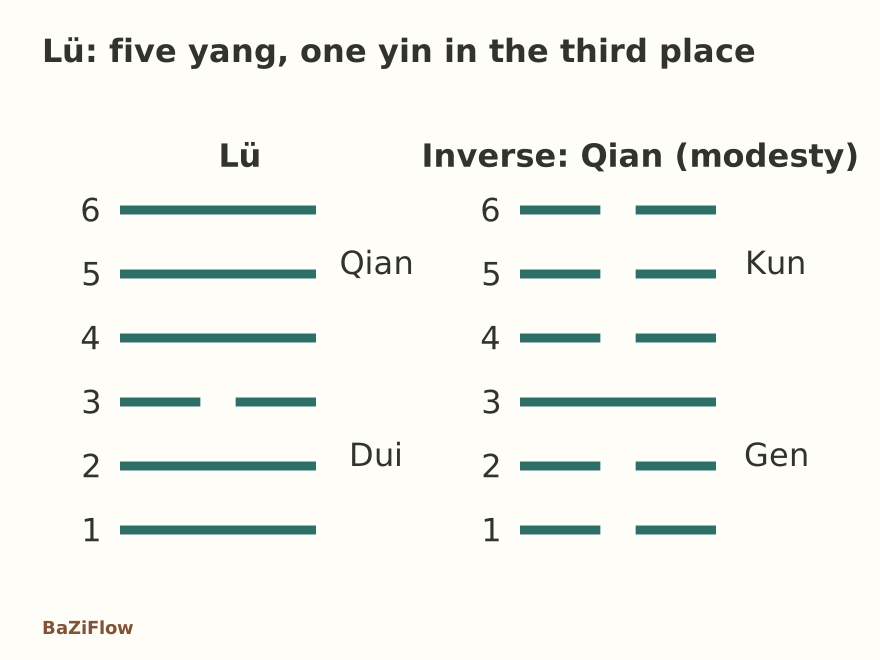
Lü and its inverse hexagram Qian (謙): a figure with its yin in place three and a figure with its yang in place three are each other's inverse.
Enlarge diagram · scroll sideways to read
Words the hexagram leans on
- Lü
- The name; literally to tread, to walk over. The Commentary on the Judgments explains it with "the yielding treads on the firm". The figure has a matching picture: the yin line in the third place sits on top of the yang line in the second.
- The tiger's tail
- The thing that appears in the Judgment, line 3 and line 4. Whether the tiger turns round after being stepped on is the question the whole hexagram leaves hanging.
- Bite
- The character means to bite. "Bites the person" is being bitten; "does not bite the person" is not being bitten.
One phrase, three endings
"Treading on the tiger's tail" occurs three times in the hexagram: once in the Judgment, once in line 3, and once in line 4. The tail is the same each time, but the second half of the sentence is different.
Enlarge diagram · scroll sideways to read
For the Judgment's "does not bite", the Commentary on the Judgments finds the reason in the trigram virtues: "delighted, and answering Qian", since Dui is delight and answers the Qian above it. For line 3's "bites", the Small Image (小象) gives four characters: "the place is not fitting", a yin line standing in the third place, which belongs to yang. For line 4's "wary and alarmed", the usual reading is an anxious, watchful manner, and the Small Image says "his will is carried out".
Lü means the yielding treads on the firm. Delighted, and answering Qian, so he treads on the tiger's tail and is not bitten: success. Firm, central and upright, he treads the ruler's seat without distress: this is brightness.
The last two phrases come down on the fifth line: firm, central and in the right place, it treads the ruler's seat without feeling guilty, which is why it is called "brightness".
The Great Image: heaven above, marsh below
The Great Image (大象) of Lü reads: heaven above, the marsh below, Lü; the noble person uses it to tell above from below and to settle the people's aims. The first half is the figure: heaven high, marsh low, each in its own place. The second half is the conduct: telling above from below, and settling the aims of the many.
Enlarge diagram · scroll sideways to read
Six lines: six ways of walking
Every line statement of Lü is about walking: what is worn on the feet, what road is taken, how the step is made, and how one looks back afterwards.
Enlarge diagram · scroll sideways to read
First nine: "plain sandals; going on, no blame". Plain means unadorned, and the Small Image says "he walks alone by his own wish". Nine in the second place: "the road he treads is smooth and level; a secluded person, steadfast: good fortune", with the Small Image "within, he does not fall into disorder".
Line 4 is back at the tiger's tail, and this time it is "wary and alarmed, in the end good fortune". Nine in the fifth place: "resolute treading; steadfast, but dangerous", where resolute means decisive. Top nine: "look at the steps he has trodden and read the omen in them; when he turns back, supreme good fortune", and the Small Image says "supreme good fortune at the top: great blessing".
The word "place" appears twice in the Small Image, once as not fitting and once as right: six in the third place is a yin line on a yang place, "the place is not fitting"; nine in the fifth place is a yang line on a yang place, "the place is right and fitting".
The neighbors of Lü: Qian (謙), Xiaoxu and Jiaren
The inverse hexagram of Lü is Qian (謙, modesty), the same sound as the hexagram Qian (乾) but a different character: where Lü has one yin among five yang, it has one yang among five yin, and the odd line again stands in place three. The reversed hexagram is Xiaoxu, the yin line rising to place four when the figure is turned over, so the two read as one shape from opposite ends. The nuclear hexagram is Jiaren, made by taking lines two to five and regrouping them as two new trigrams.
Enlarge diagram · scroll sideways to read
Once things are gathered there is ritual, so it was followed by Lü.
The Xu Gua links Lü to ritual. After Lü comes Tai, and the Xu Gua's way of putting it is that after this stretch is walked, there is peace. The Za Gua gives Lü three characters, "does not stay": it does not stop.
Questions readers ask next
Does "treading on the tiger's tail" announce danger?
The first half of the sentence is identical in all three places and the second half differs, so read the second half together with the reason the commentary gives, rather than staring at the tail.
What do "one-eyed" and "lame" mean in line 3?
The one-eyed cannot see well and the lame cannot walk steadily. The statement says they "can see" and "can walk", and the Small Image answers at once that this is "not enough to see clearly" and "not enough to go along with others": enough to see and walk a little, not enough to carry what is being done. It is a figure of speech in the text.
What are "plain sandals"?
Plain means without ornament, so the phrase is simply unadorned sandals. First nine goes on with "going on, no blame", and the Small Image comments "he walks alone by his own wish", joining the plain sandals to going one's own way.
Was this article helpful?
Sources & references
Continue reading
Xiaoxu (小畜): from "dense clouds, no rain" to "it has rained" ↗
Tai (泰): heaven below, earth above, and the words "no going without a return" ↗
The Sixty-Four Hexagrams: How Upper and Lower Trigrams Form One Figure ↗
Judgment and Line Statements: Whole Hexagram or Single Line? ↗