

Two of Swords: the blindfold and the balance
Content version · · Sources & references
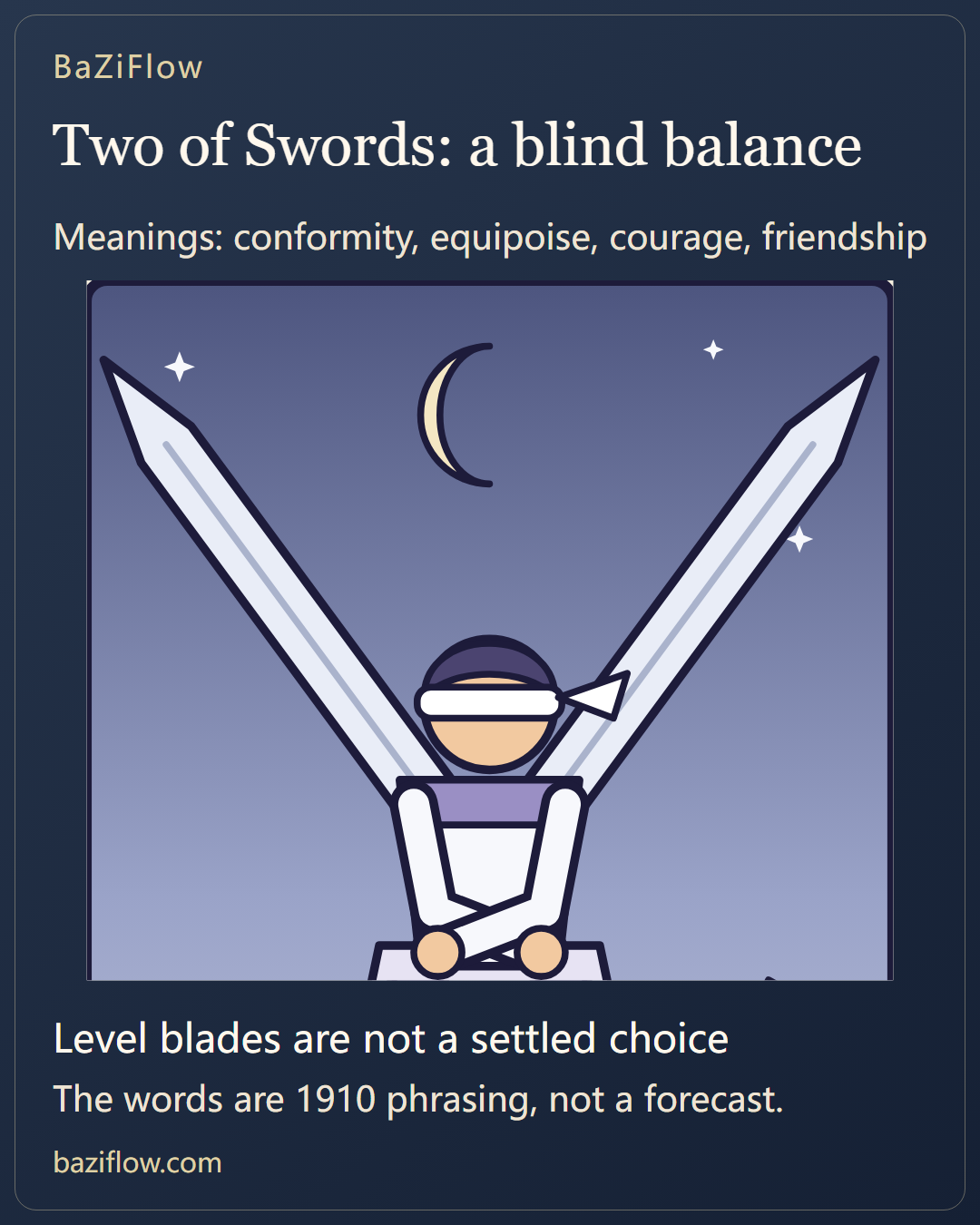
The Two of Swords shows a blindfolded figure balancing two swords on the shoulders. Separate Waite's word list, his reservation about harmony and the reversed words, then take apart a choice between two elective courses.
The short version6 min read
The figure in the Two of Swords is blindfolded, yet the two blades are held level. Waite's list speaks of equipoise, and the same passage asks you to read harmony with care.
- One sentence of description: a blindfolded woman holds two swords level on her shoulders. The word list starts from conformity and equipoise and ends on a tense phrase, "concord in a state of arms".
- The same entry carries a reservation: the suit as a whole is no emblem of kindly powers in human affairs, so the harmonious readings come with a proviso.
- Reversed: imposture, falsehood, duplicity, disloyalty. Other readers add gifts and influential protection upright and "dealings with rogues" reversed, in period wording.
Read first
Start with the picture: blindfolded, blades level at the shoulders
Waite describes the Two of Swords in one sentence: a hoodwinked female figure balances two swords upon her shoulders. His list comes next: conformity and the equipoise it suggests, then courage and friendship, then "concord in a state of arms".
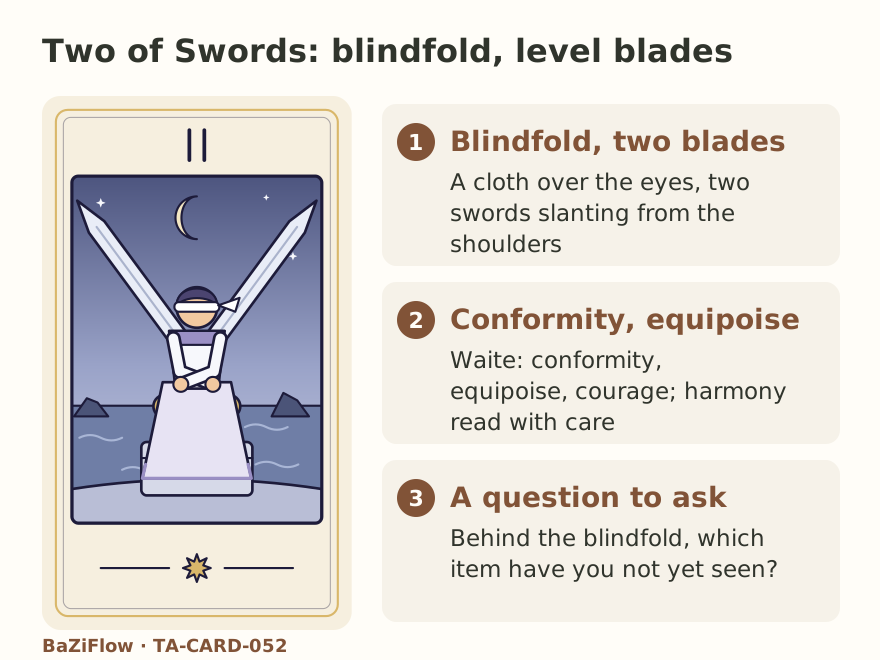
BaZiFlow original Two of Swords with three labels
On the Rider-Waite-Smith card there is more to see than that one sentence. The figure sits on a low stone bench with arms crossed over the chest, each hand steadying the hilt of a sword, the blades slanting up and outward to make a V. Behind her lies a sea with a few rocks breaking the surface, a low strip of land far off, and a crescent moon in the sky. BaZiFlow's original card follows the same plan with blindfold, blades and crescent. Read the three layers together: blades on top, cloth in the middle, sea and moon behind.
Enlarge diagram · scroll sideways to read
What Waite lists: conformity, equipoise, and one reservation
Waite's divinatory meanings come in groups: conformity and the equipoise it suggests; courage and friendship; "concord in a state of arms". A second reading offers tenderness, affection, intimacy. He ends with a proviso: wherever the card seems to promise harmony or other favorable things, take it with reservations, because the Swords suit as a whole does not stand for kindly powers in human affairs.
Conformity and the equipoise which it suggests ... another reading gives tenderness, affection, intimacy.
Enlarge diagram · scroll sideways to read
Blindfold, blades, moon and sea: who is speaking
Three things on this card deserve their own look: the blindfold, the blades, and the moon with the sea. Only the first two appear in Waite's text.
Three things, each in someone else's voice
- Blindfold
- Waite's word is "hoodwinked". In English that word can mean having the eyes covered, and also being deceived or misled. Whether he had the second sense in mind when he wrote it, the text does not say.
- Two blades
- "Balances two swords upon her shoulders": the action Waite names is balance. What each of the swords stands for, he does not say.
- Moon and sea
- The RWS drawing has a crescent, water and rocks, and Waite mentions none of them. A common teaching reading takes them as night and unclear water; that is a later borrowing.
Enlarge diagram · scroll sideways to read
"Blindfold as not seeing everything" and "balance as not having decided yet" are teaching readings, and the next section uses them. They are drawn from the picture and are not in Waite's text.
How to read it: first see what the blindfold hides, in one course choice
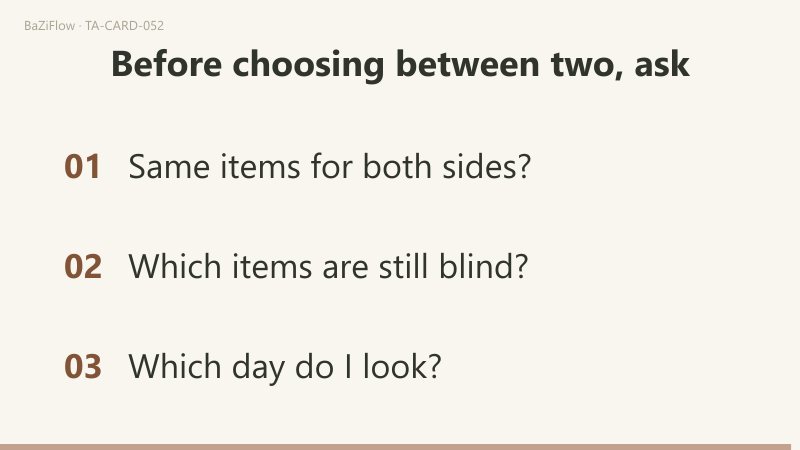
The card has a plain shape: a blindfolded figure holds two blades at the same height. Carried to a concrete matter, it breaks into three questions:
Are the blades really level?
Write both options on the same few items, one pass each. If one side gets more lines than the other, the two weights have not been brought to the same height.
What is behind the blindfold?
Mark each item as seen and checked by you, or only heard about. The balance is being held while blind, and the blind items decide how far the "equal" can be trusted.
On which day does the cloth come off?
The card has no such step, it is a teaching extension: give each blind item one action and one date, and look when the day comes instead of holding the blades up any longer.
An example: two elective courses run in the same slot on Wednesday afternoons, you want both, and you have been stuck for a week. Write each course down on the same three items and mark which have been checked:
Enlarge diagram · scroll sideways to read
Where the "equipoise" reading stops
Can read
- The two weigh about the same for now
- The information is not complete
Cannot read
- The two courses are equally good
- Someone will choose for you if you wait
Next step
- Fill in the three items for Course B
- Set a date for the blindfold
Reversed, additional meanings and neighbors: imposture, disloyalty, and "dealings with rogues"
Waite's reversed list for the Two of Swords has four words: imposture, falsehood, duplicity, disloyalty. They sit directly opposite the upright "conformity, friendship" and speak of something that looks in agreement and is not.
Enlarge diagram · scroll sideways to read
The additional meanings come from other readers and read "gifts for a lady, influential protection for a man in search of help", with "dealings with rogues" reversed. This is wording from around 1910, and its assumptions about gender belong to that time; they do not follow from the picture.
Three neighboring cards, and how each places "two"
Two cups, two people
The cups are in two pairs of hands and touch in the middle; the matter is the response on each side.
A balance, a sword, a seated figure
The list opens with equity and includes "executive". Balance again, but with a seat for someone who rules.
The next card
Three swords through one heart. The list begins with removal and absence, words of parting.
Questions readers ask next
Does the Two of Swords mean two options are equal and I can pick either?
Waite's list speaks of conformity and equipoise; it does not say "pick either". The figure is blindfolded, so the balance holds while she cannot see. Find out what the blindfold hides before you judge whether the sides really match.
What does the Two of Swords mean reversed?
Waite's reversed words are imposture, falsehood, duplicity, disloyalty, and the additional list says "dealings with rogues". Those are 1910 phrasings; in a question, a more useful reading is "which statement has not been checked yet".
Is the Two of Swords a good card or a bad one?
The list includes friendship and concord, and then adds a reservation that the suit as a whole is not a symbol of benevolent forces. It describes balance under tension: nothing is leaning now, which does not mean the matter is settled.
Was this article helpful?
Sources & references
Continue reading
Ace of Swords: a hand, a sword and a crown, and a word list built around force ↗
Three of Swords: three blades through a heart, and a list of absence and parting ↗