

Knowing enough, knowing when to stop
Content version · · Sources & references
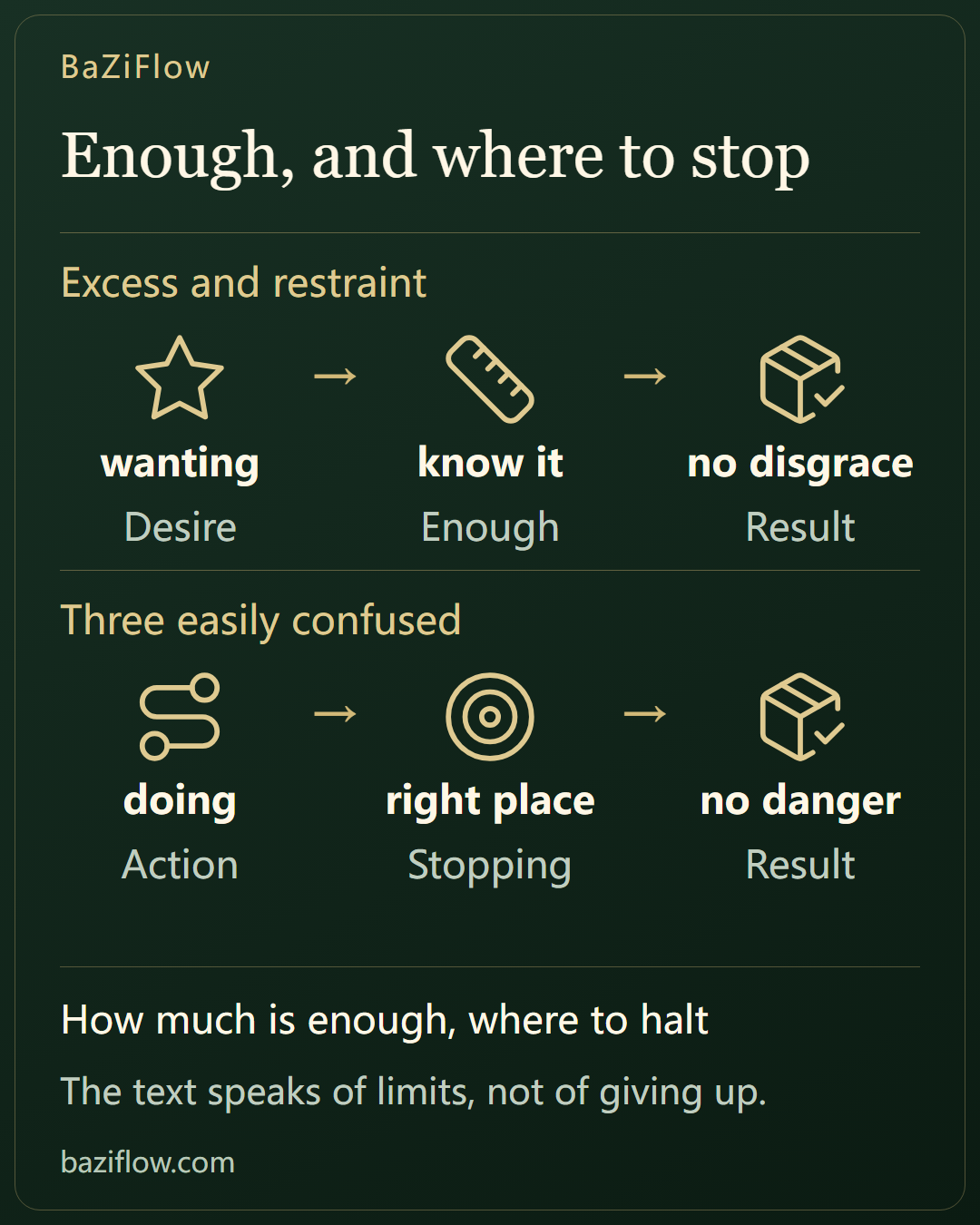
Chapters 44, 46, 33, 9 and 12 of the Laozi show that knowing enough asks "how much is enough" and knowing when to stop asks "where to halt". Side by side, the lines separate moderation, stopping and passive restraint.
The short version9 min read
Knowing enough and knowing when to stop each answer one question: how much is enough, and where to halt. Neither means doing nothing; chapter 33 sets "one who presses on has purpose" right beside "one who knows enough is rich".
- Knowing enough asks how much is enough (chapters 33, 44, 46); knowing when to stop asks where to halt (chapters 32, 44): one measures having, the other measures acting.
- Chapter 44 asks three questions (name and body, body and goods, gain and loss) and then totals a bill: "great love brings great expense, great hoarding heavy loss", which leads to knowing enough and knowing when to stop.
- The text sets knowing enough beside striving: in chapter 33 the line after "one who knows enough is rich" is "one who presses on has purpose", so knowing enough does not ask anyone to stand still.
Read first
Dao and De in the Laozi: Reading Chapters 1, 21, 25, 38 and 51 ↗
Wu Wei: Why It Is Not Doing Nothing, Read Through Chapters 2, 48, 57 and 64 ↗
One asks how much, the other where
Chapter 44 puts "knowing enough, no disgrace" and "knowing when to stop, no danger" in two neighboring lines. They look like one idea but ask different things: knowing enough (知足) asks "how much is enough", knowing when to stop (知止) asks "where to halt".
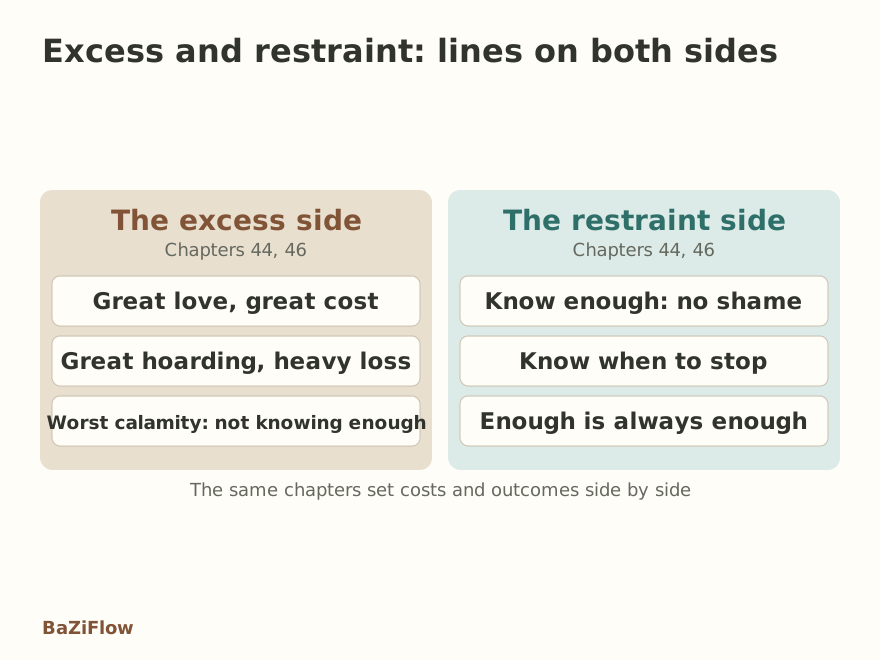
Text comparison: the left column gives the costs of excess, the right the results of restraint; the lines come from chapters 44 and 46.
The table sets out lines from chapters 44 and 46: on the left the costs of going too far, on the right the results of keeping measure. On the left stands "great love brings great expense, great hoarding heavy loss", and on the right "knowing enough, no disgrace; knowing when to stop, no danger". To read these chapters, first take the words apart:
Three words to keep apart
- Knowing enough
- To know is to recognize; "enough" is sufficiency. Recognizing what is enough measures what one has. It appears in chapters 33, 44 and 46.
- Knowing when to stop
- To stop is to halt. Knowing where to halt measures what one does. It appears in chapters 32 and 44.
- Desire
- Wanting, wanting to get. Chapter 46 writes "wanting to get", chapter 19 "fewer private aims, fewer desires".
Chapter 44: three questions and a bill
Chapter 44 is only a few lines. It asks three questions and then totals a bill:
Name or body: which is dearer? Body or goods: which counts for more? Gain or loss: which does more harm? So great love brings great expense, and great hoarding heavy loss. To know enough is to suffer no disgrace; to know when to stop is to meet no danger; and so one can last long.
Enlarge diagram · scroll sideways to read
Every question sets two things against each other: fame and the self, which is nearer; the self and goods, which counts for more (the word is often taken as "carries more weight"); gain and loss, which does more harm. The text answers none of them one by one and moves straight to the sum: love too much and the cost will be large, hoard too much and the loss will be heavy. To know enough is to avoid disgrace, to know when to stop is to avoid danger, and so one can last.
In this bill "expense" and "loss" are costs, "disgrace" and "danger" are outcomes, and "lasting long" is the benefit the text names.
Where to stop: chapters 9 and 32
Knowing when to stop measures action. Chapter 9 draws it in several pictures:
To hold it and fill it to the brim is worse than stopping; to hammer it to a point cannot be kept for long. When gold and jade fill the hall, no one can guard them; wealth and rank joined with pride leave one's own misfortune behind. When the work is done, withdraw: this is the Way of heaven.
Enlarge diagram · scroll sideways to read
One common reading of the first line is of someone pouring into a cup who keeps going after it is level with the rim, and would do better to stop earlier. The second is traditionally read as hammering something to a point and then honing it further, so that the sharper it gets the more easily it breaks. The first four lines describe going too far; only the last describes measure: "when the work is done, withdraw", where the work comes first and the withdrawal after it.
In chapter 32 knowing when to stop is tied to names:
Once the making begins there are names; and once there are names, one must know where to stop. Knowing where to stop is how one avoids danger.
"Making" means starting to set things up, and "names" is traditionally read as titles, ranks and institutions: once they are established, one must know where to stop. The line reads well beside "knowing when to stop, no danger" in chapter 44: one speaks of what one will know, the other of the outcome.
Chapters 12 and 46: what desire reaches for
What does "desire" reach for? Chapter 12 names it:
The five colors make the eye blind; the five sounds make the ear deaf; the five flavors dull the mouth; racing and hunting make the heart go wild; goods hard to get hinder one's conduct.
Enlarge diagram · scroll sideways to read
The text turns five kinds of "more" into five kinds of harm: eyes dazzled, ears dulled, taste lost, the mind unhinged by chase and hunt, conduct hindered by rare goods. The next line settles on "belly" and "eye": "Therefore the sage acts for the belly and not for the eye; he sets that aside and takes this." "For the belly" is traditionally read as for real needs, "not for the eye" as not chasing what dazzles; here is a standard for "enough".
Chapter 46 moves from the person to the world:
When the world has the Way, swift horses are sent back to work the fields; when it has not, war horses are born in the countryside. No calamity is greater than not knowing enough; no fault is greater than wanting to get. So the enough of knowing enough is always enough.
The first two lines speak of the world: when it has the Way, fast horses are sent back to tend the fields (the word here means tending and manuring land), and when it has not, war horses are bred in the countryside. Only then do "calamity" and "fault" come. Reading the passage inside one person's life is a later borrowing. The last line repeats the word: the first "enough" is recognizing it, the second is what suffices; recognize what is enough, and it will always be enough.
Moderation, stopping and passive self-restraint
By now it is easy to blur three things into one: moderation, stopping and passive self-restraint. Chapter 33 gives a side witness:
One who knows others is wise; one who knows himself is clear-sighted. One who overcomes others has strength; one who overcomes himself is strong. One who knows enough is rich. One who presses on has purpose. One who does not lose his place endures. One who dies and does not perish is long-lived.
The chapter runs in pairs: knowing others and knowing oneself, overcoming others and overcoming oneself. "One who overcomes himself is strong" speaks of mastering oneself, which already takes effort, and the line after "one who knows enough is rich" is "one who presses on has purpose": people who go forward with effort have purpose. The text does not write knowing enough as standing still. Place the lines in three columns and the differences show:
Enlarge diagram · scroll sideways to read
Moderation is measure in quantity, stopping is measure in place, and both stay within the sphere of doing. Passive restraint would mean giving up the work, and for that there is no matching line in the text, only "one who presses on has purpose" and "when the work is done, withdraw". To read limits through the image of water, see softness and non-contention; for how not forcing shows up in action, read wu wei; for how the Way and De themselves are read, see the Way and De.
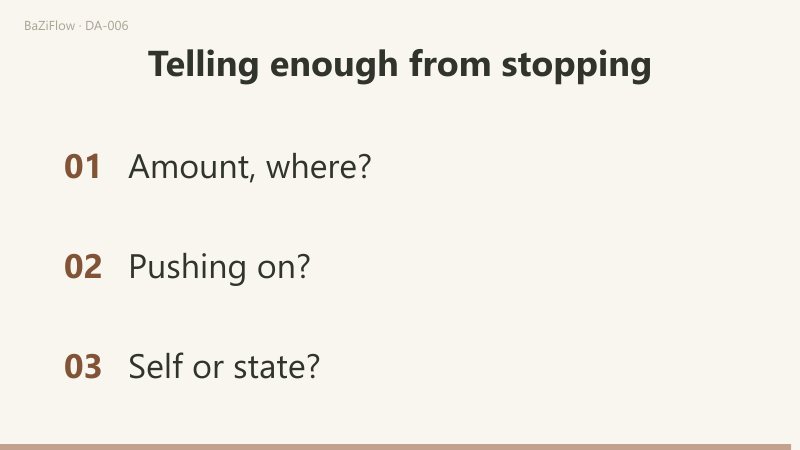
How much, or where?
See whether the line asks "is it enough" or "where to halt". The first is knowing enough; the second is knowing when to stop.
Does "presses on" follow?
Read the neighboring lines. In chapter 33 the line after knowing enough is "one who presses on has purpose".
A person, or a state?
Chapters 32 and 46 have lords and the world in the background. Setting them in one person's life is a borrowing, and should say so.
Questions readers ask next
Is "knowing enough" the same as "contentment brings happiness"?
No. The saying that contentment brings joy is a later idiom that reads "enough" as a feeling. The Laozi names other outcomes: one who knows enough is "rich" (chapter 33), knowing enough means "no disgrace" (chapter 44), and the enough of knowing enough is "always enough" (chapter 46). The talk is of sufficiency and of consequences, not of a mood.
Does knowing when to stop mean quitting halfway?
No. Chapter 9 says "when the work is done, withdraw": the work comes first, and withdrawing after it. "Better to stop than fill to the brim" speaks of a vessel already full. The stop in this phrase is a stop at the right place, not a half-finished job.
Does knowing enough make a person unambitious?
The text does not say so. Chapter 33 puts "one who knows enough is rich" beside "one who presses on has purpose", the second praising those who push forward. "No calamity is greater than not knowing enough" (chapter 46) aims at the cost of insatiable wanting, and effort itself is not the target.
Was this article helpful?
Sources & references
Continue reading
Dao and De in the Laozi: Reading Chapters 1, 21, 25, 38 and 51 ↗
Wu Wei: Why It Is Not Doing Nothing, Read Through Chapters 2, 48, 57 and 64 ↗
Softness and Non-Contention: Read the Images First, Then Talk About Strength and Yielding ↗
The Zhuangzi: Inner, Outer and Miscellaneous Chapters, Mapped ↗