

Guan: wind over earth, seeing and being seen
Content version · · Sources & references
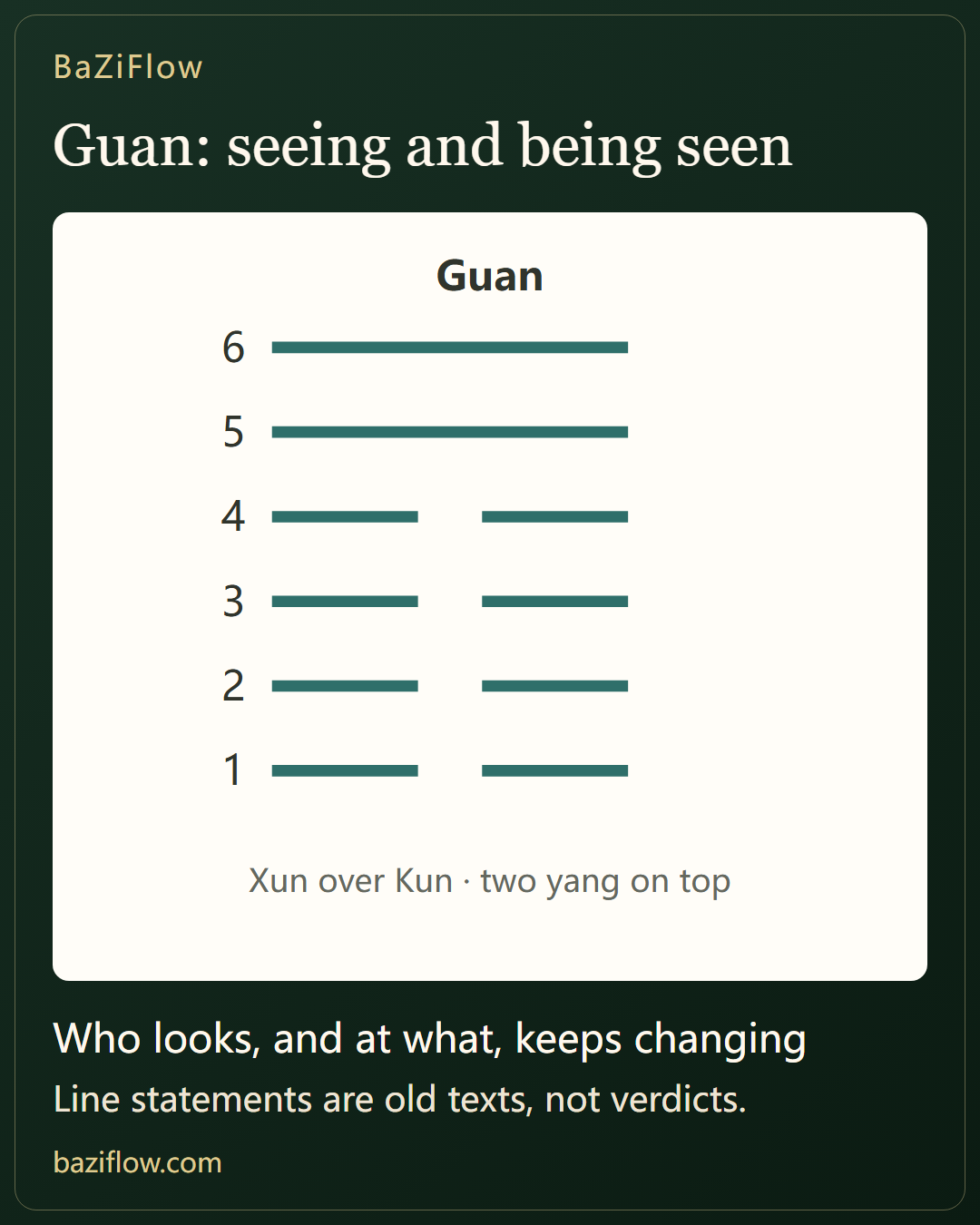
Guan is the 20th hexagram: wind over the earth, two yang lines on top of four yin. The judgment stops between the washing and the offering of a rite, and six statements change who looks at what.
The short version7 min read
Guan literally means to look. The judgment stops at the washing of hands that opens a rite; the Commentary has those above be seen and those below be transformed; and in the statements the object of looking moves from a child's view to "my life" and "his life".
- Guan (觀) stacks Xun (wind) on Kun (earth): two yang lines on top, four yin below. The Commentary on the Judgments says "a great sight stands above" and "those below look and are transformed", so what is seen sits above what looks.
- The judgment, "hands washed, offering not yet made; there is trust, solemn and looking up", stops in a rite after the washing and before the offering. The Great Image (大象) reverses direction: the ancient kings tour the regions and go to look at the people.
- Guan in the six statements is, in order: a child's look, a peeping look, observing my life, observing the glory of the state, observing my life again, observing his life. The Small Image (小象) glosses line five's "my life" as "observing the people".
Read first
The Sixty-Four Hexagrams: How Upper and Lower Trigrams Form One Figure ↗
Judgment and Line Statements: Whole Hexagram or Single Line? ↗
Wind over the earth: two yang lines on top of four yin
Guan (觀) is the 20th hexagram: Kun (earth) below, Xun (wind) above. The top two lines, line five and the top line, are yang; the four below are all yin. The Shuo Gua says "Xun is entering" and "Kun is yielding": wind slips into every crevice, and the earth yields as it carries everything. Wind passing over the ground is the image of this hexagram.
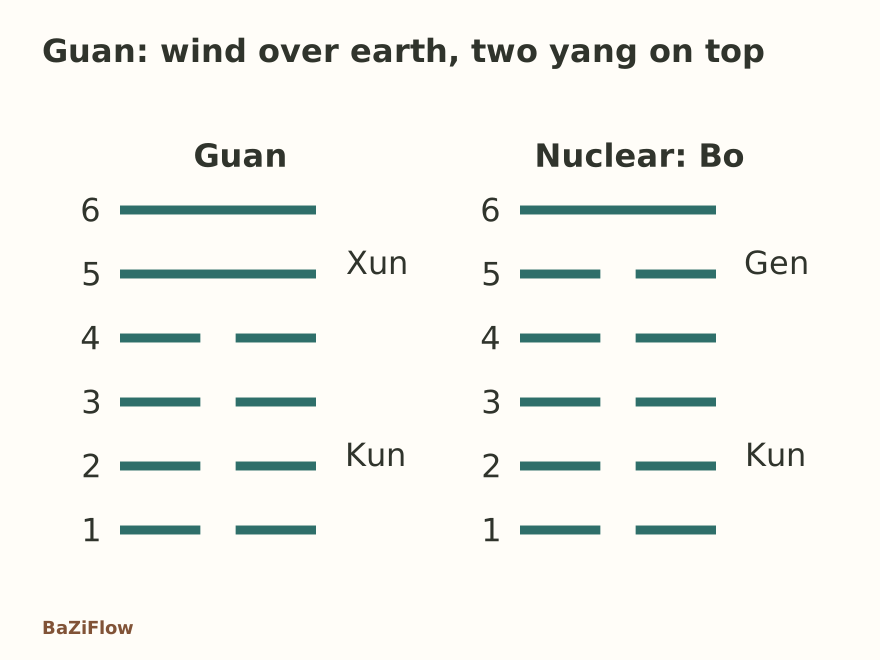
Guan and its nuclear hexagram Bo: the two yang lines shrink to a single one at the top.
Enlarge diagram · scroll sideways to read
Three terms before reading Guan
- Guan
- Literally, to look. In this hexagram it is both the act of looking (the judgment and the statements) and what is seen (the "great sight" of the Commentary on the Judgments).
- Washing and offering
- In a sacrifice, to wash is to wash the hands and to offer is to present the food. The judgment "washed but not offered" describes the moment between the two.
- "My life" and "his life"
- What "life" refers to in the statements is read in several ways: way of living, conduct, the people one is born among. Here the wording stays literal. "My life" and "his life" are given word for word, with no choice made between the readings.
Four yin lines below and two yang lines above look like a crowd with their heads tilted back, watching the two at the top. That layout is what the Commentary on the Judgments describes first.
The judgment: hands washed, offering not yet made
The judgment of Guan is only a few words:
Hands washed, offering not yet made; there is trust, solemn and looking up.
To wash is to wash the hands before a sacrifice, to offer is to present the sacrificial food, trust is good faith, and the last phrase is traditionally read as a solemn look turned upward. Read through, the judgment stands between two steps of a rite: the hands have been washed, the food has not yet been set out. Tradition usually takes it this way: the gravest moment is the opening one, and those who watch are convinced by that point.
Enlarge diagram · scroll sideways to read
The Commentary on the Judgments reads the judgment into the figure:
A great sight stands above. Yielding, and entering gently; central and upright, it looks over the world. Guan: "hands washed, offering not yet made; there is trust, solemn and looking up." Those below look and are transformed. Look at the spirit-like way of heaven: the four seasons never go wrong. The sages use that spirit-like way to set up their teaching, and the world submits.
"A great sight stands above" says that the yang lines at the top are what is looked at. "Yielding, and entering gently" is Kun below and Xun above, and "central and upright" is line five, in the middle of the upper trigram and a yang line in a yang place. "Those below look and are transformed" is the key of the passage: looking, the lower ones are changed. The Commentary then lifts the looking to heaven: watch heaven's spirit-like way and the seasons do not err; the sages teach in the same manner and the world submits. The "spirit-like way" is traditionally read as the principle by which heaven moves without leaving a trace.
The Great Image: wind over the earth, the ancient kings tour the regions
The Great Image turns the direction around:
Wind moves over the earth: Guan. The ancient kings accordingly toured the regions, observed the people, and set up teaching.
A Great Image names the image first and then the conduct, and here the subject is "the ancient kings". Wind crosses the ground and leaves no place out. To tour the regions is to inspect every quarter, and to observe the people and set up teaching is to teach only after looking at them.
Enlarge diagram · scroll sideways to read
One character, two directions: in the Commentary the people below look up at the one above; in the Image the one above walks down to look at those below. The hexagram writes both in.
The six statements: who looks, and at what, keeps changing
Each of the six statements contains the word guan, but the one who looks and the thing looked at are different every time.
Enlarge diagram · scroll sideways to read
Line one, at the bottom, is a child's look: seeing only what is in front of the eyes. The statement gives two verdicts, no blame for a petty person and regret for a noble one, and the Small Image says plainly "the way of the petty person". Line two is a peeping look, looking through a crack. The statement adds "fitting for a woman to stay on course", and the Small Image says "this too is something to be ashamed of".
Line three turns the look onto the self: "observing my life: advance or retreat", a choice between going forward and holding back once the looking is done, and the Small Image says "he has not lost the way". Line four, "observing the glory of the state", looks at the splendor of a realm: "fitting to be a guest of the king", and the Small Image says "he is esteemed as a guest". Line five repeats "observing my life", now followed by "a noble person, no blame", and the Small Image glosses it as "observing the people". At the top the "my" changes to "his": "observing his life", with the comment "his aim is not yet at rest".
Neighbors of Guan: Lin, Bo, Dazhuang, and "can be looked at"
Turn Guan upside down and you have Lin, with the two yang lines back at the bottom. Change every line to its opposite and you get Dazhuang (大壯), which has both of its yin lines at the top. The nuclear hexagram is Bo (剝); for how it is taken, see the structure of a hexagram. Of Guan's two yang lines only the one at the top remains.
Enlarge diagram · scroll sideways to read
The Xu Gua links Guan to what precedes it in a short phrase:
Only when things are great can they be looked at.
What has grown large is worth looking at. After Guan comes Shihe (噬嗑), and the Xu Gua's account is that only after looking can there be anything to bring together.
Questions readers ask next
What does "washed but not offered" mean?
To wash is to wash the hands before a sacrifice; to offer is to present the sacrificial food. The judgment stands between the two: the hands are clean, the offering has not yet been placed. Tradition usually reads it as gravity showing itself at the very start, so that those watching already trust. The text gives only these few words; the rest is reading.
Why do lines three and five both say "observing my life" while their comments differ?
Line three goes on with "advance or retreat" and its comment says "he has not lost the way". Line five goes on with "a noble person, no blame" and its comment says "observing the people". The same three words land on a choice between advancing and retreating in one place and on the condition of the people in the other.
Does guan simply mean observation?
Literally it means to look, but the "great sight" in the Commentary reads more like the thing that is looked at. In this hexagram one character is both the act and its object, so at each place the first question is whether someone is looking or something is being looked at.
Was this article helpful?
Sources & references
Continue reading
Lin: land above the lake, six modifiers for one word and a warning about the eighth month ↗
Shihe: something in the mouth, from "shackle over the toes" to "cangue over the ears" ↗
The Sixty-Four Hexagrams: How Upper and Lower Trigrams Form One Figure ↗
Judgment and Line Statements: Whole Hexagram or Single Line? ↗