

Ace of Swords: the crowned blade
Content version · · Sources & references
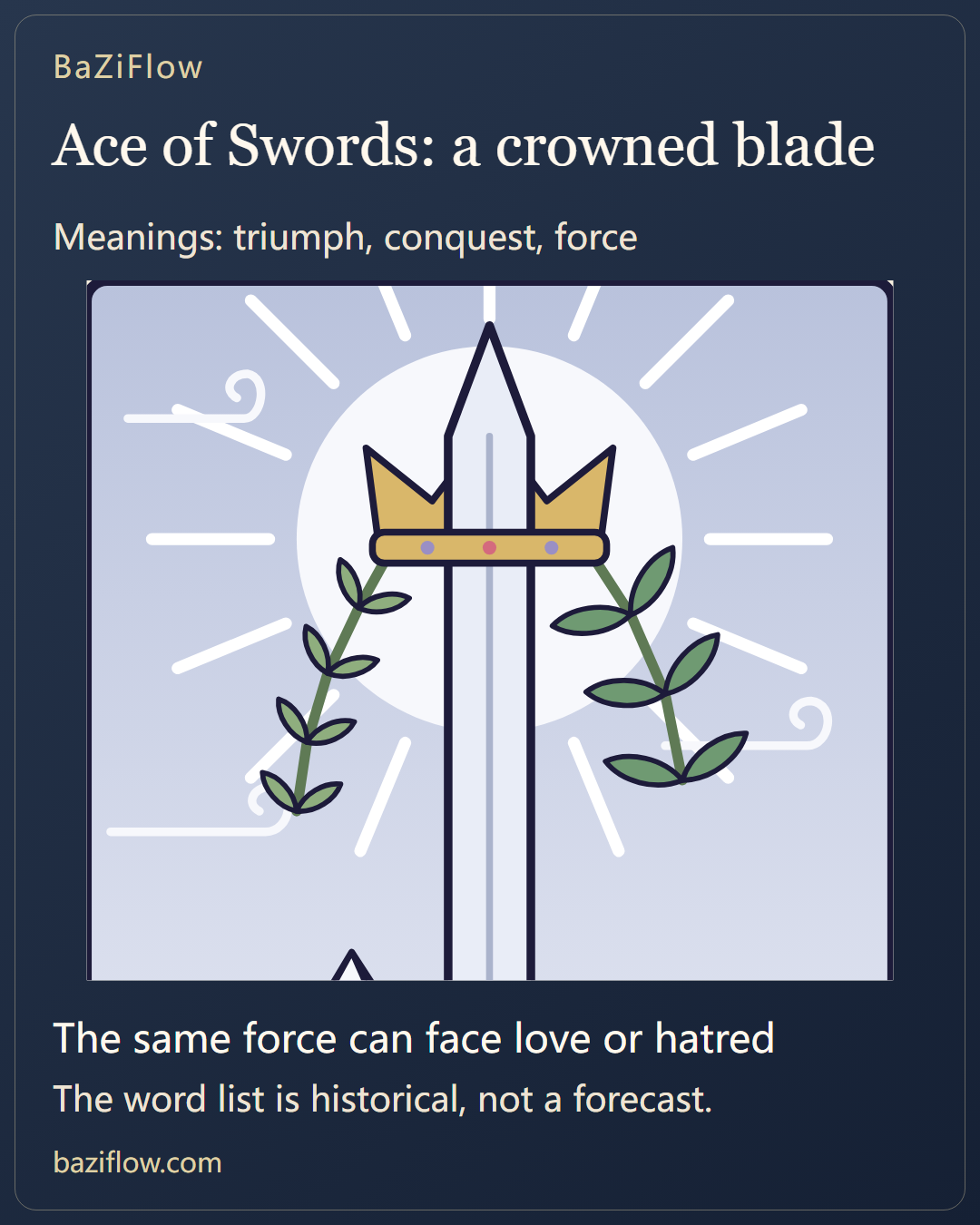
The Ace of Swords shows a hand from a cloud gripping a sword whose point is circled by a crown. Separate Waite's three layers of meanings, then measure force, direction and crown on a deposit email.
The short version7 min read
The Ace of Swords holds only a hand, a sword and a crown. Waite's word list circles force, so the first question is what this force is for.
- Waite's description is one sentence: a hand from a cloud grasps a sword whose point is encircled by a crown. The list that follows: triumph, the excessive degree in everything, conquest, triumph of force.
- He adds that it is a card of great force in love as well as in hatred, and that the crown may carry a much higher significance, which he does not spell out.
- The reversed reading comes in two accounts that do not match: the same but disastrous, or conception, childbirth, augmentation, multiplicity. The extras add "great prosperity or great misery".
Read first
Start with the picture: a hand from a cloud, a sword, a crown on its point
Waite describes the Ace of Swords in one sentence: a hand issues from a cloud, grasping a sword, the point of which is encircled by a crown. The word list follows at once: triumph, the excessive degree in everything, conquest, triumph of force.
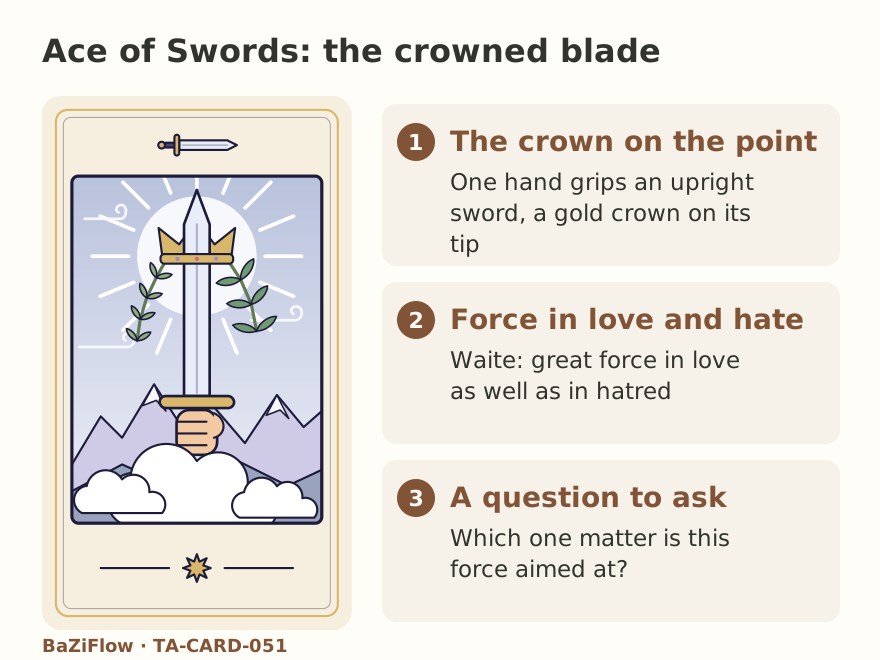
The Ace of Swords as BaZiFlow drew it for this article; the sword and crown follow the teaching, and the RWS original is composed differently.
The Rider-Waite-Smith card shows more, details Waite does not mention. The hand sits at lower left, coming out of a cloud and gripping the hilt of an upright sword. A gold crown sits on the point, with a branch hanging down each side: on the left one with red berries, on the right a broad green leaf. A few small yellow flecks drift around the blade, and there are hills in the distance. Read the picture from top to bottom: the crown on the point, the sword in the hand, the hand out of the cloud.
Enlarge diagram · scroll sideways to read
What Waite lists: triumph, conquest and "the excessive degree in everything"
Waite's divinatory meanings run: triumph; the excessive degree in everything; conquest; triumph of force. Then he adds that it is a card of great force, in love as well as in hatred.
Triumph, the excessive degree in everything, conquest, triumph of force. It is a card of great force, in love as well as in hatred.
The list speaks of how great the force is; no word in it speaks of what the force is used for. Love and hatred sit in one sentence side by side, with no choice made between them. He also adds a note on the crown, which "may carry a much higher significance than comes usually within the sphere of fortune-telling", and does not say what that significance is.
Enlarge diagram · scroll sideways to read
The three layers come from different places. The main entry is Waite's own list. The reversed readings sit inside the same entry, as two accounts. The additional meanings are other readers' words, "great prosperity or great misery", and should be labeled apart from the main entry.
Sword, crown, hand: what is written in the original
There is little in the picture, and three things are worth separating: the sword, the crown and the hand. Waite only mentions the sword and the hand; he adds a note on the crown but gives no symbolism.
Three things, each with its source
- Sword
- Waite writes "a sword", grasped in the hand; the picture shows it upright. About the suit he remarks, under the Two of Swords, that Swords "generally are not symbolical of beneficent forces in human affairs"; that is his view of the whole suit.
- Crown
- On the point of the sword. Waite says it may carry a much higher significance than fortune-telling usually reaches, and goes no further. A crown as a sign of kingship and victory is common knowledge, not Waite's explanation of this card.
- Hand
- Out of a cloud, with no body in sight. Waite writes only "a hand issues from a cloud, grasping a sword", and does not say whose hand it is.
Enlarge diagram · scroll sideways to read
Reading the crown as "the outcome you want" and the hand as "your own hand" are modern teaching devices. They turn the card into questions you can act on, and the next section uses both; they come from the teaching tradition, not from Waite's text.
How to read it: measure the sword three ways before writing
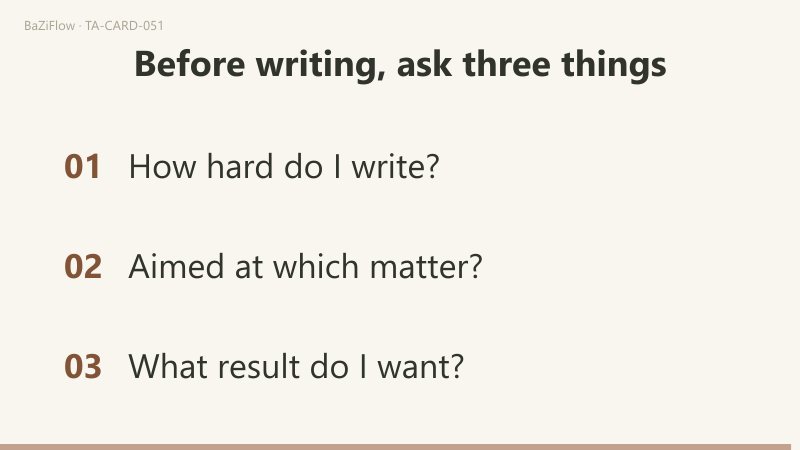
The card hands you a ready-made shape: a hand grips a sword, and a crown sits on the point. Carry it to an everyday matter and it becomes three measures: force, direction and crown.
Force: which notch is it?
Waite's list includes "the excessive degree in everything". Before you write, set the notch for what you are about to do: stating facts, making a request, or issuing an ultimatum. You set the notches; the original only warns that it is easy to overshoot.
Direction: which one matter is it aimed at?
Waite says the same force runs in love as in hatred. Write what yours is aimed at as one concrete matter (whether the deposit is returned, and by when) and not as a person's name. Once the target becomes a person, the sword is harder to take back.
Crown: what result do you want?
The crown sits on the point; in teaching it is often read as what the force is meant to win. Write it in one sentence: the full deposit back, in the account by a date. If you cannot write that sentence, the sword has no direction yet.
Say you moved out of a shared flat two months ago, the landlord still has not returned the deposit, and you plan a firm email. Here is how the first paragraph of two drafts handles the three measures:
Enlarge diagram · scroll sideways to read
Reversed and neighboring cards: disaster, childbirth, and "great prosperity or great misery"
Waite writes the reversed reading in an unusual way. First: "the same, but the results are disastrous". Then he cites "another account": conception, childbirth, augmentation, multiplicity. The two sit side by side and neither is chosen.
The same, but the results are disastrous; another account says: conception, childbirth, augmentation, multiplicity.
In the additional meanings the upright reads "great prosperity or great misery" and the reversed "marriage broken off, for a woman, through her own imprudence": other readers' period wording, set here for contrast. Different sources point the reversed card in different directions.
Enlarge diagram · scroll sideways to read
Three cards to read alongside, and what each does with force
Another hand from a cloud
The hand grasps a stout wand. Waite's list there runs creation, invention, enterprise, beginning and source; the Ace of Swords' list circles triumph and force.
Another upright sword
Waite's list is equity, rightness, probity, executive, and "triumph of the deserving side in law". It also speaks of triumph, on the condition of being deserving; the Ace of Swords' list says triumph and nothing about deserving.
The next card
A hoodwinked woman balances two swords upon her shoulders. The list: conformity and equipoise, courage, friendship, concord in a state of arms. Where the Ace's force goes one way, this list is about balance.
Questions readers ask next
Is the Ace of Swords a victory card or a danger card?
Waite's lists reach both ways: the main entry says triumph and conquest, the extras say great prosperity or great misery. The list does not pick a side; the matter you ask about and how the force gets used do.
What does the Ace of Swords mean reversed?
Waite gives two accounts. One says the same meaning but with disastrous results; another says conception, childbirth, augmentation, multiplicity. The extra list says a marriage broken off through a woman's imprudence, in period wording. Say which source you follow before you read.
What does the crown on the sword stand for?
Waite says only that it may carry a much higher significance than fortune-telling usually reaches, and he does not say what. Reading it as "the result you want" is a borrowing from modern teaching; label it as one.
Was this article helpful?
Sources & references
Continue reading
King of Cups: a throne on the sea, with a sceptre in one hand and a cup in the other ↗
Two of Swords: a blindfold, two level blades, and a qualified harmony ↗