

Sandstone Metal: the Na Yin of Yang Wood Horse and Yin Wood Goat
Content version · · Sources & references
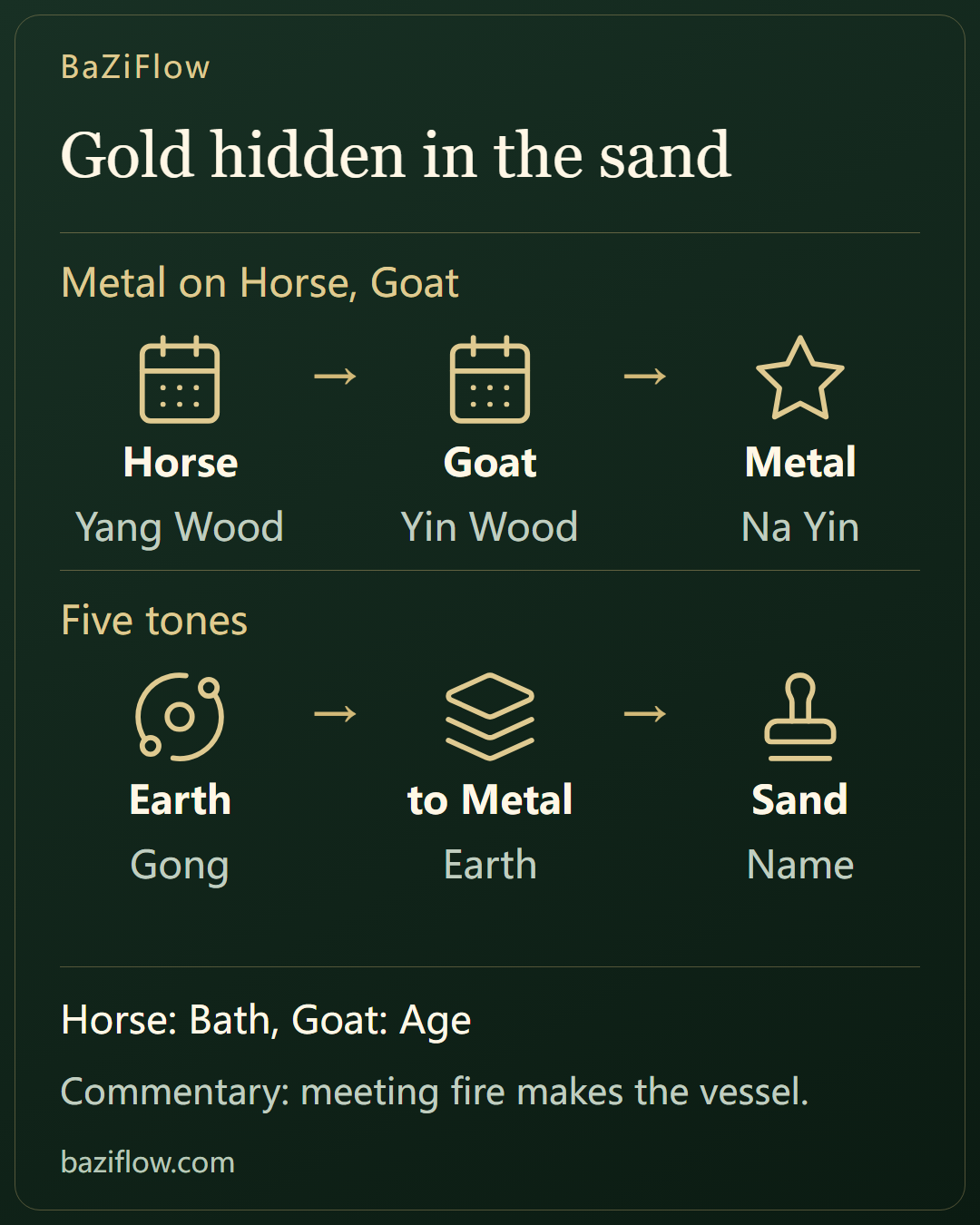
Yang Wood Horse and Yin Wood Goat share the sixteenth Na Yin name: four spellings, the Xieji Bianfang Shu's five-tone derivation, why Horse is "defeat" and Goat "coming of age", and the named pairings checked.
The short version10 min read
Gold mixed into sand, to be washed before it shows: that is the picture behind Sandstone Metal, the Na Yin shared by Yang Wood Horse and Yin Wood Goat. The calendar specialists tie it to two positions: fire peaks on the Horse and Metal is beaten, and only on the Goat does Metal come of age, still too weak to cut.
- Yang Wood Horse is the thirty-first of the sixty pillars, and the Xieji Bianfang Shu says yin is born at the Horse. The five tones start again from gong, which is Earth, and Earth makes Metal, so the Na Yin returns to Metal.
- The calendar specialists tie the name to two positions: fire flourishes on the Horse so Metal is beaten there, and fire fades on the Goat so Metal only just comes of age. On the table that is Bath, then Coming of Age.
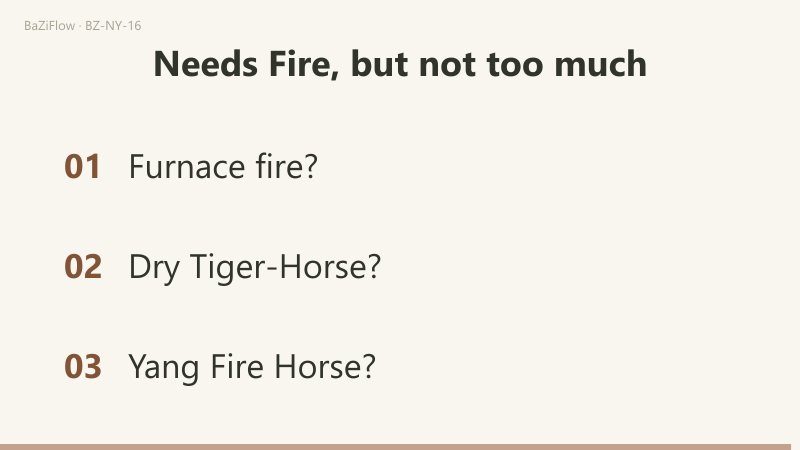
- The entry wants furnace fire to master this metal and fears fire too dry. In the tables, Yang Fire Tiger, Yin Earth Snake and Yang Earth Tiger show a half-combination, a stem combination and no relation; Yang Fire Horse differs by pillar.
Read first
What is Na Yin in BaZi? Why Yang Wood Rat Gold in the Sea does not replace Yang Wood ↗
Four spellings, one pair of pillars
Sandstone Metal (沙中金) is the sixteenth of the thirty Na Yin names. The thirty-first and thirty-second pillars, Yang Wood Horse (甲午) and Yin Wood Goat (乙未), share it, and the picture behind the name is gold mixed into sand that has to be washed before it shows.
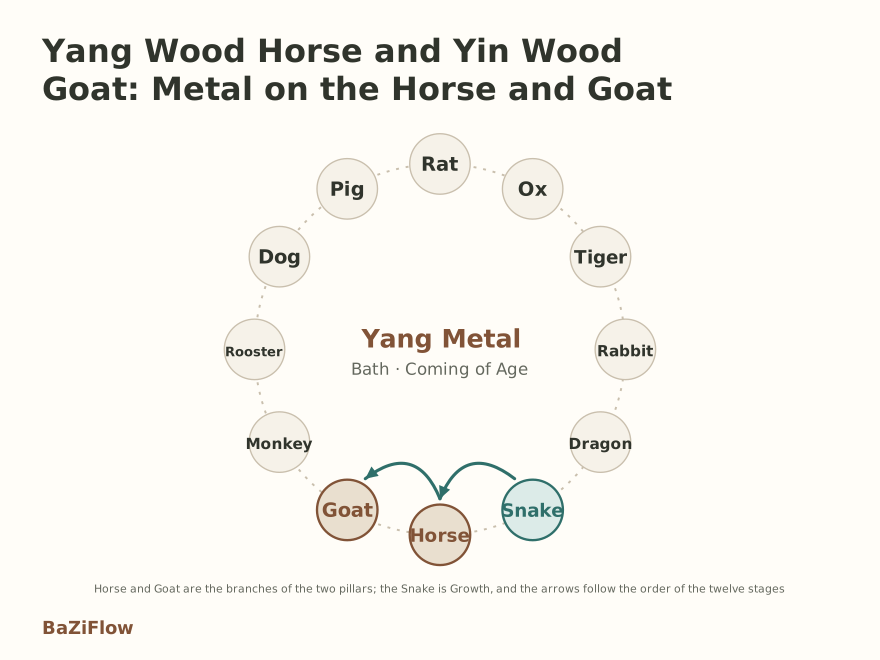
Sketch: the position of Metal is read from the twelve-stage table in yang order with Yang Metal as yardstick; the Na Yin names follow the Sanming Tonghui and the Xieji Bianfang Shu.
The ring highlights the Horse and the Goat, the branches of the two pillars. With Yang Metal as yardstick, Metal is at Growth on the Snake, Bath on the Horse and Coming of Age on the Goat; the book's "beaten" and "coming of age" fall on these two positions.
The name appears in at least four forms. In juan 1 of the Sanming Tonghui (三命通会), the section On the Images of Na Yin writes "gold in the sand" (沙中金), the form used for this site's Chinese name; the entry heading later in the juan swaps in a near-synonym for "sand" (砂中金); a note quoted in the pillar-by-pillar commentary writes "sand-and-stone metal" (沙石金); and the Xieji Bianfang Shu (协纪辨方书), quoting Tao Zongyi (陶宗仪), has the form that the English name Sandstone Metal renders (砂石金). All four point to the same pair, so a look-up goes by pillar, not by spelling.
The second half of the sixty-cycle opens on the Horse
Yang Wood Rat is the first pillar and Yang Wood Horse the thirty-first, so the two split the cycle into halves. The Xieji Bianfang Shu, juan 1, marks where the second half begins:
Yang is born at the Rat, running from Yang Wood Rat to Yin Water Snake; yin is born at the Horse, running from Yang Wood Horse to Yin Water Pig; so after thirty it comes round again.
"Comes round again" works through the five tones. In each round the tones gong, shang, jue, zhi and yu are matched in turn to the five stem pairs, running from the Yang Wood pair through Fire, Earth and Metal to the Water pair. Each tone has an element (gong Earth, shang Metal, jue Wood, zhi Fire, yu Water), and the element that tone generates is the Na Yin of the pair. The round on the Horse and Goat starts at gong: Earth makes Metal, so Yang Wood Horse and Yin Wood Goat are Metal, and the next four pairs follow as Water, Fire, Earth and Wood.
Enlarge diagram · scroll sideways to read
The first pair, Gold in the Sea, also starts from gong. The Sanming Tonghui sets the two pairs side by side, one in the sea and one in the sand, and calls it a difference of water and earth, of yin and yang. The Rat and the Horse stand opposite each other on the twelve-branch circle, and this site's relation table lists them as a clash: the same Yang Wood stem, half a circle apart, and the name moves from sea to sand.
Horse is "defeat", Goat is "coming of age"
The reason behind the name comes from a view the Sanming Tonghui credits to the calendar specialists:
Yang Wood Horse and Yin Wood Goat: the Horse is where fire flourishes, and when fire flourishes Metal is beaten; the Goat is where fire declines, and when fire declines Metal comes of age. Beaten, and only just come of age, it cannot yet hew, so it is called gold in the sand.
On the table the Horse position is Bath and the Goat position Coming of Age, so the place the book calls "beaten" is the one the table labels Bath. The Xieji Bianfang Shu quotes the same sentence but ends it with "cannot yet fill out" in place of "cannot yet hew".
The commentary that later goes through the sixty pillars one by one adds a layer: Yang Wood Horse is "self-defeated metal, also called fierce metal; meeting fire in growth and strength, the vessel is made", and Yin Wood Goat is "metal of a side storehouse", which does well "checked by fire and fed by earth". "Self-defeated" lands on the Horse like the calendar specialists' "beaten"; "the vessel is made" says this metal needs fire, as the entry below says too.
Enlarge diagram · scroll sideways to read
Washing needs fire, and too much fire spoils it
The entry first describes the metal: lumps spread over the ground and treasure hidden in sand, valuable once washed, and only furnace fire can master it. The juan 1 section on Na Yin imagery adds one line:
Mixed with the sand yet distinct from the sand, sitting in fire and refined by fire: that is why it is called gold in the sand.
"Mixed with the sand" puts it among sand, "distinct from the sand" says it is different stuff, and "sitting in fire and refined by fire" says that its own Horse and Goat are fire's ground: place, substance and process, one image each. The entry then lists what this metal needs and what it fears:
Enlarge diagram · scroll sideways to read
Each of those three fires has its own article; here they matter only as partners of this metal.
The named pairings, checked one by one
The entry and the annotation in juan 12 name some combinations. The annotation, from the Yuan Li Fu (元理赋) with commentary, reads:
Yang Wood Horse day meeting the Yin Earth Snake hour, Yin Wood Goat day meeting the Yang Earth Tiger hour: since Yang Wood Horse and Yin Wood Goat are gold in the sand, Yang Earth Tiger is the green sand and Yin Earth Snake is the yellow gravel.
The ones the engine tables can confirm:
Enlarge diagram · scroll sideways to read
Two things can be read straight off the tables. The Na Yin of Yang Earth Tiger is Earth on the City Wall, yet the book calls it "green sand"; the Na Yin of Yin Earth Snake is Wood of the Great Forest, while the book names it "yellow gravel". The images here do not follow the Na Yin name of the pillar. And the Na Yin of Yang Fire Horse is Water of the Heavenly River, which has its own article: Water of the Heavenly River.
The stretch of days each pillar covers
The Yang Wood Horse year is 1954 and the Yin Wood Goat year is 1955. Sixty years on the same pair comes round again, in 2014 and 2015, and once more in 2074 and 2075. Year pillars turn over at the Start of Spring (立春), and in Beijing time the limits are:
Enlarge diagram · scroll sideways to read
Two exercises
A birth at 10 a.m. on 4 February 2015: which year pillar?
The Start of Spring that year falls at 11:58, which 10 a.m. has not reached, so the year pillar is still the previous year's Yang Wood Horse. From 11:58 on it is Yin Wood Goat. Both pillars carry Sandstone Metal.
What are the Na Yin of Yang Water Horse and Yin Water Goat by the tone table?
In the Horse and Goat round, Yang Water and Yin Water fall on yu. Yu is Water and Water makes Wood, so the Na Yin is Willow Wood.
Walk the sixty-cycle backward to Long Flowing Water or forward to Fire at the Mountain Foot (Yang Fire Monkey and Yin Fire Rooster). Every other stage Metal passes through is laid out in the article on twelve life stages and void branches, and the case for keeping Na Yin on a layer of its own is made in Na Yin versus the ordinary five elements.
Questions readers ask next
The commentary says Yang Wood Horse "meets fire and the vessel is made". Does that contradict "fire flourishes and Metal is beaten"?
They describe two things. The calendar specialists speak of where Metal stands on the Horse: fire is at its height, Metal is at "defeat", which the table calls Bath, and that explains the name. The commentary says this metal needs fire to be refined into a vessel, the same point as the entry's "only furnace fire masters it", and that concerns pairings. Neither is a judgment of the person born then.
Why is the name written several ways, and which one is right?
All four forms point to the same pair, Yang Wood Horse and Yin Wood Goat: gold in the sand in the imagery section, a near-synonym in the entry heading, sand-and-stone metal in a note quoted by the commentary, and the form behind Sandstone Metal in the Xieji Bianfang Shu. A look-up goes by the pillar, so the spelling does not change the answer.
Yang Wood on the Horse is "Death" but the Na Yin Metal on the Horse is "Bath". Which is right?
They answer different questions and both are right. Yang Wood itself on the Horse is at Death on the table. The Na Yin Metal, with Yang Metal as yardstick, on the Horse is at Bath. When the book says Metal is "beaten", it uses the second reading.
Was this article helpful?
Sources & references
Continue reading
Long Flowing Water (长流水): Yang Water Dragon, Yin Water Snake and Newborn Metal ↗
Fire at the Mountain Foot (山下火): The Na Yin of Yang Fire Monkey and Yin Fire Rooster ↗
Five Elements cycles: learn the relationships, not just the order ↗