

Mars by sign and by house
Content version · · Sources & references
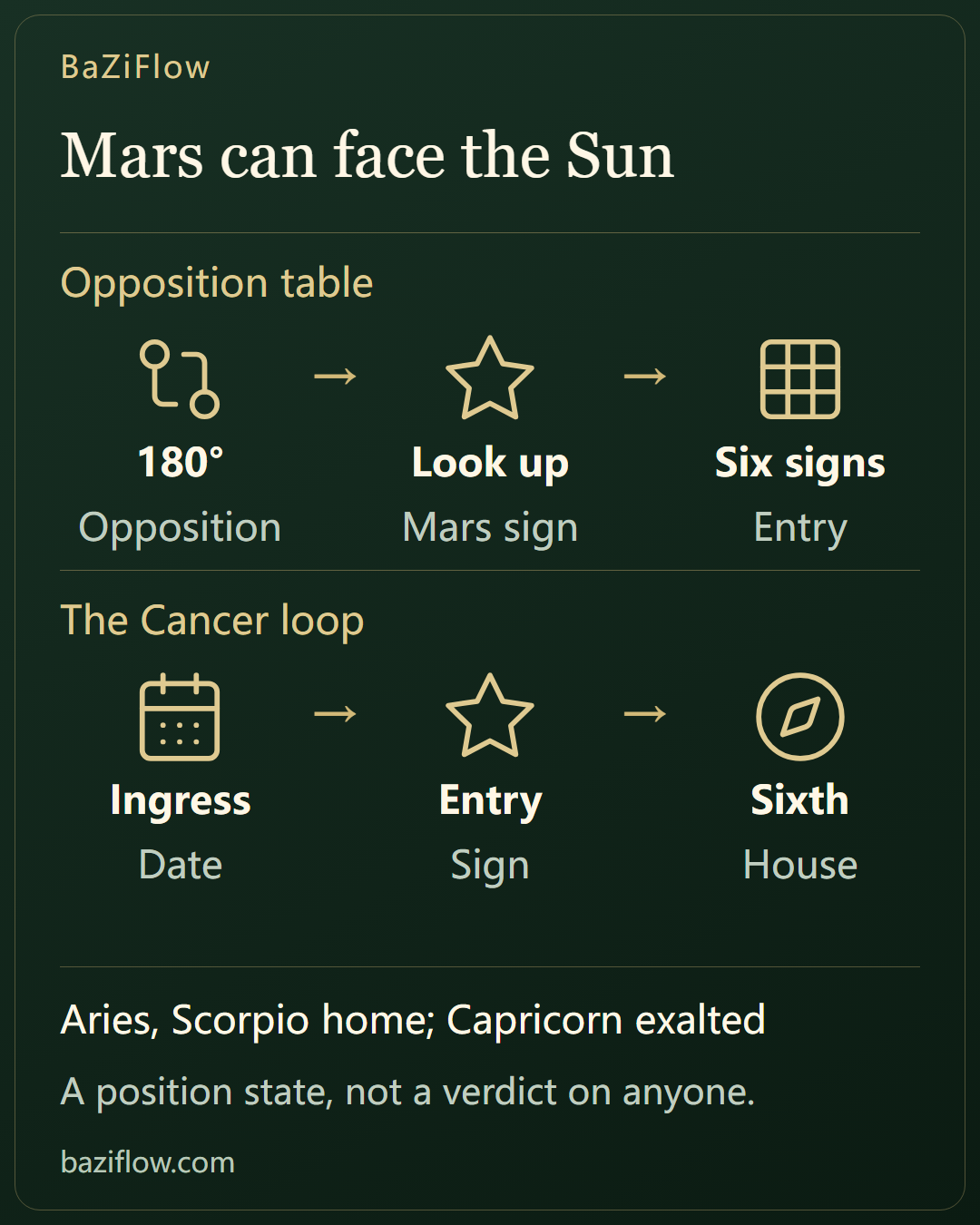
Mars: domicile in Aries and Scorpio, exaltation in Capricorn, detriment in Taurus and Libra, fall in Cancer. An opposition table, Lilly's numbers against the engine, the 2024-26 sign changes and the sixth house.
The short version8 min read
Mars is in domicile in Aries and Scorpio, exalted in Capricorn, in detriment in Taurus and Libra and in fall in Cancer; it has no distance limit from the Sun, can stand directly opposite it, and a retrograde loop can keep it in one sign for months.
- Of the six entries, Aries and Scorpio at home and Capricorn exalted are stated by Ptolemy; Taurus and Libra in detriment and Cancer in fall are read from "opposite". The other six signs carry no Mars entry.
- Mercury and Venus have a ceiling on their distance from the Sun; Mars does not. A daily scan of 1900 to 2100 reaches 180.00 degrees, and in all 15 oppositions from 2003 to 2033 Mars was retrograde.
- From September 2024 to April 2025 Mars spent 162 days in Cancer in all; in the houses, Lilly names the sixth as the house where Mars rejoices.
Read first
Personal, Social and Outer Planets: Use Groups as a Directory ↗
Aries and Scorpio at home, Capricorn exalted: Mars's six rows
In plain words first: Mars has entries on six of the twelve signs. It is in domicile in Aries and Scorpio, exalted in Capricorn, in detriment in Taurus and Libra, and in fall in Cancer; the other six signs are blank.
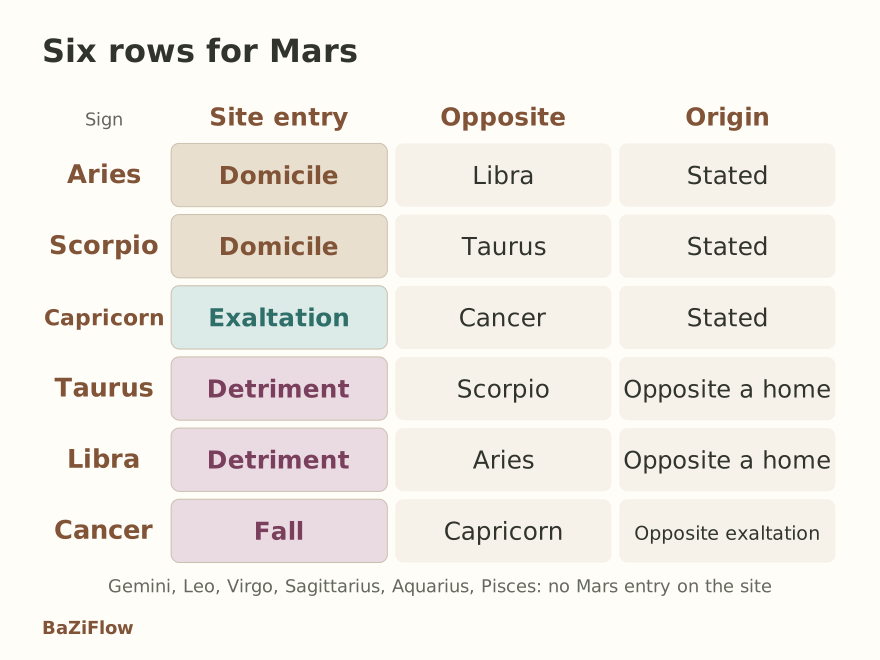
Table: Mars's six entries, the sign opposite each and where each comes from; the first three are stated by Ptolemy, the last three are read from "opposite", and the other six signs carry no entry.
Read the table in two halves. The upper three rows are laid out by Ptolemy in the Tetrabiblos. In I.17, which hands out the houses, Mars sits below Jupiter's sphere and takes Aries and Scorpio, signs of a nature close to his own. In I.19, on exaltations, Mars's fire is at its fiercest in Capricorn because he stands furthest south there, so his exaltation goes in Capricorn, directly opposite Jupiter's in Cancer. The lower three rows are worked out by the site's "opposite" rule: detriment is opposite a home, fall is opposite the exaltation sign.
Each of those rows has its own article: how Aries and Scorpio stand to the houses of the Sun and Moon is in Scorpio, and the axis between Capricorn and Cancer is in Capricorn. This one does not repeat the reasons. It looks at three things that belong to Mars alone: he can stand directly opposite the Sun, a retrograde loop stretches his stay in a sign, and the house table gives him a house of joy.
Lilly words it a little differently. He splits the homes by day and night, and he gives the exaltation as an exact degree:
By day Mars is at home in Aries and by night in Scorpio; he is exalted at 28 degrees of Capricorn, falls at 28 of Cancer, and suffers detriment in Libra and Taurus.
Opposition: Mars can stand directly across from the Sun
In plain words first: Mercury and Venus are tied to the Sun on a short rope; Mars has no rope.
Enlarge diagram · scroll sideways to read
The limits for Mercury and Venus were covered in the Venus article just before this one. Mars covers everything from 0 to 180 degrees. The moment the gap is exactly 180 degrees is called opposition: the Sun and Mars are on opposite sides of the sky, and the sign Mars stands in is always the sign opposite the Sun's. Here are seven oppositions from 2020 to 2033:
Enlarge diagram · scroll sideways to read
Among these seven, consecutive oppositions are 764 to 786 days apart, and the opposition point moves east along the ecliptic by 34 to 55 degrees each time. Five of the seven land on a sign with an entry; 2022 and 2027 are blank. At 02:37 UTC on January 16, 2025, Mars stood in Cancer (fall) and the Sun in Capricorn, which is Mars's own exaltation sign.
One check
The Sun is in Scorpio. Can Mars be in domicile?
Yes. At opposition Mars would be in Taurus, but at conjunction (a gap of 0 degrees) they share a sign: at noon UTC on November 17, 2023 Mars was at 25°05′ of Scorpio and the Sun at 24°52′, with Mars in domicile.
Three numbers from Lilly, checked against the engine
In his Christian Astrology of 1647, Lilly gives Mars a short block of motion data. Three of its numbers can be checked directly: the daily speed, the time for one round, and the length of a retrograde.
Enlarge diagram · scroll sideways to read
The first two agree closely. 31′27″ is 31.45′; the engine's daily mean over two hundred years is 31.46′; and dividing 360 degrees by JPL's sidereal period of 686.98 days gives 31.44′. Lilly's "one year and 321 days" is 686 days, less than a day off JPL's figure.
The retrograde number is a round figure. The engine finds 24 retrogrades from 1990 to 2040: the shortest 60 days (2003), the longest 81 days (1995, 1997, 2012, 2027 and 2029), the mean 73.9. Eighty sits near the top of that range, but every retrograde has its own length. Speed differs a little too: Lilly says 32 to 44 minutes a day and seldom more, while the engine's fastest day is 47.5, slightly above his largest.
How to read a retrograde Mars at birth is in retrograde planets.
162 days in Cancer: a retrograde loop stretches one sign
One round of Mars takes 687 days, about 57 days a sign on average. The first signs of 2024 were all shorter: Aries 39 days, Taurus 42, Gemini 46. In Cancer the rhythm changed:
Enlarge diagram · scroll sideways to read
Mars entered Cancer, a sign of fall, on September 4, 2024. It moved into Leo on November 4 and turned retrograde on December 7 at 6°10′ of Leo. It backed all the way down, returned to Cancer on January 6, 2025, stood at opposition on January 16, turned direct on February 24 at 17°00′ of Cancer, and entered Leo a second time on April 18. The loop ran back about 19 degrees.
From September 4 to April 18 is about 225 days, and 60 + 102 = 162 of them, 72%, were spent in Cancer. In the table, "fall" is one state; on the calendar it covered two stretches adding up to more than five months.
The next round has no loop. From August 2025 to September 2026 Mars walks forward through all six signs that carry an entry:
Enlarge diagram · scroll sideways to read
The sixth house: where Lilly says Mars rejoices
A sign needs only a date; a house needs a birth time as well, because the Ascendant turns once a day. In whole-sign houses the sign of the Ascendant is the first house, and the sixth house is the sixth sign counting on from it.
In his entry for the sixth house Lilly says that Mars rejoices there, and that it is a feminine, cadent house with no aspect to the Ascendant. The last point can be checked: the sixth sign lies 150 degrees from the Ascendant sign, which is none of the five Ptolemaic aspects (the Gemini article explains this kind of "unconnected" pair).
Put the house of joy together with Mars's signs, and only six Ascendants give the sixth house a sign that carries a Mars entry:
Enlarge diagram · scroll sideways to read
The two tables keep separate books. With Scorpio rising, Mars in Aries is both in domicile and in the sixth house; with Aquarius rising, Mars in Cancer is in fall and in the sixth house at the same time. Joy does not cancel detriment and detriment does not cancel joy; they are not added or converted into one score.
Two house checks
Scorpio rising, Mars in Aries: which house, and what state?
The sixth house; domicile.
Virgo rising, Mars in Libra: which house, and what state?
The second house; detriment. If the birth time is unknown the Ascendant cannot be fixed, so you can state the sign but not the house.
The planet before Mars is Venus, and the one after is Jupiter.
Questions readers ask next
Does Mars at opposition mean Mars is especially strong then?
Opposition is a position relation: Mars and the Sun are 180 degrees apart in longitude, opposite each other in the sky, and Mars is retrograde at the time. Strength in the dignity sense is a separate look-up; at the January 2025 opposition Mars stood in Cancer, which the table calls fall.
Lilly gives Mars a "joy" house. Is that the same as domicile?
No. Domicile is an entry for a sign and joy is an entry for a house; Lilly puts Mars's joy in the sixth. The two tables keep separate books. With Gemini or Scorpio rising they coincide; with Aquarius rising Mars in Cancer is in fall and in the sixth house at once.
Do the entries change when Mars turns retrograde?
Not while the sign is the same. Retrograde changes how Mars moves: from December 7, 2024 to February 24, 2025 it backed from Leo into Cancer, so Cancer's fall was recorded over a longer stretch of days. How to read a retrograde Mars at birth has its own article.
Was this article helpful?
Sources & references
- Ptolemy, Tetrabiblos Book I (F. E. Robbins text on LacusCurtius): houses, exaltations ↗
- William Lilly, Christian Astrology (1647), Of the Twelve Houses, pp. 50–56 ↗
- NASA JPL Solar System Dynamics, Planetary Physical Parameters: sidereal orbital period ↗
- William Lilly, Christian Astrology (1647), Book I, Of the Planets (Saturn pp. 57–61, Jupiter pp. 61–65, Mars pp. 65–68, Sun pp. 69–71, Venus pp. 72–75, Mercury pp. 76–79, Moon p. 80ff; Cazimi p. 113) ↗
Continue reading
Venus: Home in Taurus and Libra, Exalted in Pisces — Six Positions and a Two-Sign Rule ↗
Jupiter in the Signs and Houses: Six Signs on Record and Four Houses Lilly Names ↗